

Your third-party inspection vendor delivers a 98% pass rate, but your field teams keep finding contamination issues that should've been caught weeks ago. The vendor insists their inspectors followed protocol. Your QA team discovers basic safety violations marked as "compliant." Operations wants answers about why they're paying for inspections that miss obvious problems.
This gap between vendor reports and actual conditions creates operational chaos. You're managing inspections through contractors with different standards, inconsistent training, and sometimes zero accountability. Clean reports mask real problems until something fails catastrophically.
Most inspection managers try more meetings, additional oversight, or switching vendors entirely. The real issue runs deeper – it's about structuring vendor relationships operationally from the start, not hoping they'll align with your standards after signing paperwork.
The credential gap that creates phantom expertise
A facilities management company contracted for third-party electrical inspections across 47 locations. They chose a vendor promising "certified inspectors" and started receiving reports. Six months later, an internal audit revealed half the inspectors weren't qualified for the specific equipment they evaluated. The vendor technically hadn't lied – their inspectors had certifications, just not the right ones for industrial electrical systems.
Most vendor agreements treat credentials as a checkbox rather than operational requirements. Contracts specify "certified inspectors" without defining which certifications, experience levels, or validation frequency. You end up with inspectors who look qualified on paper but lack specific expertise your operations require.
The operational fix starts with a credential matrix mapping inspection types to required qualifications:
| Inspection Type | Required Certification | Experience Minimum | Recertification Period | Verification Method |
|---|---|---|---|---|
| Electrical Systems | NETA Level III | 3 years industrial | 24 months | Direct cert check |
| Pressure Vessels | API 510 | 2 years vessels | 36 months | NBIC database |
| Food Safety | PCQI + HACCP | 18 months production | 12 months | Training records |
| Structural | PE License + ICC | 5 years commercial | State renewal | License lookup |
Credentials alone don't prevent bad data. A food processing plant discovered their third-party sanitation inspectors all had proper certifications but were completing 12-minute inspections on production lines requiring 45 minutes minimum. The vendor scheduled them for 8 facilities daily, making thorough inspection physically impossible.
Contract clauses that actually protect operations
Standard vendor contracts focus on liability and payment terms while ignoring operational performance. You need specific language creating accountability for data quality, not just service delivery.
Eliminate inspection delays and errors.
Chekzly helps you plan, execute, and document inspections efficiently and accurately.
- Real-time inspection tracking
- Automated report generation
- Compliance and checklist management
No credit card required
Start with performance standards tied to measurable outcomes. Instead of "vendor will perform inspections according to industry standards," write "vendor will maintain a defect detection rate within 5% variance of internal QA sampling, measured quarterly." This creates trackable, enforceable benchmarks.
Add data ownership clarity. Many vendors consider inspection data their property, complicating audits or system integration. Include language like: "All inspection data, including raw observations, photographs, and measurements, becomes client property upon collection. Vendor maintains read-only access for records."
Build in sampling rights. Reserve ability to shadow inspections randomly, review inspector qualifications mid-contract, and conduct parallel inspections without notice. One manufacturing client discovered their vendor was subcontracting to unqualified inspectors only because they exercised shadow inspection rights and showed up unannounced.
Include escalation triggers. Define responses when inspections fail QA checks. First failure might trigger retraining. Second failure removes that inspector from your account. Third failure could reduce payment or enable contract termination.
The data exchange problem nobody talks about
Even when inspections happen correctly, data often arrives in formats destroying its operational value. A retail chain with 200 locations received third-party safety inspections as PDFs with inconsistent naming conventions, making trend tracking or systemic issue identification nearly impossible across sites.
Vendors default to whatever reporting format works for them, not what integrates with your operations. They send narrative reports when you need structured data. They use internal codes instead of your asset IDs. They batch reports weekly when you need real-time visibility.
Create data exchange templates before contracts start. Define field names, acceptable values, file formats, and submission timelines. A proper template specifies:
-
Asset identification using your internal numbering system
-
Inspection results in CSV format with predefined columns
-
Photo naming convention
[AssetID][InspectionDate][IssueNumber]
-
Submission within 4 hours of inspection completion
-
Severity classifications matching your risk matrix
One property management company reduced data processing time by 73% simply by requiring vendors to use their asset IDs instead of creating their own. This eliminated manual matching that consumed 15 hours weekly of coordinator time.
QA sampling that catches vendor drift early
Most third-party inspection coordination relies on trusting vendor reports until problems surface. By then, you might have months of questionable data affecting operational decisions. Smart QA sampling catches quality drift before it becomes systemic.
Stratified random sampling works better than pure random checks – targeted validation based on risk factors. Sample more frequently from:
-
New inspectors in their first 90 days
-
Locations with historically high defect rates
-
Inspection types with subjective criteria
-
Vendors showing performance decline trends
A facilities company managing parking structures implemented this approach after discovering their vendor missed critical concrete spalling issues. They now sample 15% of high-risk inspections (older structures, previous issues) and 5% of routine inspections. This caught three inspectors consistently underreporting structural concerns within the first month.
Your sampling should test different aspects:
-
Accuracy sampling
Re-inspect the same asset within 48 hours
-
Completeness sampling
Verify all checklist items were actually evaluated
-
Consistency sampling
Have different internal staff inspect the same asset
-
Documentation sampling
Match photos and notes to reported findings
Prioritize higher sampling rates for new inspectors and high-risk locations to catch drift early.
Track variance between vendor reports and QA samples. Anything over 10% variance suggests systematic issues. One industrial client found their vendor's thermal imaging inspections showed 22% variance from internal checks – the vendor's equipment hadn't been calibrated in two years.
Building the feedback loop that prevents degradation
The biggest mistake in third-party inspection coordination happens after QA finds problems: telling vendors to "do better" without specific operational changes. This creates cycles where quality temporarily improves, then degrades once scrutiny decreases.
Effective feedback requires operational specificity. Instead of "your inspector missed several issues," provide: "Inspector #4782 marked conveyor bearing #CB-447 as operational on March 3rd. Our QA check on March 5th found visible wear scoring and measured temperature of 187°F, exceeding threshold by 32°F. See attached thermal image and wear pattern photo."
Create standard feedback templates vendors must acknowledge and address:
-
Issue identification
Specific asset, date, finding variance
-
Root cause from vendor
Why the issue occurred
-
Corrective action
What changes prevent recurrence
-
Verification method
How you'll confirm improvement
-
Timeline
When corrections will be implemented
A chemical plant transformed vendor relationships by requiring written corrective action plans for any QA variance over 15%. Vendors initially resisted, but inspection quality improved 40% within six months because inspectors knew their work would be validated and discrepancies required explanation.
Technology coordination without the integration nightmare
Modern inspection platforms promise to solve vendor coordination through technology, but most create new problems. Your internal system uses one platform, each vendor has their own, and suddenly you're managing five different inspection apps that don't communicate.
The practical approach focuses on data standards over platform integration. Instead of forcing vendors onto your system or adapting to theirs, establish data exchange protocols working regardless of platform. Vendors use their preferred inspection app but export data in your required format.
API integration sounds appealing but rarely works smoothly with multiple vendors. One construction firm spent $200k trying to integrate three vendor platforms with their internal system. Two years later, they switched to simple CSV uploads with standardized templates – implementation took two weeks and works with any vendor.
AI-powered operational software helps most when processing vendor data after collection. Rather than standardizing how vendors collect data, use automation to flag inspection reports with unusual patterns, compare vendor findings against historical baselines, identify inspectors with consistently different results than peers, generate QA sampling schedules based on risk patterns, and create exception reports when vendors miss SLA requirements.
This approach lets vendors work with familiar tools while maintaining data quality and operational control.
When vendor relationships actually improve operations
A regional healthcare network managing 12 facilities demonstrates effective third-party inspection coordination. They previously struggled with inconsistent vendor quality across fire safety, medical equipment, and facility maintenance inspections.
After implementing structured coordination:
-
Created role-specific credential requirements for 7 inspection types
-
Built standardized data templates all vendors must use
-
Established 10% QA sampling with variance tracking
-
Required monthly performance reviews with corrective action plans
Results after 8 months:
-
Variance between vendor and internal QA dropped from 31% to 7%
-
Critical issues caught increased by 44%
-
Time spent processing vendor reports decreased by 60%
-
Avoided an estimated $400k in compliance penalties through early detection
The key wasn't finding better vendors – it was creating operational structures making existing vendors perform better.
Making the transition without disrupting operations
Implementing better third-party inspection coordination while maintaining ongoing operations requires careful sequencing. Start with your highest-risk inspection category or most problematic vendor, prove the approach works, then expand systematically.
Phase your implementation:
Month 1-2: Document current state
-
Map all vendor relationships and inspection types
-
Identify quality gaps through historical analysis
-
Calculate current coordination costs and risks
Month 3-4: Design operational framework
-
Create credential matrices for each inspection type
-
Develop data exchange templates
-
Write QA sampling procedures
-
Draft contract amendment language
Month 5-6: Pilot with one vendor
-
Choose your most cooperative or most problematic vendor
-
Implement new requirements gradually
-
Measure quality improvements
-
Document lessons learned
Month 7+: Scale across all vendors
-
Apply refined approach to remaining vendors
-
Standardize feedback and corrective action processes
-
Automate data validation and exception reporting
Below is a simple workflow visualization.
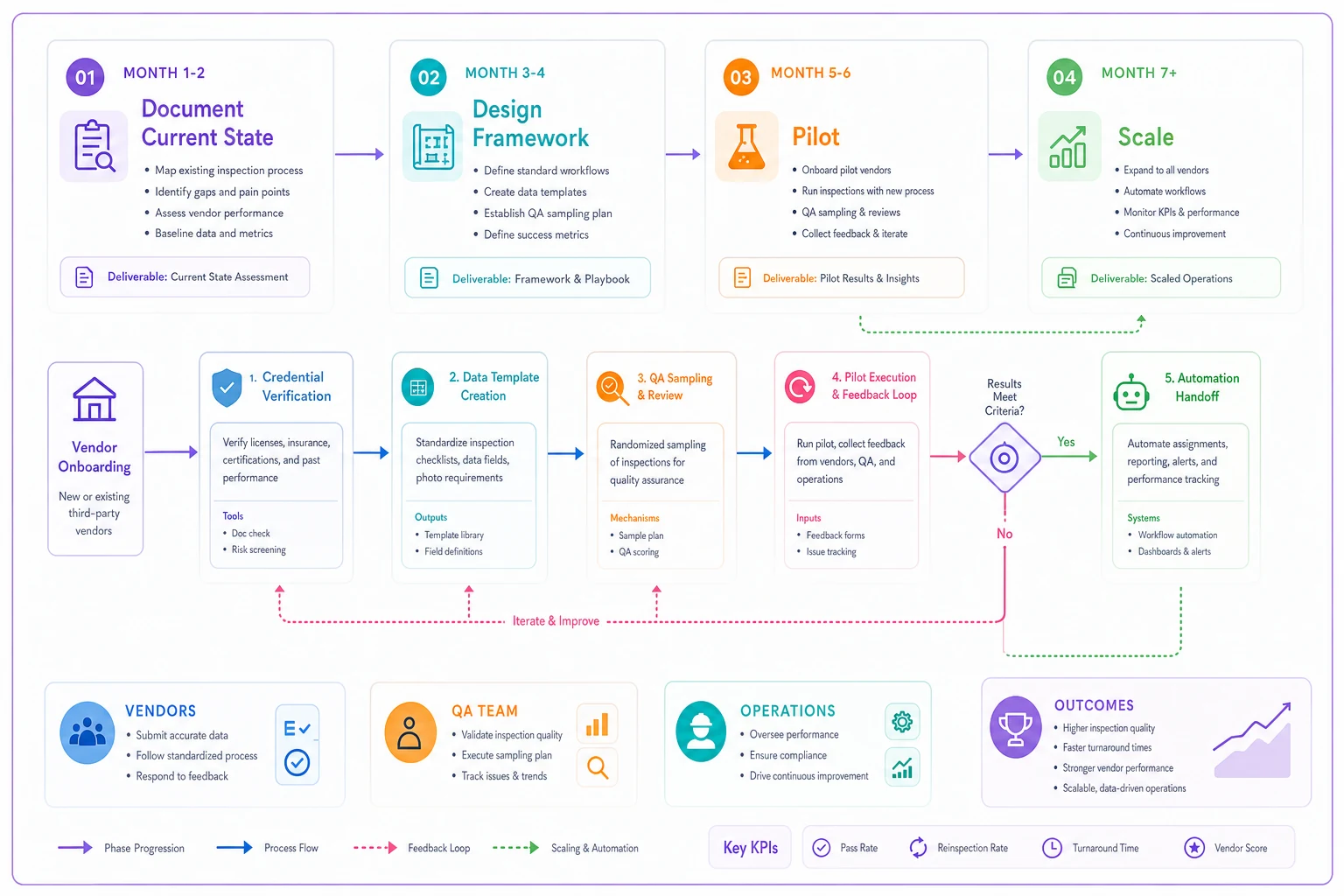
This staged approach maintains operations while building better vendor coordination. You'll identify problems during the pilot phase instead of discovering them across all vendors simultaneously.
The compound effect of operational discipline
Better third-party inspection coordination doesn't just improve data quality – it changes how your organization operates. When vendor data becomes reliable, field teams trust reports instead of duplicating inspections. Management makes decisions based on accurate risk assessments instead of guessing about asset conditions. Compliance becomes proactive instead of reactive.
The real value emerges over time. One manufacturing company tracked improvement over two years of disciplined vendor coordination. Year one saved $180k through catching issues early. Year two saved $340k as predictive patterns emerged from clean historical data. By year three, they'd reduced emergency repairs by 60% because inspection data actually reflected asset conditions.
Operational discipline with vendors cascades through organizations. When field teams see vendor issues get addressed systematically, they report problems instead of working around them. When vendors know their work will be validated, they invest in better training and tools.
Start with one vendor, one inspection type, and basic credential verification. Build your QA sampling process next. Add data standardization, then performance feedback loops. Within six months, you'll transform unreliable vendor relationships into operational assets that actually strengthen your inspection program.
The alternative – hoping vendors will somehow improve independently – guarantees you'll keep explaining why inspection reports showed everything was fine right before something failed. That conversation never gets easier.
Ready to modernize your inspection process?
Join 500+ inspection teams using Chekzly to reduce paperwork, improve compliance, and accelerate reporting.