

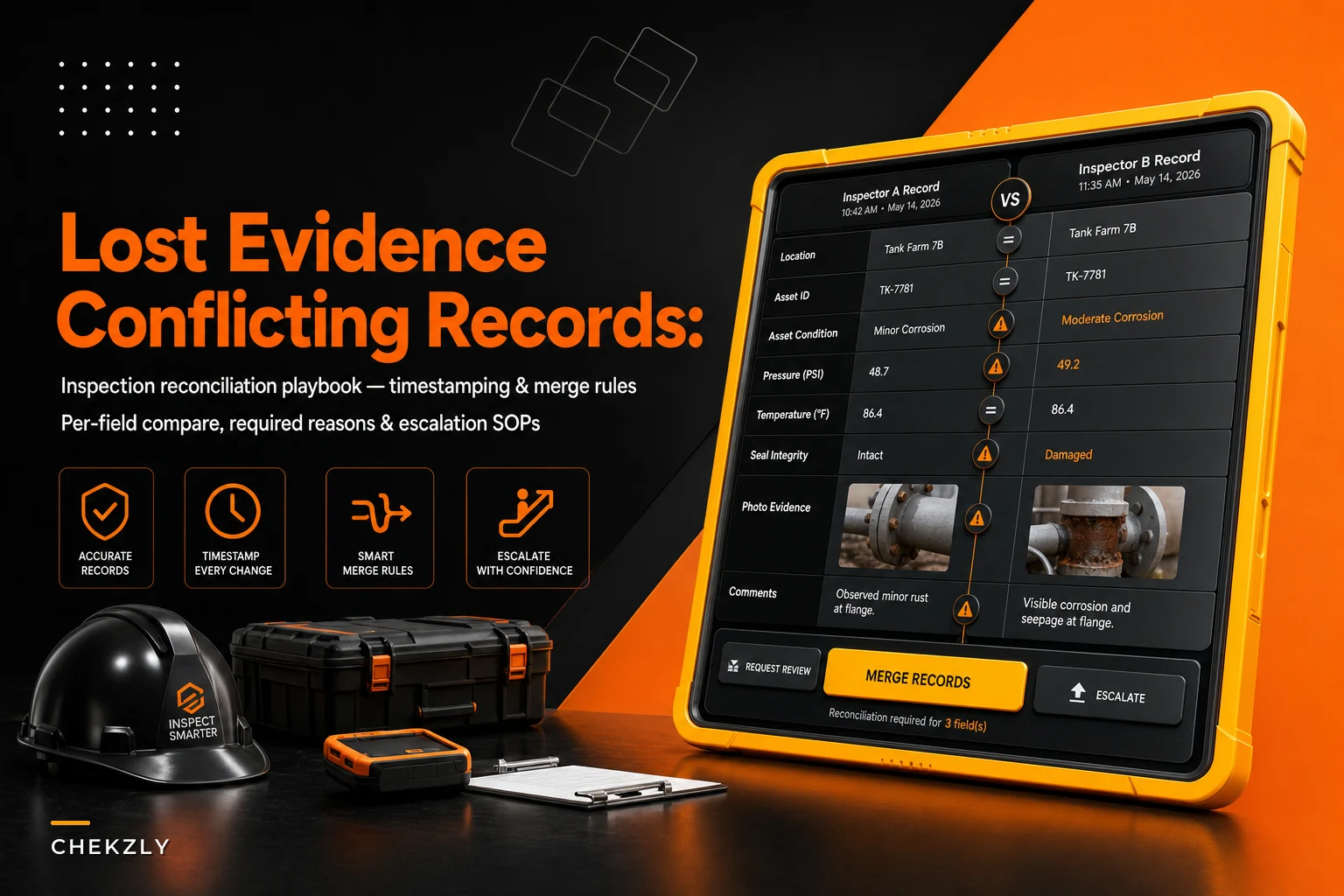

An inspector finishes a boiler check in a basement with no signal. Two hours later, back in the truck, the app syncs. The record that uploads overwrites a field correction a supervisor made earlier that afternoon — from the office, online. Now you have two "true" versions of the same inspection, both timestamped, both signed, and neither one obviously wrong.
That's the core of offline sync conflict resolution in inspections, and it's one of the quietest failure modes in a field program. Nobody files a ticket for it. The conflict just sits there until an auditor pulls the record, sees a value that doesn't match the photo, and starts asking questions.
This guide is narrow on purpose. We're not covering version control for checklists or timestamp verification in general — those are their own problems. This is specifically about what happens when offline edits collide, how to decide which version wins, and what your team should do when the merge rules can't figure it out on their own.
The three conflict shapes you'll actually see in the field
Most sync conflicts aren't exotic. After enough field rollouts, they fall into a handful of recognizable patterns, and once you can name them, you can write rules for them.
The stale overwrite. Inspector captures data offline. While they're offline, someone online edits the same record — maybe a reviewer fixes a mislabeled asset ID. When the offline device syncs, its older copy clobbers the newer online edit. The device "won" simply because it synced last, not because it was right. This is the most common one and the most dangerous, because the losing edit disappears silently.
The dual-origin edit. Two inspectors both have the record offline. A lead inspector and a trainee both fill out the same gas-meter checklist during a joint visit, each on their own phone. Both sync. Now you've got two full submissions for one inspection event, and depending on your system, you either get a duplicate record or one silently buried under the other.
The partial-field collision. This one's sneaky. The same record gets edited offline by one person and online by another, but on different fields. Inspector updates the corrosion rating offline; office updates the next-due date online. A naive "last write wins" system throws away one of those edits entirely, even though a smart merge could have kept both. You end up losing a perfectly good edit that never needed to conflict in the first place.
The pattern worth internalizing: the system almost never tells you why a version won. It tells you which one won. That gap — between "which" and "why" — is where evidence quietly gets lost.
Why "last write wins" quietly destroys audit trails
Most off-the-shelf sync logic uses last-write-wins (LWW) based on sync time, not capture time. That distinction matters more than anything else in this article.
Eliminate inspection delays and errors.
Chekzly helps you plan, execute, and document inspections efficiently and accurately.
- Real-time inspection tracking
- Automated report generation
- Compliance and checklist management
No credit card required
A realistic timeline from a utility inspection crew:
| Time (actual) | Event | Device state | Sync time |
|---|---|---|---|
| 9:14 AM | Inspector captures pressure reading = 142 psi | Offline | — |
| 10:02 AM | Office reviewer corrects asset tag typo | Online | 10:02 AM |
| 11:47 AM | Inspector's phone regains signal, syncs | Was offline since 9:00 | 11:47 AM |
Under naive LWW, the 11:47 sync wins because it happened last — and it overwrites the 10:02 reviewer correction, even though that correction was based on newer information. The system did exactly what it was told. The problem is what it was told to do.
The audit consequence is specific. When a regulator asks "who last touched this record and why," your log shows the inspector at 11:47, not the reviewer at 10:02. The correction is gone, and there's no breadcrumb that it ever existed. You're not just wrong — you can't even show how you got there.
The mistake teams make: assuming the sync timestamp is the authoritative timestamp. It almost never should be. The capture timestamp — when the edit was actually made on the device — is what your merge logic should reason about, and it has to be recorded locally, at the moment of the edit, before the device ever reconnects.
Timestamping rules that actually hold up
If you fix nothing else, fix your timestamps. Every offline edit needs three separate time values recorded on the device, independent of the network:
-
Capture time — when the field user actually made the edit, from the device clock.
-
Device-boot/monotonic offset — a non-resettable counter so you can detect if someone manually changed their phone clock. Device clocks drift and get adjusted more than people expect.
-
Sync time — when the server received it.
Why all three? Because a field phone clock is not trustworthy on its own. Devices come back hours off after a timezone change, and a dead battery resetting the clock to an old date will make every offline edit from that day look impossibly old. If your merge logic only sees capture time, that phone's edits would all lose — or all win — for the wrong reason.
The practical rule set for merging:
-
Compare capture times, not sync times, to decide ordering.
-
Flag any record where the device clock and server clock disagree by more than a small threshold as untrusted-time, and route it to human review instead of auto-merging.
-
Never let an untrusted-time record silently overwrite a trusted one. A questionable timestamp is a conflict, not a tiebreaker.
A questionable timestamp is a conflict, not a tiebreaker.
Field-level merge rules: keep both edits when you can
The partial-field collision is where most lost data actually hides, and it's also the most fixable. Stop treating an inspection record as one atomic blob.
If your records are structured so each field carries its own last-edited metadata, then two edits on different fields don't conflict at all — you merge them. The corrosion rating from the inspector and the next-due date from the office both survive. No human intervention needed.
The real conflicts are narrower than people assume. You only need human eyes when the same field was edited by two sources with overlapping validity. Everything else can merge automatically if the data model supports it.
A simple decision order for each field in conflict:
-
If only one side edited the field → take that edit. No conflict.
-
If both sides edited it but one has untrusted time → hold for review, don't auto-pick.
-
If both edited it with trusted times → apply your tiebreak policy (more on that below), and preserve the losing value in the record history so nothing vanishes.
-
If the field is a legally significant value — a measurement, a pass/fail, a signature — never auto-resolve. Always escalate.
Preserve the losing value in the record history so nothing vanishes.
That last rule is the one that keeps you out of trouble. Automating the merge of a comment field is fine. Automating the merge of a pass/fail determination is how you end up explaining to an auditor why the system, not a person, decided an asset passed.
The reconciliation flow your inspectors should see
When a conflict can't auto-resolve, the worst thing you can do is handle it silently in a backend queue nobody checks. The inspector who made the edit is usually the only person who remembers the context, and that memory has a short half-life.
Step one — surface it immediately on sync. The moment a conflict is detected, the inspector who just synced should see a clear prompt: "This record was also changed while you were offline. Here's what differs." Not a buried notification. A blocking prompt before they close out the job.
Step two — show both versions side by side, field by field. Not a diff dump. Label them plainly: Your version (captured 9:14 AM) vs Office version (edited 10:02 AM). Show the photo or evidence attached to each if there is one.
Step three — let the inspector choose per field, with a required reason. If they pick their value over the reviewer's, they type why. That reason becomes part of the audit trail. "Office tag was wrong, I re-verified serial on nameplate" is worth more to a future auditor than any automated rule.
Step four — route anything the inspector can't resolve to a named owner. Not "the team." A specific person, with a deadline.
This works because it captures intent at the one moment intent is still fresh. A week later, nobody remembers why 142 psi became 138 psi. At sync time, the inspector does.
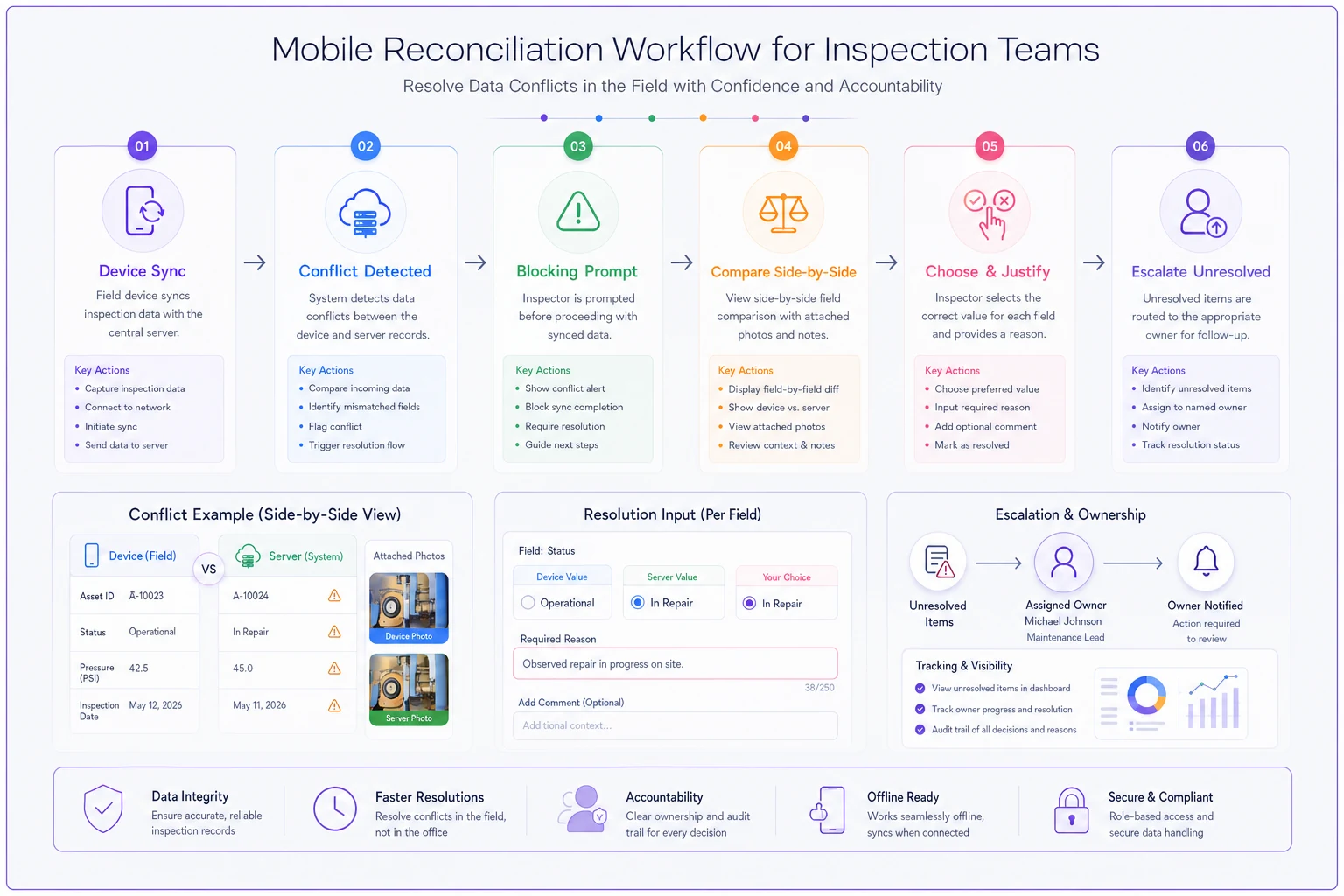
A simple reconciliation flow: detect the conflict, surface the differences, compare side-by-side, choose per-field with reasons, and escalate unresolved items to a named owner.
Escalation SOP: when the field can't settle it
Some conflicts aren't the inspector's to resolve. If a reviewer changed a pass/fail and the inspector disagrees, that's not a data-entry squabble — it's a disagreement about the finding itself, and it needs to climb.
A workable escalation ladder:
-
Tier 0 — Auto-merge. Non-conflicting fields, trusted timestamps, non-critical data. No human needed.
-
Tier 1 — Inspector reconciliation. Same-field conflicts on non-critical data. Resolved at sync with a reason logged.
-
Tier 2 — Supervisor review. Conflicts on measurements, ratings, or anything feeding a risk score. Supervisor sees both versions plus both reasons and makes the call within a set window — a day or two, not whenever.
-
Tier 3 — Program/QA hold. Conflicts on pass/fail, safety findings, or signatures. Record is frozen, flagged non-final, and cannot be included in any report until resolved. These should be rare — if they're not, the capture process upstream is broken.
The frozen-record rule in Tier 3 is the critical one. A conflicted safety finding should never flow into a generated report or a client package while it's unresolved. A record in conflict is not final, and treating it as final is how a disputed value ends up in a signed deliverable.
A real scenario: regional elevator inspection firm
A mid-size elevator inspection outfit — around 40 inspectors across three states — ran into this hard. Their crews worked machine rooms and shafts, mostly dead zones, syncing hours later. Their app used plain last-write-wins on sync time.
Over roughly six months, they found that around 2–3% of inspections had silent overwrites — office corrections wiped out by late-syncing devices, and a handful of dual-origin duplicates from two-person jobs. On a volume of about 1,400 inspections a month, that was dozens of quietly corrupted records every month. Most went unnoticed until a client disputed a report and the record didn't match the field photos.
The damage wasn't one big fine. It was the slow bleed: time spent reconstructing what actually happened, a couple of inspections re-done at the firm's cost because the original record was untrustworthy, and a client relationship that got noticeably colder. A few thousand dollars in direct rework, and a lot of eroded trust.
The fix wasn't exotic. They moved to capture-time comparison, added per-field edit tracking so non-overlapping edits merged cleanly, and built a sync-time reconciliation prompt for real conflicts. Within a couple of months, silent overwrites essentially stopped. The conflicts that remained surfaced to a human instead of disappearing. Volume of true conflicts needing manual work dropped to a trickle — because most of what they'd been losing never actually needed a human in the first place. It was just bad merge logic throwing away good data.
When automation should handle this — and when it absolutely shouldn't
When auto-merge makes sense: non-conflicting fields, comments, non-critical metadata, and anything where both timestamps are trusted and only one side edited. Letting software quietly stitch these together removes a huge amount of pointless manual reconciliation. This is exactly the kind of coordination work field platforms with proper offline conflict handling should take off your team's plate.
When it's a bad idea: pass/fail determinations, measurements feeding a risk calculation, signatures, safety findings, or any record where a timestamp is untrusted. Automating these doesn't save time — it manufactures liability. "The system merged it" is not a defense an auditor accepts.
Who should not lean on auto-resolution at all: small teams without per-field edit tracking. If your records are atomic blobs and your merge logic can only pick a whole version, automated resolution will throw away good data. The honest answer for those teams is to surface every conflict to a human until the data model is fixed. Slower, yes. But you won't lose evidence you can't recover.
A short checklist before you trust your sync layer
A short checklist before you trust your sync layer
-
[ ] Every offline edit records capture time locally, before reconnecting.
-
[ ] Merge logic compares capture time, not sync time.
-
[ ] Clock-drift detection flags untrusted timestamps for review.
-
[ ] Records are structured so field-level edits can merge without colliding.
-
[ ] Same-field conflicts surface to the inspector at sync, with a required reason.
-
[ ] Pass/fail, measurements, and signatures never auto-resolve.
-
[ ] Conflicted records are frozen out of reports until resolved.
-
[ ] Every escalation tier has a named owner and a time window.
-
[ ] Losing values are preserved in history, never deleted.
Losing values are preserved in history, never deleted.
The thing most teams miss
When sync conflicts start causing problems, the instinct is to tell inspectors to sync more often or to "be more careful." That misreads the problem. Conflicts aren't a discipline failure — they're a design failure in how the system decides which version of reality to keep.
The teams that get this right don't try to eliminate conflicts. Dead zones aren't going anywhere, and two-person jobs will always produce overlapping edits. What they do is make sure that when a conflict happens, nothing disappears silently and a human sees the ones that matter — with the context still fresh enough to decide correctly. Get the timestamps honest, merge at the field level, and escalate the handful of real conflicts to someone who can actually make the call. Everything else is just plumbing.
When sync conflicts start causing problems, the instinct is to tell inspectors to sync more often or to "be more careful." That misreads the problem. Conflicts aren't a discipline failure — they're a design failure in how the system decides which version of reality to keep.
The teams that get this right don't try to eliminate conflicts. Dead zones aren't going anywhere, and two-person jobs will always produce overlapping edits. What they do is make sure that when a conflict happens, nothing disappears silently and a human sees the ones that matter — with the context still fresh enough to decide correctly. Get the timestamps honest, merge at the field level, and escalate the handful of real conflicts to someone who can actually make the call. Everything else is just plumbing.
Ready to modernize your inspection process?
Join 500+ inspection teams using Chekzly to reduce paperwork, improve compliance, and accelerate reporting.