



Your field team spent 127 hours driving last month. That's three full work weeks sitting in vehicles instead of completing inspections. Most inspection managers think they need expensive routing software or complex algorithms to fix this. They don't.
After watching inspection teams across utilities, property management, and code enforcement struggle with routing inefficiencies, a pattern emerges. Teams waste travel time because they schedule inspections individually rather than in batches. They mix urban and dispersed sites without adjusting their approach. They lack simple rules for when to hold an inspection versus dispatch immediately.
The operational cost hits harder than you think. A 12-inspector team averaging 4 sites daily loses roughly $92,000 annually just from inefficient routing—that's pure windshield time that could've been productive inspections. And that doesn't count vehicle wear, fuel costs, or the morale drain from inspectors spending half their day in traffic.
Why individual scheduling creates exponential waste
Picture your typical Tuesday morning dispatch meeting. An urgent inspection request comes in for the industrial district. You assign it to whoever's free. Twenty minutes later, another request arrives for a site two blocks away. Different inspector, different time slot. By noon, you've sent three separate inspectors to the same neighborhood on three different trips.
This happens because inspection scheduling typically follows a first-come, first-served queue. Each request gets processed individually, assigned to the next available inspector, without considering geographic clustering or route efficiency. The math compounds fast—if each inspector makes just one unnecessary trip daily, that's 250 wasted trips annually per inspector.
The constraint blindness makes it worse. Your scheduler doesn't know that Inspector A has equipment constraints (can't do confined space), Inspector B has certification limits (no high-voltage areas), or Inspector C has vehicle restrictions (sedan can't reach off-road sites). So you end up with inspectors crisscrossing territories because the "closest" inspector can't actually complete the inspection.
Emergency inspections blow everything up. One emergency call can destroy an entire day's routing efficiency. Inspector drives 40 minutes north for scheduled inspections, gets redirected south for an emergency, then has to drive back north to finish the original route. Three hours of driving for what should've been 90 minutes of travel.
The batching rules that actually work
Forget complex algorithms. This batching framework cuts travel time by roughly 35% without any special software:
Eliminate inspection delays and errors.
Chekzly helps you plan, execute, and document inspections efficiently and accurately.
- Real-time inspection tracking
- Automated report generation
- Compliance and checklist management
No credit card required
The 2-Hour Rule: Hold all non-urgent inspection requests for 2-hour batching windows. Process requests at 8am, 10am, noon, and 2pm. This creates natural clustering opportunities without delaying urgent work.
The Density Threshold: For urban areas (more than 4 sites per square mile), batch minimum 3 inspections before dispatch. For suburban zones (1-4 sites per square mile), batch minimum 2. For rural areas, dispatch individually but prioritize full-day routes.
In dense urban zones, the travel time between sites might be 8-12 minutes. Sending an inspector for a single 30-minute inspection means 66% of their time is travel. Batch three inspections in the same area, and travel drops to 25% of total time.
Constraint Clustering: Group inspections by constraint requirements first, geography second. All confined space inspections go to certified inspectors. All high-voltage work stays with qualified personnel. This prevents the wasteful scenario where you send Inspector A to a site, discover they can't complete it, then dispatch Inspector B for the same trip.
The Tuesday/Thursday rural run works particularly well. Instead of sending inspectors to rural sites throughout the week, designate specific rural days. Inspector takes a company vehicle, completes 6-8 rural inspections in a single circuit. The per-inspection travel time drops from 45 minutes to about 18 minutes when properly sequenced.
Designate fixed rural run days to concentrate travel and reduce repeated long drives.
Emergency Override Protocol: Define exactly what qualifies as "emergency" versus "urgent" versus "routine." Real emergency (safety hazard, service outage) dispatches immediately. Urgent (regulatory deadline, customer complaint) gets priority in next batch window. Routine follows standard batching rules. Without clear definitions, everything becomes an emergency and your batching system collapses.
Urban concentration versus dispersed territories
Urban and rural inspection routing require completely opposite strategies, yet most teams apply the same rules everywhere.
Urban inspection patterns
In urban zones, your enemy is traffic timing, not distance. A 3-mile trip at 8:30am takes 22 minutes. The same trip at 10:30am takes 11 minutes. Urban batching should prioritize time windows over pure geography.
The "Downtown Fridays" approach works surprisingly well for city centers. Instead of fighting daily downtown traffic, one inspector handles all downtown sites every Friday. They park once, walk between nearby buildings, complete 8-12 inspections that would've required 8-12 separate parking hassles throughout the week. One property management company cut downtown travel time by 58% with this single change.
Urban constraint: parking and access. Account for 10-15 minutes of parking/access time per site in downtown areas. In residential neighborhoods, 3-5 minutes. Factor this into your batching calculations—sometimes two "distant" sites with easy parking beat three "close" sites with parking nightmares.
Dispersed territory challenges
Rural inspections flip the entire equation. Distance dominates everything. A rural inspector might drive 180 miles in a day to hit 5 sites. Your batching rules need to maximize sites-per-trip, not minimize time-per-site.
The milk run method works best. Plot all rural inspections on a map weekly. Create logical circuits that hit maximum sites with minimum backtracking. Yes, some inspections wait 3-4 days for their "run day," but the efficiency gain more than compensates for the delay.
Rural constraint: daylight and weather. An inspector can't start a 2-hour rural inspection at 3pm in winter. Build your rural routes with completion times, not just drive times. Add 30% buffer for weather delays, difficult access, or getting lost on unmarked roads.
Hybrid zones—suburban sprawl—need flexible rules. Monitor your density metrics monthly. When a suburban zone consistently generates more than 5 inspections weekly, shift it from rural rules to urban batching. When an urban zone drops below 3 weekly inspections, treat it as dispersed territory.
Building KPIs that expose routing waste
Most inspection managers track the wrong metrics. "Inspections completed" tells you nothing about efficiency. "Average inspection time" ignores travel waste. You need KPIs that specifically measure routing performance.
Travel Ratio: (Total travel time) ÷ (Total inspection time). Anything above 0.5 means inspectors spend more time driving than inspecting. Urban teams should target 0.3 or lower. Rural teams might accept 0.7 as reasonable. Track this weekly by inspector and by zone.
Batch Effectiveness Rate: (Actual batched inspections) ÷ (Total batchable inspections). If you're only batching 40% of eligible inspections, you're leaving massive efficiency gains on the table. Target 75% or higher for urban zones.
Route Density Score: (Inspections completed) ÷ (Miles traveled). This simple ratio immediately exposes routing problems. An inspector averaging 0.2 inspections per mile in an urban zone is zigzagging inefficiently. The same score in rural areas might be acceptable.
Deadhead Percentage: (Miles to first site + Miles from last site) ÷ (Total miles). This shows how much travel happens without any inspection benefit. High deadhead usually means poor territory assignment or bad start/end positioning.
Here's a real tracking table from a utility inspection team:
| Metric | Week 1 | Week 4 | Week 8 | Target |
|---|---|---|---|---|
| Travel Ratio | 0.72 | 0.54 | 0.41 | 0.40 |
| Batch Effectiveness | 31% | 52% | 68% | 75% |
| Route Density (urban) | 0.18 | 0.29 | 0.37 | 0.40 |
| Deadhead % | 34% | 27% | 22% | 20% |
Notice the gradual improvement as they implemented batching rules. The travel ratio dropped 43% in two months without any routing software—just better operational discipline.
Territory Balance Index: Compare the inspection load across territories weekly. If Inspector A drives 500 miles while Inspector B drives 200 miles for the same number of inspections, your territories need rebalancing. Calculate as (Highest inspector mileage) ÷ (Lowest inspector mileage). Anything above 2.0 signals imbalanced territories.
The constraint-aware scheduling matrix
Every inspection has hidden constraints that destroy routing efficiency when ignored. Building a constraint matrix takes maybe two hours but saves hundreds of hours annually.
Start with inspector capabilities:
-
Equipment certifications (confined space, high-voltage, hazmat)
-
Vehicle type (4WD, ladder capacity, equipment storage)
-
Physical limitations (ladder work, crawl spaces)
-
Customer relationship (specific client requests)
-
Schedule constraints (part-time hours, training days)
Then map site requirements:
-
Access needs (keys, escort, security clearance)
-
Equipment requirements (specific tools, testing gear)
-
Time windows (business hours, production schedules)
-
Certification requirements (mandatory qualifications)
The intersection creates your routing constraints. Inspector Miller has confined space certification and drives a 4WD truck. She gets all rural confined space inspections. Inspector Johnson has electrical certification but drives a sedan. He handles urban electrical inspections only.
Without this matrix, your dispatcher wastes 15 minutes per routing decision figuring out who can actually complete each inspection. Multiply that by 20 daily inspections, and you're burning 5 hours weekly just on routing decisions—before anyone drives anywhere.
When to break your own batching rules
Rigid batching rules create their own inefficiencies. Smart teams know when to break the rules for net efficiency gains.
The 80% Rule: When an inspector completes nearby inspections and has less than 80% of a full day used, add one more inspection even if it breaks batching principles. The marginal travel cost beats sending another inspector tomorrow.
The Expiration Override: If waiting for optimal batching means missing a regulatory deadline or service agreement, dispatch immediately. The penalty cost exceeds any routing efficiency gain.
The Customer Priority Exception: Your biggest client needs an inspection today. Don't make them wait for batch optimization. The relationship value outweighs travel efficiency. But track these exceptions—if the same client consistently disrupts routing, negotiate scheduled inspection windows.
Weather Windows: Rain forecast for Thursday-Friday? Compress your outdoor inspection schedule into Monday-Wednesday, even if it means suboptimal routing. Weather delays cost more than routing inefficiency.
Inspector Expertise Mismatch: Sometimes the "wrong" inspector geographically is the right inspector technically. If your structural expert is 40 minutes away but your closest inspector would need 3 hours to complete the same complex inspection, send the expert.
Manual tracking to automated insights
The progression from manual to automated inspection route optimization follows predictable stages. Teams typically start with paper maps and Excel, then gradually adopt more sophisticated approaches as volume grows.
Stage 1: The Spreadsheet Phase. You track everything in Excel. Inspectors get printed route sheets. It works until you hit about 15 daily inspections, then the manual overhead becomes crushing. One coordinator spent 3 hours daily just organizing routes for 8 inspectors—that's 40% of their entire workday on one task.
Stage 2: Basic Digital Mapping. You plot sites on Google Maps, manually sequence routes, share links with inspectors. Better than paper, but still heavily manual. The breaking point comes around 30 daily inspections when your routing coordinator can't keep up with changes and updates.
Stage 3: Operational Platform Integration. This is where AI-powered operational software transforms the entire workflow. Instead of manual batching, the system automatically groups inspections by geography, constraints, and time windows. Instead of Excel-based KPIs, you get real-time routing efficiency metrics. Instead of guessing at territory balance, AI agents continuously optimize assignments based on actual travel patterns.
The value isn't just automation—it's intelligence. The platform learns your team's actual constraints, recognizes patterns humans miss, and suggests routing improvements based on historical data. When emergency inspections arise, it instantly recalculates optimal routes for all affected inspectors, something manual coordination could never achieve quickly enough.
Visualizing this progression helps teams plan their transition.
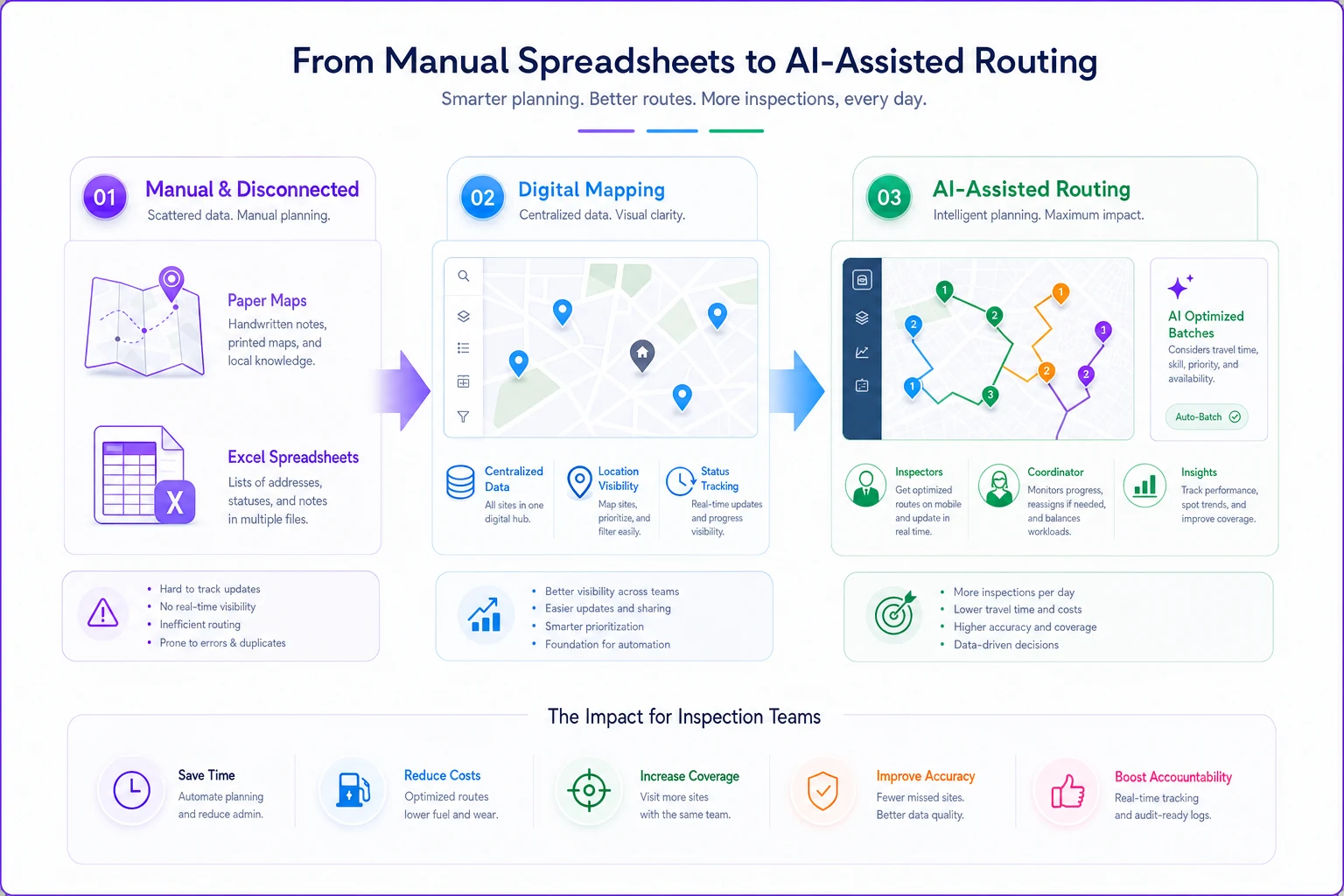
Teams typically see the biggest time savings after the operational platform stage.
A property inspection company made this transition last year. Manual routing with 12 inspectors took their coordinator 4 hours daily. After implementing AI-assisted operational software, the same routing takes 30 minutes, and their travel efficiency improved by 41%. The coordinator now spends those saved hours on quality assurance and client communication—actual value-adding work instead of administrative overhead.
Real-world territory rebalancing
A regional code enforcement agency struggled with inspector burnout. Some inspectors drove 400+ miles weekly while others drove less than 150. The disparity created resentment and turnover.
First, they mapped three months of historical inspections. Clear patterns emerged—certain zip codes generated consistent inspection volume, others were sporadic. They redrew territories based on inspection density, not geographic size.
The rebalancing results after 60 days:
-
Travel variance between inspectors decreased from 280% to 45%
-
Average weekly windshield time dropped from 11.5 to 8.7 hours
-
Inspector satisfaction scores increased across the board
-
Overtime hours reduced by roughly $2,800 monthly
The key insight: geographic equality creates operational inequality. A "fair" map with equal-sized territories produces unfair workload distribution. Balance the work, not the map.
They also introduced territory trading. Inspectors could swap territories for a day when it made routing sense. If Johnson has one inspection in Miller's territory while Miller has three in Johnson's, they trade those specific sites. Simple, flexible, and inspectors appreciated the autonomy.
Small rules, big impact
You don't need million-dollar routing software to cut travel waste. You need clear batching rules, enforced constraints, and meaningful KPIs. The teams that successfully reduce windshield time share common traits: they batch religiously, respect constraints, measure the right metrics, and adapt rules to local conditions.
Start with the 2-hour batching window. Just this single change typically reduces travel time by 20-25% within a month. Add constraint clustering and urban/rural differentiation, and you're looking at 35-40% improvement without any technology investment.
The operational discipline matters more than the tools. Track your travel ratio weekly. Review your territory balance monthly. Audit your constraint matrix quarterly. These simple practices prevent the gradual slide back into routing chaos that kills inspection productivity.
Most importantly, remember that inspection route optimization isn't about perfection—it's about consistency. Better to batch 70% of inspections reliably than attempt perfect routing that falls apart under real-world pressure. Your inspectors will thank you when they're spending their time actually inspecting instead of driving between poorly planned routes.
Ready to modernize your inspection process?
Join 500+ inspection teams using Chekzly to reduce paperwork, improve compliance, and accelerate reporting.