

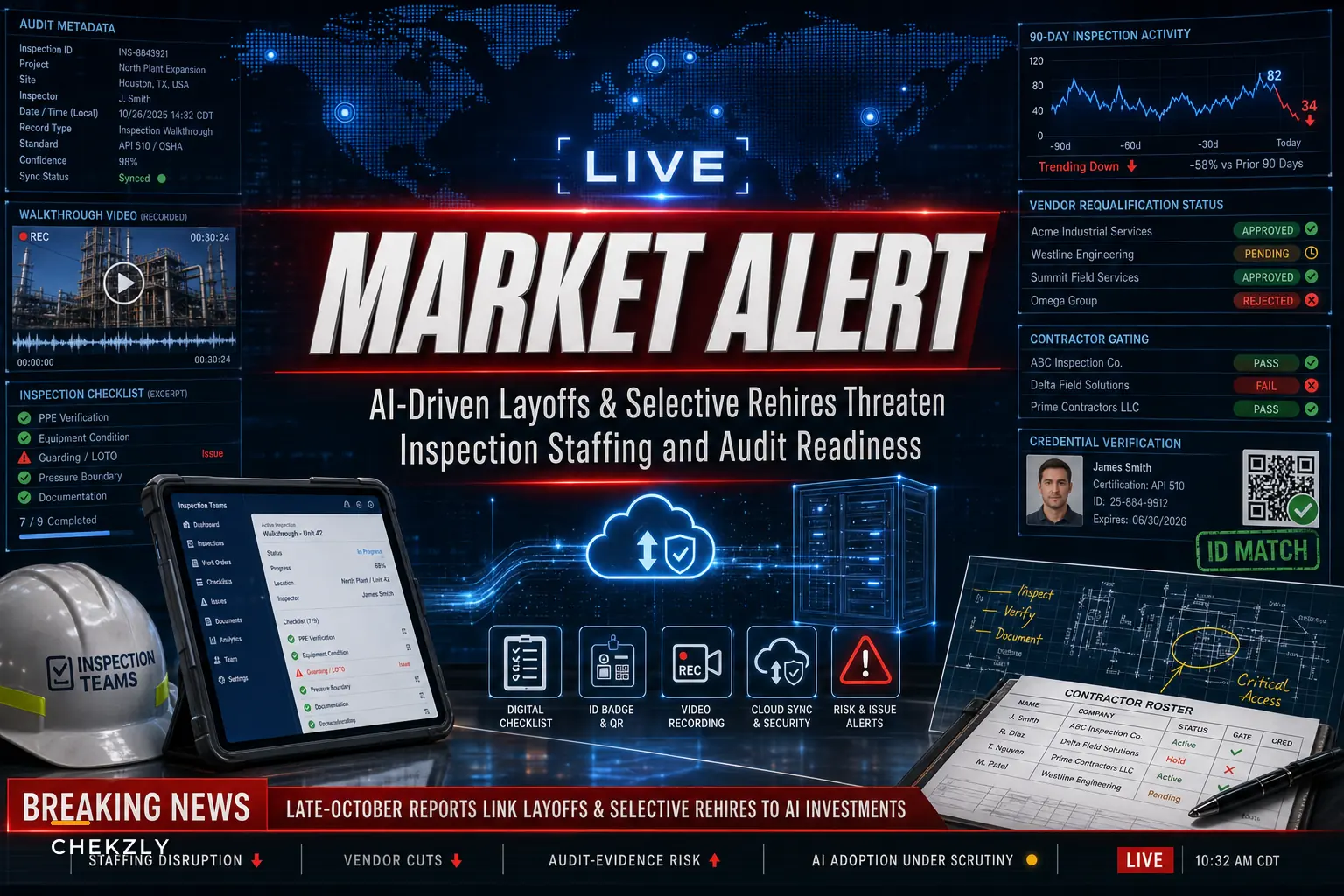

The staffing whiplash happening right now is different from the usual turnover cycle. Companies cut aggressively on the promise of automation, then quietly start calling people back when the gaps show up in the work. CNBC recently described the rise of a "boomerang employee" class — firms admitting they "pulled the plug too quickly" after AI-driven reductions, then scrambling to rehire. Meanwhile, the running tally of 2026 cuts across finance, tech and services, tracked by Business Insider, keeps growing with AI cited as a reason.
For most office roles, that churn is painful but recoverable. For inspection programs, it's a different kind of problem. When an experienced inspector walks out the door — or gets redeployed to a "higher-value" team overnight — you don't just lose labor. You lose calibration habits, site-specific knowledge, chain-of-custody discipline, and the quiet judgment that keeps findings defensible. And when that same person gets rehired three months later under new pay bands and new conditions, you inherit a morale and consistency problem on top of everything else.
This post isn't about the headlines. It's about what happens to your audit trail, your credentialing records, and your field coverage when staffing moves this fast in both directions — and how to build a program that absorbs the shock instead of cracking under it.
The real exposure isn't the vacancy — it's the undocumented knowledge that leaves with it
When a senior inspector leaves, the org chart shows one open slot. The actual loss is spread across dozens of small, undocumented decisions that person made every single week.
Which torque spec applies to the older equipment at Site 4. Why the north dock gets photographed from two angles instead of one. The informal rule that out-of-tolerance readings on a specific gauge get re-shot before escalation. None of that lives in the SOP. It lives in the inspector's head, and it walks out with them.
In real operations, this usually surfaces two or three weeks after the departure — not immediately. The replacement runs the checklist correctly, passes their competency check, and still produces reports that fail acceptance QA because they're missing the tacit context. An auditor flags inconsistent evidence between two inspectors covering the same asset class, and suddenly you're defending a gap you didn't know existed.
The AI-driven nature of this round makes it worse. These cuts aren't happening gradually through retirement and attrition, where knowledge transfer has time to happen naturally. They're happening in batches, by headcount target, often without the team lead getting a say in who goes. A typical pattern: a regional program loses three mid-level inspectors in the same month because they sat in a cost center flagged for automation, even though two of them held the only current certifications for a specialized inspection type.
Boomerang rehires create a consistency problem most programs aren't built for
The rehiring trend sounds like good news — get your experienced people back. In practice it introduces friction that a lot of managers underestimate.
Eliminate inspection delays and errors.
Chekzly helps you plan, execute, and document inspections efficiently and accurately.
- Real-time inspection tracking
- Automated report generation
- Compliance and checklist management
No credit card required
Someone rehired after a layoff comes back with different expectations. Often a higher pay band, sometimes a guarantee, occasionally a part-time or contract arrangement instead of their old full-time role. Now you've got two inspectors doing identical work with visibly different terms, and the rest of the team knows. That's a retention risk for the people who stayed through the disruption.
There's also a credentialing question nobody likes to ask: what expired while they were gone? A three-month absence can mean lapsed certifications, missed recertification windows, or calibration-authority sign-offs that are no longer valid. Treating a boomerang hire as a plug-and-play return — skipping competency reverification because "they already know the job" — is one of the faster ways to put a non-current inspector back in the field with full authority.
The pattern worth noticing: rehires fail audits not because they lack skill, but because the paperwork trail of their re-entry is thinner than a fresh hire's. Fresh hires go through the full onboarding gauntlet. Boomerangs get waved through. Six months later the auditor asks for the recertification record and there isn't one.
A triage framework for sudden staffing loss
When you lose coverage fast, you need a ranking system before you start backfilling. Not every vacancy carries the same audit risk, and treating them all as equal wastes your limited rehiring budget.
| Loss type | Audit risk | Backfill urgency | First move |
|---|---|---|---|
| Sole holder of a specialized cert | High | Immediate | Secure interim coverage via vendor or redeploy, document the gap |
| Senior inspector with site-specific knowledge | High | Within 1–2 weeks | Capture tacit knowledge before exit if possible, assign shadow |
| Mid-level generalist | Medium | Within a month | Redistribute load, start standard hiring |
| Support/admin for evidence handling | Medium–High | Within 1–2 weeks | Protect chain-of-custody continuity first |
| Junior inspector still in ramp | Low | As budget allows | Absorb into existing competency pipeline |
The common mistake is backfilling by headcount instead of by risk. Managers panic over the number of empty seats and rush to fill the easy ones — the generalists — while the single-point-of-failure certification role sits open because it's harder to hire for. That open specialized role is the one that actually fails your next audit.
Protecting knowledge before it leaves: a short exit-capture process
When you get notice that someone's being cut or redeployed — even a few days' notice — run this. It takes less time than people expect and saves weeks of downstream confusion.
-
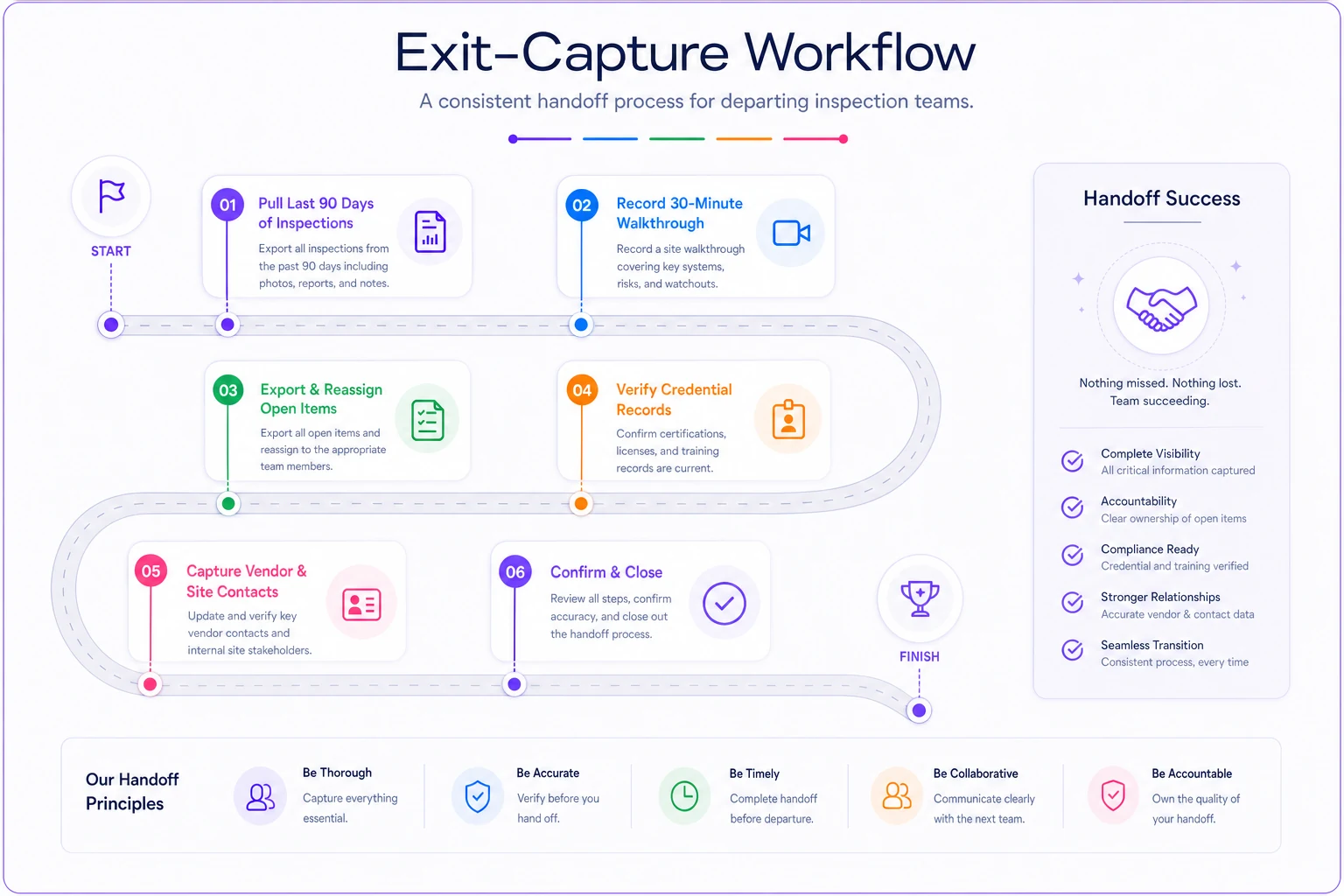
Pull their last 90 days of inspections and flag any sites or asset types only they covered. Those are your knowledge-gap hotspots.
-
Sit them down for a recorded 30-minute walkthrough of anything non-obvious in their routine — the "I always do X because Y" rules that aren't in the SOP.
-
Export their open items — pending remediations, flagged follow-ups, anything mid-cycle — and reassign explicitly, by name, not to a general queue.
-
Verify their credential records are complete and current in your system before access is revoked, so you're not chasing lapsed documentation later.
-
Capture their vendor and site contacts — the plant maintenance lead they always called, the access coordinator at a remote site. That relational knowledge is invisible until it's gone.
Visual workflow of the exit-capture steps.
Even a partial version of this beats nothing. Programs that skip it spend the next quarter rediscovering the same information through failed inspections and confused handoffs.
Vendors are churning too — and their instability lands on your acceptance QA
The staffing turbulence isn't contained to your direct reports. Third-party inspection vendors are under the same AI-efficiency pressure, which means the firm you've relied on for two years may quietly reconfigure its own staffing, swap experienced inspectors for cheaper ones, or lean harder on automated tooling it hasn't fully validated.
You often won't be told. The contract stays the same; the people executing it change. The first signal is usually a shift in the quality of what comes back — slightly thinner photo documentation, timestamps that don't reconcile cleanly, findings that read like they came from someone unfamiliar with the site.
This is the moment to tighten acceptance sampling on vendor deliverables, not loosen it because you're short-staffed. The temptation runs the other way: when your own team is stretched, you want to trust the vendor output and move on. That's exactly when a destabilized vendor is most likely to slip degraded work past you.
A practical response is to raise your QA sampling rate on any vendor you know is going through internal change, and add a simple question to your vendor reviews: has your inspection staffing changed since our last engagement? The honest ones will tell you.
Don't rush into AI/sensor automation to cover the gap
There's a reflexive move happening across a lot of programs right now: lose headcount, replace it with automation. Sensor-assisted capture, automated report generation, AI-flagged anomalies. Some of that is genuinely useful. But adopting it under staffing pressure — without the governance, metadata discipline, and human-oversight structure already in place — is how programs trade a labor gap for a much more expensive audit gap.
Automated tooling that isn't properly governed produces evidence that's harder to defend, not easier. If the chain-of-custody metadata isn't clean, if there's no documented human review of AI-flagged findings, if the model's decisions aren't logged — you've created exposure that a short-staffed team is in no position to absorb.
When automation genuinely makes sense: filling repetitive, well-defined capture tasks where the evidence standards are already clear and human review is built in. When it's a bad idea: using it to replace the judgment-heavy work of departed senior inspectors on the assumption that the tool will "figure it out." That's exactly the work you most need a qualified human validating.
A real scenario
A mid-sized facilities inspection program covering around 40 sites lost four inspectors in six weeks after a corporate efficiency push — two layoffs, two redeployed internally. One held the only current certification for a pressure-system inspection type across the whole region.
The initial instinct was to backfill the three generalist roles fast, because those were the easy hires. The certified role sat open. Within about seven weeks, two audit findings landed: inconsistent evidence quality between the new generalists and the remaining team, and a pressure-system inspection completed by someone without current certification — a direct compliance miss.
The fix wasn't dramatic. They reprioritized: secured interim certified coverage through a vetted vendor while hiring for the specialized role, ran a proper reverification on the two redeployed inspectors who later boomeranged back part-time, and tightened acceptance sampling on everything produced during the transition. Report consistency recovered over roughly the next two months, and the follow-up audit cleared. The takeaway was straightforward: the empty seats you can fill easily are rarely the ones that put you at risk.
Where onboarding structure becomes the pressure valve
Everything above — triage, boomerang reverification, covering specialized gaps — only works if you have a repeatable way to turn any new or returning person into a defensible, audit-ready inspector quickly. Programs that treat onboarding as a one-off scramble get crushed by this kind of churn. Programs with a structured competency and recertification pipeline absorb it.
That's the piece worth investing in before the next wave hits, not during it. If your onboarding path, competency checks, and recertification workflows aren't already documented and consistent, our breakdown of turning new hires into audit-ready inspectors is worth working through — and it applies just as directly to boomerang rehires as it does to fresh ones.
Keep a centralized tracker for credential expirations and recertification deadlines so returning hires trigger an automatic reverification step.
This is also where good operational software earns its place. Not as a replacement for people, but as the system of record that keeps credential status, recertification deadlines, and competency checks visible and current — so a rushed rehire can't quietly slip into the field with a lapsed certification, and a sudden departure doesn't take your only copy of critical knowledge with it. When staffing moves this fast, the programs that stay audit-ready are the ones where that information is centralized and gaps are flagged before an auditor finds them.
What to do this quarter
A short checklist to pressure-test your program before the next round of cuts or rehires:
-
- Map your single points of failure — every certification or site knowledge held by exactly one person.
-
- Confirm your exit-capture process exists and someone owns running it, even on short notice.
-
- Audit your boomerang reverification policy — if you don't have one, returning hires are a hidden risk.
-
- Check vendor staffing stability and raise QA sampling on any vendor in flux.
-
- Resist automation-under-pressure — don't deploy ungoverned tooling to patch a labor gap.
-
- Make credential and recertification status visible so nothing lapses unnoticed.
The staffing environment right now rewards programs that built their coverage, credentialing, and knowledge-capture systems before they needed them. The ones treating this as a hiring problem will keep scrambling. The ones treating it as an operational-readiness problem will keep passing audits — regardless of how many times their headcount swings up and down.
The staffing environment right now rewards programs that built their coverage, credentialing, and knowledge-capture systems before they needed them. The ones treating this as a hiring problem will keep scrambling. The ones treating it as an operational-readiness problem will keep passing audits — regardless of how many times their headcount swings up and down.
Ready to modernize your inspection process?
Join 500+ inspection teams using Chekzly to reduce paperwork, improve compliance, and accelerate reporting.