

You've got 47 pages of training materials. Your new inspector just signed off on everything. Three weeks later, an auditor asks for evidence that this person actually knows how to identify critical defects in your facility's cooling towers. You scramble through sign-in sheets and completion certificates while the auditor taps their pen.
The real problem isn't missing paperwork. Most inspection teams confuse training completion with operational competency. Your inspector might have watched every video and passed every quiz, but can they actually spot corrosion patterns under field conditions? Can they tell the difference between surface rust and structural degradation when water is dripping and visibility is poor?
This pattern destroys programs across manufacturing, utilities, and facility management. Teams chase signatures instead of verifying skills. They track hours instead of capabilities. Then audit season hits and nobody can actually prove their inspectors know what they're doing.
The competency gap that kills inspection programs
Inspector onboarding breaks down in pretty predictable ways. Hire someone with field experience, run them through orientation, pair them with a senior inspector for a few days, send them out alone. Six months pass. An incident occurs. Suddenly everyone's asking about training records and wondering who actually verified this person could perform critical inspections.
The disconnect happens because inspection work requires layered competencies that traditional training doesn't address well. Technical knowledge about equipment and regulations forms the foundation. But field judgment — knowing when a hairline crack matters versus when it's cosmetic — takes months to develop. Documentation skills matter too. An inspector might spot every defect, but if their reports can't withstand legal scrutiny, the competency doesn't count for much.
Most programs also ignore the degradation curve. An inspector who perfectly identifies electrical hazards today might miss obvious issues after six months of routine work. Without periodic re-verification, skills atrophy — especially for high-risk or infrequent inspection types.
Think about a water treatment facility with a dozen inspectors covering chemical storage, process equipment, and safety systems. Each area requires completely different competencies. Chemical storage needs hazmat knowledge. Process equipment demands mechanical aptitude. Safety systems require regulatory expertise. One inspector might excel at mechanical inspections but struggle with chemical compliance. Another might write excellent reports but miss subtle equipment degradation signs.
Standard training treats everyone the same — run everyone through the same modules, test everyone on the same material, hope it sticks. When competency varies by role, location, and inspection type, this approach almost guarantees gaps.
Role-based training paths that actually match field reality
Effective inspector onboarding starts by mapping competencies to actual job functions, not generic skill buckets. A structural inspector needs different training than an environmental compliance inspector, even working at the same facility.
Eliminate inspection delays and errors.
Chekzly helps you plan, execute, and document inspections efficiently and accurately.
- Real-time inspection tracking
- Automated report generation
- Compliance and checklist management
No credit card required
Start with competency matrices broken down by inspection type. For each type, identify:
Knowledge requirements: What regulations, standards, and technical concepts must they actually understand? A pressure vessel inspector needs ASME code knowledge. A food safety inspector needs HACCP principles. Don't list everything — focus on knowledge they'll apply in the field.
Skill demonstrations: What specific tasks must they perform correctly? Can they use measurement tools accurately? Can they photograph defects properly? Can they complete inspection forms without missing critical fields?
Judgment thresholds: What decisions will they make independently? When should they escalate findings? How do they prioritize defects? What's the line between immediate shutdown criteria and a maintenance recommendation?
Here's a simplified competency matrix for electrical system inspections:
| Competency Level | Knowledge Requirements | Field Skills | Decision Authority |
|---|---|---|---|
| Trainee | Basic electrical safety, NFPA 70E awareness | Visual inspection only, no testing equipment | Must work under direct supervision |
| Level 1 | Arc flash boundaries, basic troubleshooting | Infrared scanning, voltage testing | Can inspect low-voltage panels independently |
| Level 2 | Load calculations, protective device coordination | Power quality analysis, insulation resistance | Can assess entire electrical rooms |
| Level 3 | Full NEC code knowledge, forensic analysis | All diagnostic equipment, failure analysis | Can determine shutdown requirements |
Build progression paths between levels. A trainee might need 40 supervised inspections before attempting Level 1 certification. Level 2 might require 200 completed inspections plus advanced training. Set clear milestones that match your actual operational tempo.
The training itself needs to mirror field conditions. Classroom sessions establish foundation knowledge, but field exercises prove competency. Take trainees to actual equipment. Create scenarios with planted defects. Time their inspections. Review their documentation. A new inspector might know that corrosion under insulation is dangerous, but can they actually identify it when the insulation looks intact from the outside?
On-the-job verification that proves competency without disrupting operations
Book knowledge means nothing if inspectors can't apply it under real conditions. But you can't shadow every inspector forever. You need scalable ways to verify competency without grinding operations to a halt.
Sampling-based verification is the practical answer. Instead of checking every inspection, review a statistically reasonable sample. For new inspectors, sample heavily — maybe 30% of their first 50 inspections. For experienced staff, drop to 5–10% quarterly. Adjust sampling rates based on risk. Critical safety inspections might need full review for new inspectors, while routine visual checks need minimal oversight.
Defect identification accuracy: Do they find what they should find? Plant known defects before their inspection. If they miss more than a handful of planted issues consistently, they need additional field training. One utility planted 5 defects per month across their facilities — things like loose connections, missing labels, minor corrosion. New inspectors had to find at least 4 to maintain independent status. Simple, unglamorous, but it worked.
Documentation quality: Can someone else understand and act on their reports? Pull random inspection reports. Check photo quality, defect descriptions, and location accuracy. If maintenance can't find the reported issues based on documentation alone, the inspector needs coaching on report writing.
Time management: Are they thorough without taking forever? Track inspection durations. If someone takes 3 hours for a 1-hour inspection, they might be overthinking things. If they finish in 20 minutes, they're probably missing things. Build time benchmarks based on your best performers, then allow some variance for actual field conditions.
Decision consistency: Do they escalate appropriately? Review their severity ratings against your standards. If they mark everything as critical or nothing as urgent, their judgment needs calibration. Create standardized scenarios with clear pass/fail criteria — "You find a 2-inch crack in a concrete support column. What severity level? What's your recommendation?"
Document everything in competency records that link specific evidence to specific skills. Don't just note "passed field evaluation." Record something like: "Correctly identified 7 of 8 planted defects including hidden corrosion under insulation (missed minor gauge damage). Completed inspection in 67 minutes (benchmark: 60–75 minutes). Documentation scored 9/10 — one photo lacked proper scale reference."
Re-certification triggers that prevent skill decay
Competency isn't permanent. An inspector who excels today might develop bad habits or forget critical procedures over time, especially for inspection types they rarely perform.
Build re-certification rules based on three triggers:
-
Time-based recertification
Set maximum intervals between competency checks. High-risk inspections might need annual recertification. Routine visual inspections might go 2–3 years. But don't pick arbitrary timeframes — look at your incident data. If problems tend to surface around the 18-month mark, set recertification at 12.
-
Volume-based triggers
Inspectors who don't practice lose proficiency. If someone hasn't performed confined space inspections in 6 months, require supervised re-entry before going solo again. Track inspection volumes by type. When volume drops below a reasonable threshold — maybe 2 inspections per month — flag for competency review.
-
Performance-based triggers
Quality metrics should drive recertification decisions. If defect discovery rates drop, if report rejection rates climb, if audit findings increase — these signal competency issues. Don't wait for annual reviews. Set automatic triggers. Three rejected reports in a month? Immediate coaching session. Zero defects found across 10 consecutive inspections? Field verification required.
A regional facility management company tracked every inspector's performance metrics monthly across 8 sites:
-
Defect discovery rate compared to peer average
-
Documentation scores from random audits
-
Time variance from benchmarks
-
Escalation accuracy based on follow-up findings
When any metric dropped below roughly 80% of peer average for two consecutive months, it triggered a competency review. Not punishment — just verification and coaching. They caught performance issues months before those issues would have surfaced through incidents or audits. The operations manager said it shifted the whole culture; supervisors stopped feeling like they were policing people and started actually developing them.
Building evidence packages that survive scrutiny
When auditors or lawyers ask about inspector competency, training certificates aren't enough. You need comprehensive evidence packages that prove ongoing capability.
Structure competency records around demonstrable evidence:
Initial qualification package:
-
Knowledge test results with specific topics covered
-
Field evaluation reports with observed tasks
-
Supervised inspection logs with mentor sign-offs
-
Work samples showing actual inspection reports
Ongoing competency evidence:
-
Sampling verification results with dates and findings
-
Performance metrics trending over time
-
Corrective action records from any issues
-
Re-certification assessments with specific criteria
Supporting documentation:
-
Equipment calibration records for tools they use
-
Procedure revision training when standards change
-
Refresher training attendance
-
Incident investigation participation
Don't bury this in filing cabinets. Build searchable records where you can instantly pull any inspector's complete competency history. Include certification dates, expiration triggers, and verification methods. When someone asks "How do you know Inspector Johnson can evaluate structural steel?" you should produce evidence in minutes.
The evidence needs to tell a story. Initial training established baseline knowledge. Field evaluations confirmed practical application. Ongoing sampling verified continued competence. Performance metrics showed consistent quality. Any issues triggered retraining with documented improvement.
A manufacturing client faced a serious audit after a missed defect caused equipment failure. The auditor questioned whether their inspector was properly qualified. Within about 10 minutes, they produced:
-
Initial certification from 18 months prior with roughly 20 supervised inspections logged
-
Quarterly sampling reports showing strong accuracy over time
-
A recent recertification triggered by procedure updates
-
Performance metrics showing above-average defect discovery rates
The audit finding went from potential major violation to a commendation for robust competency management. That's not luck — that's what a well-maintained evidence trail actually looks like when it matters.
Templates and tools for standardized competency tracking
Generic training tracking won't capture the nuance of inspector competency. You need purpose-built templates that match your operational reality.
Start with a Competency Progression Template that maps each inspection type:
-
Inspection Type
[Electrical Systems - Low Voltage]
-
Prerequisites
Basic electrical safety certification, 1 year field experience
-
Level 1 - Observer
-
- Shadow 10 inspections minimum
-
- Pass written exam (80% minimum)
-
- Document 5 practice inspections for review
-
Level 2 - Supervised Practice
-
- Complete 20 inspections under supervision
-
- Achieve 90% accuracy on planted defects
-
- Documentation score 8/10 or higher
-
Level 3 - Independent Inspector
-
- Pass field evaluation with senior inspector
-
- Complete 10 solo inspections with sampling review
-
- Maintain 85% accuracy on all metrics
-
Recertification Triggers
-
- Annual skills verification
-
- Less than 5 inspections in 90 days
-
- Two documentation rejections in 30 days
-
- Any safety incident involvement
Create Sampling Plan Templates for different risk levels:
High-Risk Inspections (confined space, electrical, pressure systems):
-
New inspector
100% review for first 10, then 50% for next 20
-
Experienced
20% monthly sampling minimum
-
Random unannounced field observations quarterly
Medium-Risk Inspections (routine equipment checks, visual inspections):
-
New inspector
50% review for first 20
-
Experienced
10% quarterly sampling
-
Annual field observation
Low-Risk Inspections (housekeeping, basic documentation):
-
New inspector
25% review for first month
-
Experienced
5% annual sampling
-
Biannual competency confirmation
Build Competency Scorecards that track multiple dimensions:
-
Inspector
[Name]
-
Period
[Quarter/Year]
-
Technical Accuracy
-
- Defect Detection Rate
___% (Target: 85%)
-
- False Positive Rate
___% (Target: <5%)
-
- Severity Assessment Accuracy
___% (Target: 90%)
-
Documentation Quality
-
- Report Completeness
___/10
-
- Photo/Evidence Quality
___/10
-
- Timeliness
___% on-time (Target: 95%)
-
Operational Efficiency
-
- Inspection Duration vs Benchmark
___%
-
- Route Optimization Score
___/10
-
- Equipment Utilization
___%
-
Professional Development
-
- Training Hours Completed
___
-
- Procedure Updates Acknowledged
___
-
- Peer Review Participation
___
These templates become living documents. Update them when regulations change, when you identify new failure modes, when technology introduces new inspection methods. Version control matters — you need to know which competency standard someone was certified under.
AI-assisted competency tracking and pattern recognition
Manual competency tracking becomes overwhelming as teams scale. You're juggling dozens of inspectors, hundreds of inspection types, thousands of individual assessments. Important patterns get buried in the noise.
AI-powered operational software shifts competency management from reactive tracking to proactive problem-solving. Instead of waiting for problems to surface through incidents or audits, these platforms continuously analyze performance patterns across your entire inspection workforce.
At the individual level, the software tracks each inspector's performance trajectory — is their defect discovery rate declining? Are their reports getting rejected more frequently? Are they taking longer on inspections they used to complete quickly? These trends are genuinely easy to miss when you're reviewing things manually month to month.
At the team level, the software identifies competency gaps before they become operational problems. If several inspectors at the same site all miss similar defects, that usually points to a training gap, not individual failure. If scores drop after specific trainers deliver sessions, maybe the training approach needs adjustment. When certain inspection types consistently cause documentation errors, maybe the forms themselves need redesign.
One client discovered their inspectors who started with mechanical inspections performed noticeably better on electrical inspections later compared to those who went the other direction. Not by a small margin either — it was significant enough to change how they structured the entire progression path. That's not something you catch from monthly manual reviews.
These platforms also handle evidence compilation automatically. Instead of assembling competency packages before every audit, the system maintains comprehensive records for each inspector continuously. Every training module, every field evaluation, every performance metric gets organized and tagged. When auditors ask for proof of competency, you generate complete packages in minutes rather than spending two days hunting through folders.
Scheduling works the same way. The system tracks when each inspector needs recertification, which inspection types they haven't performed recently, whose metrics are trending downward. It flags issues for supervisors without requiring someone to babysit a spreadsheet. For teams managing more than 15 or 20 inspectors, this kind of automation isn't a luxury — it's what makes the whole program sustainable.
Prioritize automating recertification flags first — it's the fastest route to stopping skill decay.
Here's a simple workflow visualization:
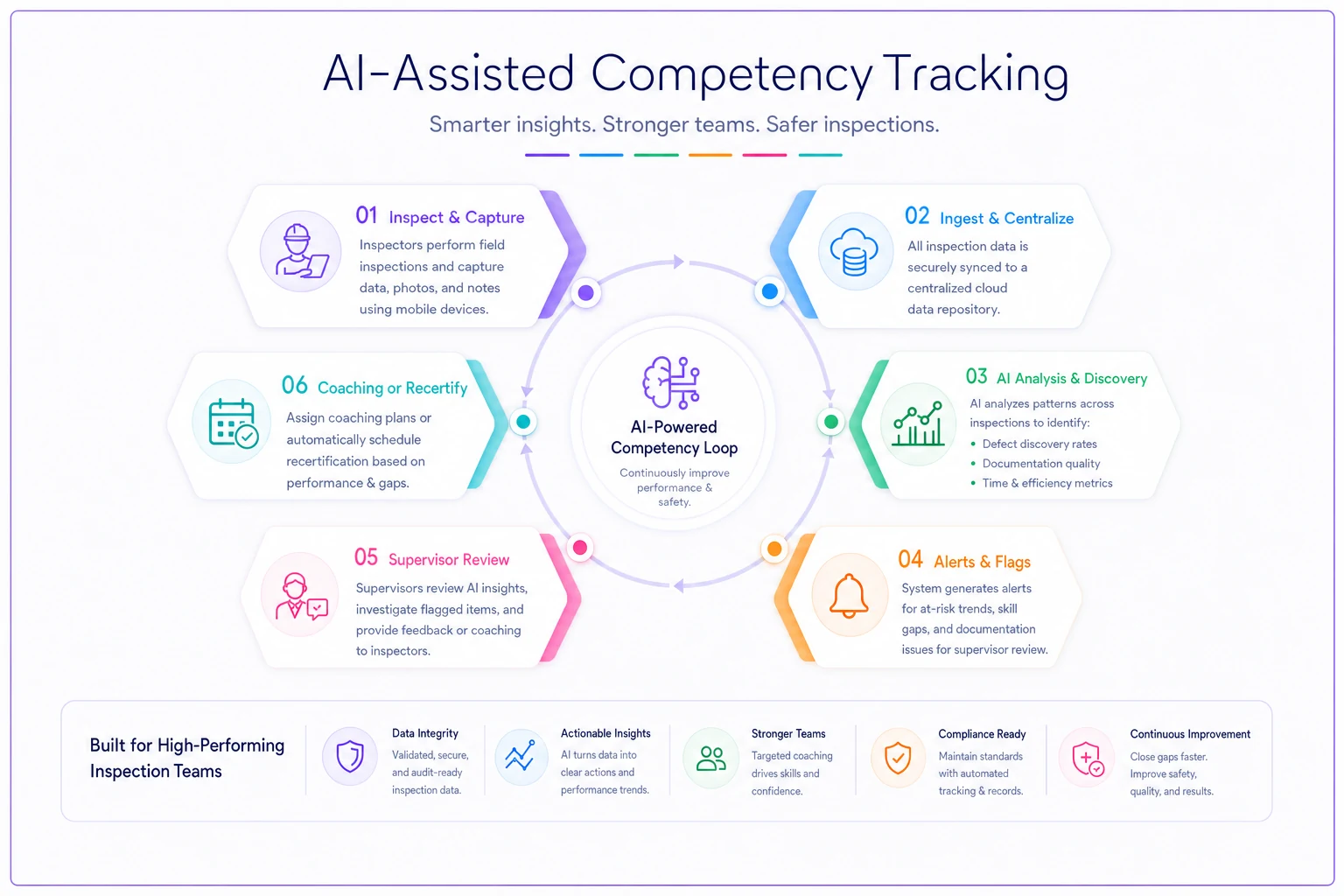
This shows how data flows from field work into analysis and back into action without manual bookkeeping.
Operational integration without disrupting field work
The best competency system means nothing if it adds real friction to field work. Inspectors will quietly work around any program that makes their day noticeably harder.
Integration needs to feel natural. Competency verification should happen through normal work, not special sessions pulled out of thin air. When an inspector submits a report, that's a documentation data point. When they complete an inspection, that's an efficiency metric. When they identify defects others missed, that's validation of expertise.
Build verification into existing workflows. If supervisors already review high-risk inspection reports, add a quick competency scoring component — takes maybe 30 seconds to check three boxes: technical accuracy, documentation quality, decision appropriateness. If you already conduct field audits, include competency observations. The auditor is already there.
Stagger recertification to avoid operational disruption. Don't recertify everyone in January. Spread assessments throughout the year based on hire dates or previous certification dates. If you have 24 inspectors and need annual recertification, doing 2 per month is much more manageable than a January pile-up.
Make competency valuable to the inspectors themselves, not just management. Show them their progression. Link competency levels to advancement opportunities. One company created certification badges for specialized competencies — inspectors competed to collect them. Simple idea, but people responded to it.
When programs succeed versus when they create more problems
Not every organization needs elaborate competency management. A small team with stable, experienced inspectors might do fine with simple annual reviews. But certain conditions demand more structure.
-
Inspector turnover exceeds roughly 20% annually
-
You're scaling from a small team to 50+ inspectors
-
Regulatory requirements explicitly demand competency evidence
-
Inspection types vary significantly in complexity and risk
-
Incidents trace back to inspector error patterns
-
Geographic distribution prevents consistent supervision
-
You're integrating contract or third-party inspectors
You can probably skip formal programs when your team is small and stable (fewer than 5 inspectors), all inspections follow identical simple procedures, senior inspectors directly supervise all work, or you're dealing with low-risk inspections with minimal compliance requirements.
The middle ground often works best. Start with critical inspection types that carry real risk. Build competency frameworks for those first. Once the system proves value, expand to routine inspections. Incremental implementation reduces resistance and gives you room to refine before rolling out everywhere.
A regional hospital network managing facility inspections across 6 locations started by building competency requirements just for life safety inspections — fire systems, emergency power, medical gas. Highest risk, strictest regulatory requirements. After six months, they expanded to infection control inspections, then general facility rounds. Two years later, they had comprehensive competency management built gradually without overwhelming their team or triggering major pushback from field staff.
The path from basic training to audit-ready competency
Building audit-ready inspector competency isn't about creating more paperwork. It's about proving your inspectors can do what you claim they can do. When an incident occurs, when an audit arrives, when performance questions come up — you need evidence, not assumptions.
Start with role-based training paths that match actual field requirements. Build progression from observer to expert with clear milestones. Create on-the-job verification that tests real competency without disrupting operations. Use sampling strategies that balance thoroughness with efficiency.
Implement triggers that catch competency decay before problems surface. Track time since last inspection type, performance trends, and quality metrics. Don't wait for annual reviews. Build evidence packages that tell complete competency stories — a comprehensive history of training, evaluation, performance, and continuous improvement.
Competency management either happens proactively or reactively. Proactive programs invest upfront in frameworks, tracking, and verification. Reactive programs scramble during audits, struggle after incidents, and constantly play catch-up. The effort is roughly similar either way, but the outcomes are completely different.
Your inspectors want to succeed. They want clear expectations, fair evaluation, and recognition for expertise. Competency management gives them that structure while protecting your organization from risk. When everyone knows what good looks like, when progression paths are clear, when verification is consistent — the entire inspection program strengthens.
The companies getting this right treat competency as an operational asset, not a compliance burden. They track it the same way they track equipment reliability or safety metrics. Because ultimately, your inspection program is only as strong as the people executing it. Proving their competency isn't just about surviving audits — it's about building an inspection organization that actually prevents failures before they happen.
Building audit-ready inspector competency isn't about creating more paperwork. It's about proving your inspectors can do what you claim they can do. When an incident occurs, when an audit arrives, when performance questions come up — you need evidence, not assumptions.
Ready to modernize your inspection process?
Join 500+ inspection teams using Chekzly to reduce paperwork, improve compliance, and accelerate reporting.