

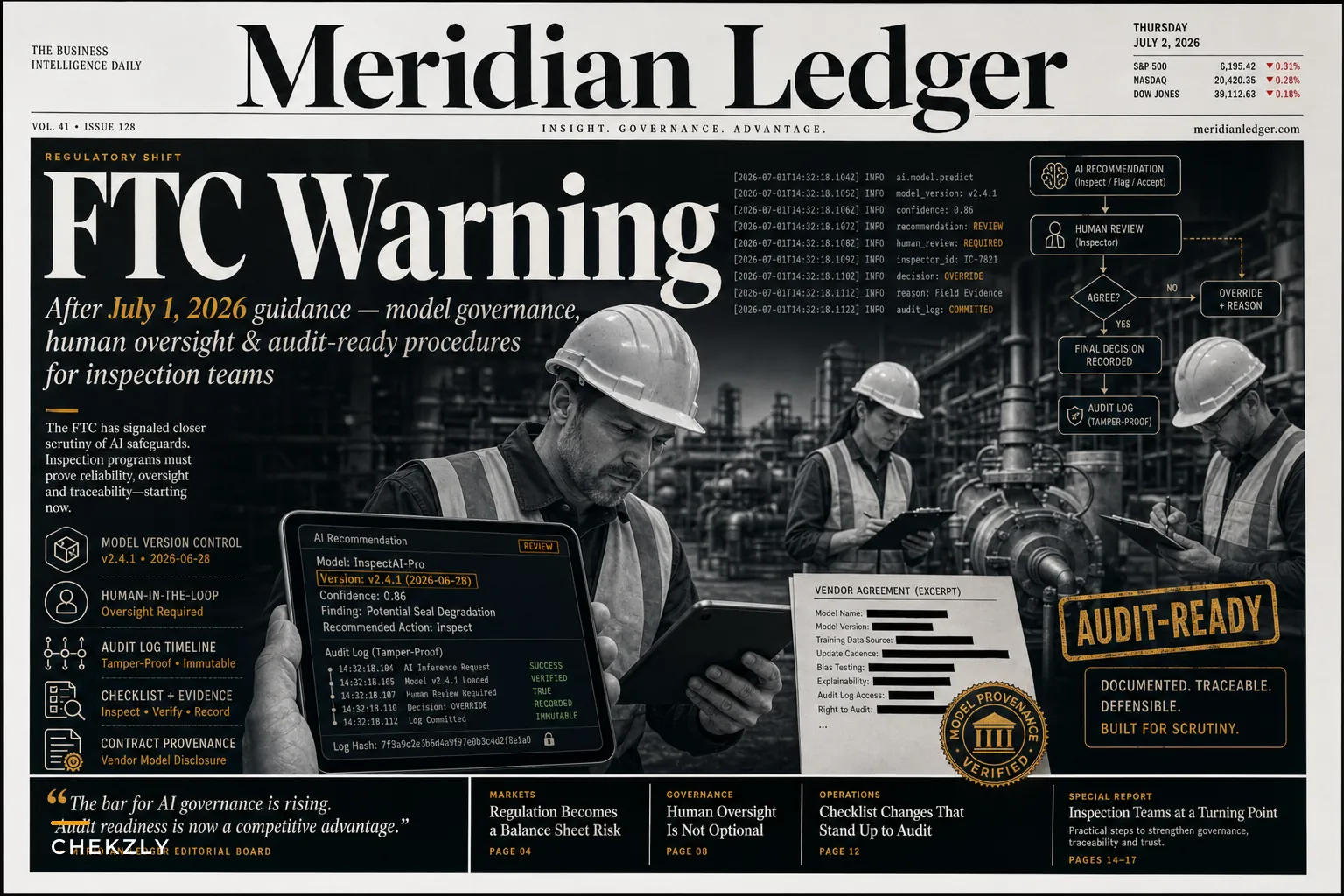

The Federal Trade Commission just dropped something that should make every inspection manager using AI tools stop and check their documentation.
According to Reuters' July 1st report, the FTC warned that certain AI bias-mitigation measures might themselves violate consumer protection laws. This isn't about whether you can use AI for inspection triage or risk scoring — it's about how you govern these systems and what evidence trail you have when things go sideways.
For inspection teams already using AI-assisted triage, automated findings classification, or predictive risk scoring, this signals a real shift. The regulator isn't just watching whether your AI makes biased decisions. They're scrutinizing your entire governance framework — including the safeguards you put in place to prevent problems in the first place.
The governance trap nobody saw coming
Most inspection managers implementing AI tools focused on the obvious compliance issues: accuracy rates, false positives, making sure the system doesn't discriminate against protected classes. Standard stuff. Build in some bias checks, add human review for edge cases, document your validation process.
But the FTC's statement reveals a more complicated problem. Your bias mitigation efforts — the extra checks, the override protocols, the demographic adjustments — might create new legal exposure. Imagine your AI flags certain facility types as higher risk based on historical violation patterns. You add a bias correction factor to avoid unfairly targeting businesses in certain neighborhoods. That correction itself could now be challenged as manipulating outcomes in ways that deceive stakeholders or violate fairness standards.
This creates an operational mess. Every adjustment you make to improve fairness becomes a potential liability. Every governance control needs its own governance.
The inspection teams getting caught flat-footed are the ones who rushed to implement AI scoring without building proper oversight infrastructure. They bought vendor solutions promising "unbiased AI" without understanding that bias mitigation isn't a feature you toggle on — it's an ongoing operational process that needs constant documentation.
What breaks first: your audit trail
When regulatory scrutiny hits, the audit trail is usually the first thing to fall apart.
Eliminate inspection delays and errors.
Chekzly helps you plan, execute, and document inspections efficiently and accurately.
- Real-time inspection tracking
- Automated report generation
- Compliance and checklist management
No credit card required
Here's what typically happens: your team implements an AI tool for prioritizing inspections based on risk scores. The model works well for six months. Then someone notices it's flagging way more facilities in certain ZIP codes. Your vendor pushes a model update to "address the issue." Three months later, an audit asks you to explain exactly what changed, why those specific adjustments were made, and who signed off on altering the risk algorithm.
Model versioning details:
-
Exact model version running on each date
-
What changed between versions (not just "bug fixes")
-
Testing results before and after changes
-
Who authorized each update
Decision explanations:
-
Why specific facilities got flagged
-
What factors contributed to each risk score
-
When human reviewers overrode AI recommendations
-
Justification for those overrides
Performance monitoring:
-
Accuracy rates by facility type
-
False positive/negative patterns
-
Demographic impact assessments
-
Drift detection results
Most inspection software wasn't built with this level of governance in mind. Teams are retrofitting documentation processes onto systems that treat AI models like black boxes.
The human-in-the-loop paradox
Adding human oversight sounds like the obvious fix. The AI suggests, humans decide. Clean and defensible, right?
Not quite. Human-in-the-loop processes create their own governance headaches that most inspection managers underestimate.
Consider this: your AI flags 47 facilities for priority inspection this quarter. Your senior inspector reviews the list and removes 12 based on "professional judgment." Six months later, one of those removed facilities has a major incident. The investigation asks: what specific criteria did the inspector use to override the AI? Was it documented? Was it consistent? Can you prove the decision wasn't arbitrary?
The paradox is that human oversight, meant to add safety, often introduces more variability and less documentation than pure algorithmic decisions. Humans don't naturally explain their reasoning in structured, auditable ways. They use intuition, experience, context that's hard to capture in a compliance report.
This compounds when you have multiple inspectors making override decisions. Inspector A might consistently override AI recommendations for facilities they've personally visited. Inspector B might trust the AI completely except for specific facility types. Without standardized override protocols and documentation requirements, human oversight becomes a liability rather than a safeguard.
Building an actually defensible AI governance framework
After watching dozens of inspection programs scramble to retrofit governance onto existing AI tools, some clear patterns emerge about what actually works versus what just looks good on paper.
Start with decision documentation, not model documentation. Most teams obsess over documenting their AI model — training data, validation metrics, bias testing results. That matters, but it's not what auditors typically care about most. They want to understand specific decisions: why did this facility get inspected while that one didn't? What role did AI play in that specific choice?
Decision-level documentation requirements:
-
Timestamp of AI recommendation
-
Specific risk factors identified
-
Human reviewer identity
-
Override decision (if any)
-
Structured reason for override
-
Supporting evidence referenced
This means changing how your inspectors interact with AI recommendations. Instead of showing a simple risk score, you need interfaces that capture the decision-making process. When an inspector agrees with an AI recommendation, they should indicate which factors they independently verified. When they disagree, they need to select from standardized override reasons — not just enter free text.
Require inspectors to select a standardized override reason and attach supporting evidence to make audits faster and more consistent.
This workflow shows how a decision should be captured from AI recommendation to a searchable decision inventory.
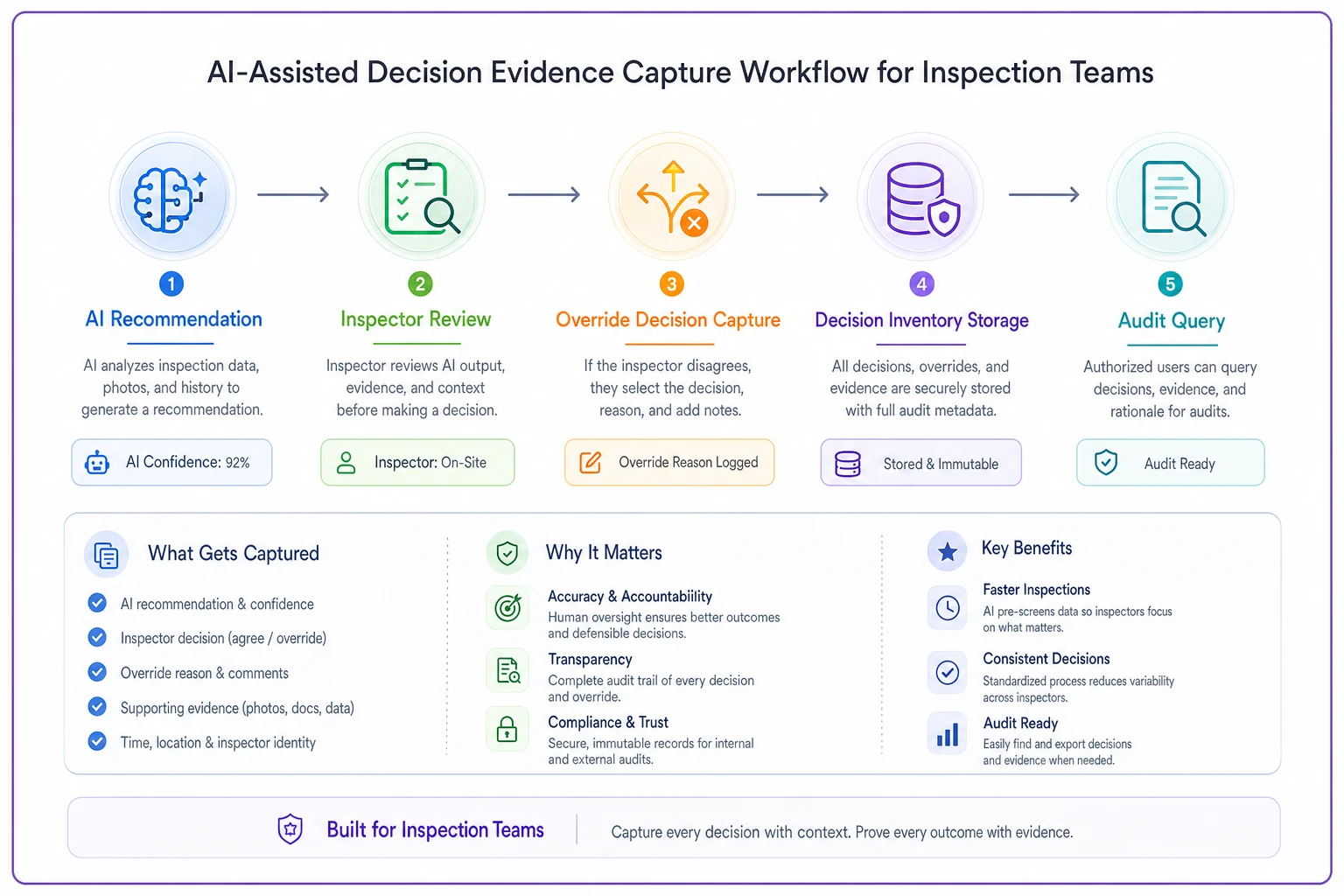
The teams handling this well have built what amounts to a "decision inventory" — a searchable record of every AI-assisted decision, who made it, what factors were considered, and what actually happened. When auditors ask about bias patterns or decision consistency, you can query actual decisions, not just model metrics.
Vendor contracts that protect you (not them)
Your AI vendor's standard contract probably doesn't protect you from FTC scrutiny. Most vendor agreements focus on technical performance — uptime, accuracy rates, data security. They rarely address governance, explainability, or regulatory compliance in any meaningful way.
Critical contract elements most teams miss:
-
Model transparency rights You need more than "the model is 94% accurate." You need access to understand what features drive decisions, how the model was trained, what data it used. Some vendors claim this is proprietary. That's their problem, not yours. If you can't explain your AI's decisions to a regulator, "our vendor won't tell us" isn't a defense.
-
Change notification and approval Your vendor shouldn't be able to push model updates without your explicit approval. Each update needs documentation of what changed, why, and what testing was performed. You need the right to reject updates that don't meet your governance standards.
-
Audit support obligations When regulators come knocking, your vendor needs to provide documentation, explanations, and potentially expert testimony. This should be explicitly stated in the contract, not assumed.
-
Liability allocation Standard contracts often indemnify vendors from regulatory actions. You want the opposite — if their model creates compliance problems, they share liability.
The inspection programs getting burned right now signed contracts that treated AI like traditional software. They're learning that AI governance in inspections requires fundamentally different vendor relationships.
The operational reality check
Here's what implementing proper AI governance actually looks like day to day.
A medium-sized inspection operation running roughly 400 inspections monthly implemented AI-assisted triage about eight months ago. Previously, their senior inspector spent 3-4 hours weekly reviewing and prioritizing incoming inspection requests. The AI reduced this to around 45 minutes.
-
Daily model performance review
20 minutes
-
Weekly bias assessment
1 hour
-
Decision documentation
~2 minutes per inspection (around 13 hours monthly)
-
Monthly governance reporting
3 hours
-
Quarterly model validation
8 hours
| Activity | Time |
|---|---|
| Daily model performance review | 20 minutes |
| Weekly bias assessment | 1 hour |
| Decision documentation | ~2 minutes per inspection (around 13 hours monthly) |
| Monthly governance reporting | 3 hours |
| Quarterly model validation | 8 hours |
They went from saving roughly 12 hours monthly to adding over 20 hours of governance overhead. The AI still delivered value through better risk targeting and more consistent decision-making, but the operational burden shifted from decision-making to decision documentation.
This is the reality teams need to plan for. AI doesn't eliminate work — it transforms it from operational tasks to governance tasks.
Warning signs your AI governance is already broken
Most teams don't realize their governance is insufficient until an audit or incident forces the issue. But there are early warning signs worth watching for.
-
You can't explain last month's decisions
Pick five random inspection priorities from last month. Can you explain exactly why each was selected? What risk factors were identified? Who reviewed the AI recommendation? If recreating this takes more than 10 minutes per decision, your documentation is insufficient.
-
Your override rate is too consistent (or inconsistent)
Human reviewers overriding AI recommendations at exactly 10% every single month suggests rubber-stamping. Wild swings from 5% to 40% indicate inconsistent standards. Both patterns raise red flags.
-
Version control is missing or meaningless
When did your AI model last update? What specifically changed? If your answer is "sometime last quarter" or "bug fixes and improvements," you have a governance gap.
-
Inspection outcomes don't match risk scores
If your high-risk facilities consistently pass inspection while medium-risk ones fail, either your AI isn't working or your documentation isn't capturing what's really driving decisions.
-
No one owns governance
If no single person is responsible for AI governance, everyone assumes someone else is handling it. Governance by committee is usually governance by nobody.
Governance by committee is usually governance by nobody.
Integration with existing data governance
The smartest inspection teams aren't building AI governance from scratch — they're extending existing data governance frameworks. If you've already built strong inspection data governance systems, you likely have most of the infrastructure you need for AI oversight.
Your data governance probably already includes:
-
Version control for inspection checklists
-
Approval workflows for process changes
-
Audit trails for data modifications
-
Role-based access controls
-
Regular compliance reviews
AI governance builds on these foundations. Your model versions become another controlled asset. AI recommendations flow through existing approval workflows. Decision documentation joins your audit trail. The same team reviewing data quality can assess model performance.
Treating AI governance as completely separate from data governance is a mistake. It creates duplicate processes, conflicting standards, and gaps where the two systems intersect.
The practical compliance checklist
For inspection managers who need to move quickly, here's what to prioritize:
Week 1: Documentation baseline
-
Document current AI model version and capabilities
-
Create decision log template for AI-assisted choices
-
Identify who owns AI governance (assign if needed)
-
Review vendor contracts for governance gaps
Week 2-3: Operational processes
-
Implement structured override protocols
-
Train inspectors on documentation requirements
-
Set up daily model performance monitoring
-
Create bias assessment workflow
Month 2: Governance framework
-
Establish model change control process
-
Build decision audit trail system
-
Create monthly governance reporting
-
Define escalation procedures
Month 3: Validation and testing
-
Conduct retrospective decision review
-
Test audit trail completeness
-
Validate bias assessment methods
-
Run mock regulatory inquiry
This timeline assumes you're already using AI tools. If you're still evaluating, build these governance requirements into your selection criteria from day one.
Beyond compliance: operational upside
The FTC warning creates urgency, but proper AI governance delivers value beyond just staying out of trouble. Teams with mature governance consistently run into unexpected benefits.
-
Better inspector training
When you document why AI recommendations get overridden, you start identifying knowledge gaps. One inspection team discovered their newer inspectors consistently missed certain risk indicators the AI caught, which led to targeted training that improved overall inspection quality.
-
Vendor accountability
Detailed performance tracking gives you real leverage with vendors. Instead of vague complaints about accuracy, you can show specific failure patterns and demand fixes.
-
Operational insights
Governance data surfaces patterns that human managers miss. One inspection program discovered their AI performed worst on Thursdays — it turned out their data pipeline had a synchronization issue that only affected mid-week updates.
-
Stakeholder trust
When facility operators question why they're being inspected more frequently, you can point to data-driven, consistent decision-making rather than looking arbitrary.
When facility operators question why they're being inspected more frequently, you can point to data-driven, consistent decision-making rather than looking arbitrary.
The path forward
The FTC's stance on AI governance isn't going to soften. If anything, scrutiny will intensify as AI becomes more embedded in regulatory and compliance functions. Inspection managers have a choice: scramble to retrofit governance onto existing systems or build it properly now.
The teams succeeding here aren't the ones with the most sophisticated models or the biggest budgets. They're the ones who recognized early that AI isn't just a tool — it's an operational change that requires rethinking how decisions get made, documented, and defended.
For inspection operations still evaluating AI tools, this regulatory attention might feel like a reason to wait. That logic is backwards. The requirements are becoming clear now, while implementation is still voluntary. Early adopters who build governance properly will shape best practices. Late adopters will inherit rigid compliance requirements designed by regulators who don't fully understand operational realities.
The real question isn't whether to implement AI governance — it's whether you'll do it on your own terms or reactively on the regulator's. Given what's coming out of the FTC, proactive is the only sensible choice.
Ready to modernize your inspection process?
Join 500+ inspection teams using Chekzly to reduce paperwork, improve compliance, and accelerate reporting.