

Three months ago, a regional inspection company lost their lead inspector. Guy had been there eight years. Within 72 hours, they realized he was the only one who knew which clients required specific photo angles for compliance, who could approve deviation reports, and where critical calibration certificates lived on the shared drive. The replacement inspector issued 47 reports that month. Sixteen got rejected during client audits because they didn't meet documentation standards nobody had written down.
This happens constantly in inspection operations. Not because companies are careless, but because inspection data governance evolves organically around whoever happens to be doing the work. You start with one inspector handling everything, then add a second person who learns by shadowing, then suddenly you're managing twelve inspectors across four states with everyone operating slightly differently.
The real problem isn't the data itself. It's that nobody designs governance structures until something breaks catastrophically.
Why inspection teams create data chaos without meaning to
Most inspection operations begin with simple needs. You inspect, you document, you deliver reports. Early on, one person handles everything—they know what photos to take, which forms to use, where to store files. Works perfectly at that scale.
Then growth happens. You hire inspector number two. They learn by watching, picking up habits and creating their own variations. Inspector three comes aboard during busy season, gets minimal training, develops their own filing system because "it makes more sense." By the time you have six inspectors, you've got six different approaches to the same work.
I watched this unfold at a commercial property inspection firm. Started with two guys doing everything. Eighteen months later, they had nine inspectors across three regions. Each region had drifted into its own report format. The Dallas team timestamped photos differently than Houston. Austin stored calibration records in email threads while everyone else used Dropbox. When their biggest client requested historical inspection data for an acquisition, it took three people two weeks to compile reports that should have taken two hours to pull.
The scattered approach creates compounding problems:
Regional managers can't compare performance metrics because everyone tracks differently. One team measures inspections completed, another tracks hours on site, a third counts report pages generated. Makes it impossible to identify which processes actually work better.
Compliance becomes a nightmare when every inspector interprets requirements their own way. Your senior inspector might know exactly what "adequate lighting documentation" means for pharmaceutical clean rooms, but the new hire thinks a single overhead shot is fine.
Client relationships suffer when consistency disappears. If Client A receives detailed thermal imaging analysis from one inspector but basic visual checks from another, they lose confidence in your entire operation.
Training new staff gets exponentially harder. Instead of teaching one clear process, you're explaining six variations and why Bob does things differently than Sandra who learned from Mike who modified Janet's original system.
The permission maze that nobody talks about
What actually kills productivity in growing inspection teams is permission structures that make zero operational sense. Your field inspector can't edit their own report after submission, but the office admin who has never conducted an inspection can modify anything. The QA lead needs regional manager approval to flag safety violations, but part-time contractors can mark inspections complete without review.
Eliminate inspection delays and errors.
Chekzly helps you plan, execute, and document inspections efficiently and accurately.
- Real-time inspection tracking
- Automated report generation
- Compliance and checklist management
No credit card required
These gaps create daily friction. An inspector spots a data entry error at 6 PM, can't fix it themselves, emails the office manager who's already gone, client receives an incorrect report the next morning, everyone scrambles to issue corrections. In operations without clear role-permission mapping, this happens multiple times per week.
The permission matrix should reflect actual workflow, not org chart hierarchy. Consider what really happens during inspection cycles:
Field inspectors need immediate access to historical reports, client preferences, and equipment databases while on site. They should be able to edit their own reports within defined timeframes, access scheduling systems, and flag urgent issues directly. Most systems default to view-only for field staff anyway.
QA reviewers need comparison tools, the ability to annotate without altering source data, and override authority for specific findings. Instead, they often get either full admin rights (too much) or basic reviewer access that forces them to communicate changes through email rather than in-system.
Regional coordinators need cross-territory visibility for resource planning, the ability to reassign inspections, and access to performance metrics. Yet many organizations restrict them to their own region's data, creating blind spots when inspectors need coverage across boundaries.
The technical team maintaining equipment and calibrations needs update rights for certification records, the ability to flag equipment as unavailable, and access to maintenance schedules. Without proper permissions, they resort to spreadsheet workarounds that nobody else can find.
Record types that demand different retention rules
Not all inspection data ages the same way. Raw field notes might be worthless after report generation, while calibration certificates stay critical for years. Environmental readings need different treatment than visual observations. Yet most operations treat everything identically—either keeping everything forever or deleting based on a single timeline.
A hazardous materials inspection company learned this the hard way. They had a simple two-year retention policy across the board. Seemed reasonable until a chemical exposure lawsuit came up from an inspection conducted four years prior. The thermal imaging data that would have proved proper ventilation? Deleted. The inspector's field notes showing additional undocumented safety checks? Gone. They had the final report, but none of the supporting evidence that would have cleared them.
Different record types serve different purposes across different timelines:
Immediate operational records (inspector notes, preliminary readings, communication logs) matter for days or weeks. Once incorporated into final reports, their value drops unless disputes arise. Keep them long enough to handle normal client questions and quality reviews—usually 60 to 90 days.
Compliance documentation (certifications, calibration records, training verification) carries multi-year legal weight. These prove your inspectors were qualified and equipment was properly maintained. Five to seven year retention is common, though some industries require longer.
Client deliverables (final reports, recommendations, photo documentation) represent your actual service. These need retention periods matching client contracts plus statute of limitations for potential disputes. Usually three to five years minimum, but it varies significantly by industry.
Performance data (time tracking, route efficiency, error rates) helps improve operations but rarely matters for compliance. Annual cycles work fine unless you're tracking long-term trends.
Safety incidents and near-misses require special handling regardless of other categories. These might become evidence years later. Many operations create permanent retention for anything safety-related.
| Record type | Retention notes |
|---|---|
| Immediate operational records | (inspector notes, preliminary readings, communication logs) matter for days or weeks. Once incorporated into final reports, their value drops unless disputes arise. Keep them long enough to handle normal client questions and quality reviews—usually 60 to 90 days. |
| Compliance documentation | (certifications, calibration records, training verification) carries multi-year legal weight. These prove your inspectors were qualified and equipment was properly maintained. Five to seven year retention is common, though some industries require longer. |
| Client deliverables | (final reports, recommendations, photo documentation) represent your actual service. These need retention periods matching client contracts plus statute of limitations for potential disputes. Usually three to five years minimum, but it varies significantly by industry. |
| Performance data | (time tracking, route efficiency, error rates) helps improve operations but rarely matters for compliance. Annual cycles work fine unless you're tracking long-term trends. |
| Safety incidents and near-misses | Require special handling regardless of other categories. These might become evidence years later. Many operations create permanent retention for anything safety-related. |
The problem compounds when different regulations apply to the same data. A structural inspection report might fall under state engineering board requirements (10 years), client contract terms (5 years), and general liability considerations (7 years). Without clear governance, teams either guess wrong or just keep everything forever.
Building enforcement playbooks that actually work
Governance without enforcement is wishful thinking. You need systematic responses when someone uploads reports to personal Google Drive, when field photos lack required metadata, when inspectors skip documentation steps. Not punishment—correction mechanisms that fix problems before they cascade.
Most enforcement fails because it relies on human intervention. The QA manager has to notice problems, chase down inspectors, manually verify corrections. By the time issues surface, bad habits are entrenched and data is already corrupted.
Effective enforcement happens through automated workflows that catch problems immediately. When an inspector tries submitting a report missing required photos, the system blocks submission and lists exactly what's missing. When someone attempts accessing records outside their permission scope, it logs the attempt and notifies their supervisor. When retention deadlines approach, automated exports run before deletion.
Building an audit-ready inspection records system starts with enforcement playbooks that run without constant human oversight. These aren't punitive—they're protective. They prevent the mistakes that cause audit failures, client complaints, and legal exposure.
Some real inspection workflow friction points worth designing for:
Photo uploads should trigger immediate validation. Check for timestamp metadata, GPS coordinates if required, minimum resolution standards. If validation fails, notify the inspector instantly while they're still on site, not days later during review.
Report submissions need completeness checks before acceptance. Missing sections, unsigned attestations, absent safety observations—catch them at submission, not during client delivery.
Data modifications require audit trails with enforcement. When someone changes inspection findings after submission, the system should require justification notes, maintain original versions, and alert stakeholders based on modification severity.
Access violations deserve graduated responses. A first attempt might just log and remind about permissions. Repeated attempts trigger supervisor notifications. Pattern violations initiate security reviews.
Retention violations need proactive intervention. Don't wait until someone needs deleted data. Run periodic checks ensuring nothing gets deleted early and nothing stays past legal requirements.
Here's a simple enforcement workflow visualization.
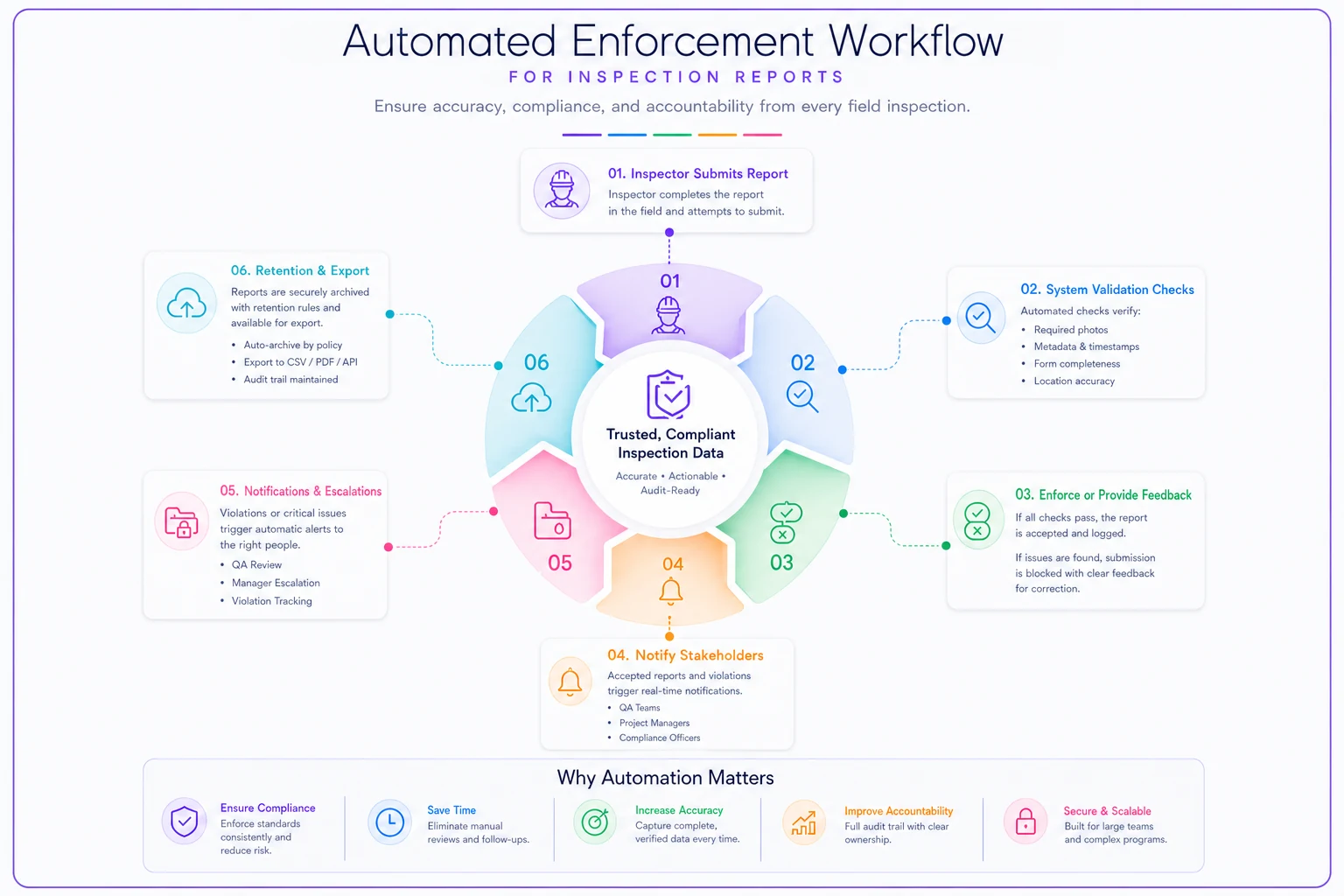
Validate photo metadata on upload so inspectors can fix issues while still on site.
Design playbooks that don't rely on memory. Build clear, automated steps that handle the common errors and produce logs for accountability.
The export requirements nobody plans for
Every inspection operation eventually faces urgent export demands. A client needs three years of inspection history for due diligence. Regulators request specific data formats for an investigation. Insurance companies demand documentation for claim evaluation. Legal teams want everything related to specific incidents.
Without proper governance structure, these requests become operational emergencies. Someone spends days pulling reports from multiple systems, converting formats, trying to verify completeness. The resulting dataset might miss critical elements or accidentally include sensitive information that shouldn't be shared.
A multi-state inspection firm ran into this during acquisition discussions. Potential buyers requested comprehensive operational data for evaluation. Seemed straightforward until they realized inspection records lived across four different systems, three file servers, and scattered email threads. The lead inspector spent two weeks assembling data that should have exported in hours. They also accidentally included employee personal information and client pricing details that weren't supposed to be in the package.
Export readiness requires three elements working together:
Defined export templates for common requests. Your standard client export differs from regulatory submissions which differs from legal discovery. Each needs specific fields, formatting, and redaction rules. Without templates, every export becomes custom work.
Permission controls determining who can export what. Field inspectors might export their own reports but not colleague data. Managers might export regional summaries but not raw databases. Legal teams need everything but only through formal request processes.
Automated execution replacing manual assembly. When someone requests inspection history for specific equipment, the system should pull relevant reports, apply appropriate redactions, format per requirements, and generate export logs. Manual processes guarantee inconsistency and errors.
The export playbook should address predictable scenarios before they become urgent:
Client transitions need complete handoff packages. When clients change inspection providers or bring services in-house, they'll want historical data. Having standard export packages ready prevents scrambling and maintains professional relationships even during transitions.
Audit preparations require specific formatting. Auditors don't want your internal report format—they want data structured for their evaluation templates. Pre-built audit exports save days of reformatting during already stressful audit periods.
Incident investigations demand comprehensive documentation. When accidents or failures trigger investigations, you need everything related to that site, equipment, or time period. The middle of a crisis is the wrong time to figure out data assembly.
Performance reviews need sanitized datasets. When analyzing inspector efficiency or error rates, you need operational data without client-sensitive information. Export templates should automatically exclude pricing, proprietary processes, and other confidential elements.
The export playbook should be ready so routine requests never become emergencies.
Escalation paths that prevent small problems from becoming disasters
Small inspection issues become major failures through broken escalation. An inspector notices unusual equipment wear but doesn't know if it warrants immediate client notification. A reviewer spots pattern issues across multiple sites but has no clear reporting path. A field team identifies safety concerns but can't reach the right decision maker fast enough.
Traditional escalation relies on individual judgment and informal communication. The inspector texts their supervisor who might email the regional manager who eventually contacts the client. By then, minor issues have evolved into major problems, and nobody can reconstruct the decision chain.
I saw this break down at a food facility inspection company. Their inspector found temperature control issues during a routine inspection. Nothing immediately dangerous, but worth flagging. The inspector noted it in the report but didn't escalate because it wasn't technically "critical." Two weeks later, product contamination traced back to that temperature issue. The client rightfully asked why they weren't notified earlier. The inspector thought they were following protocol. Management assumed inspectors would use judgment for borderline issues. Nobody had actually defined what warranted immediate escalation.
Structured escalation matrices remove that ambiguity. Every issue type gets defined triggers, notification requirements, and timeline expectations. Not bureaucracy—protection against the confusion that creates liability.
Effective escalation matrices include:
Severity definitions that remove subjective interpretation. "Critical" means immediate safety risk or regulatory violation. "Major" means potential failure within 30 days. "Minor" means efficiency issue without safety impact. Everyone operates from identical definitions.
Notification requirements based on severity and type. Critical safety issues might require immediate client contact plus regulatory notification within four hours. Major equipment degradation might need client notification within 24 hours. Minor efficiency observations go in standard reports.
Decision authority mapped to issue types. Field inspectors can declare equipment unsafe but need supervisor approval for work stoppage recommendations. Regional managers can approve deviation from standard procedures but need director sign-off for contract modifications.
Timeline enforcement ensuring rapid response. Critical issues require acknowledgment within 30 minutes, initial response within 2 hours, resolution plan within 24 hours. Major issues need same-day response. Minor issues follow standard reporting cycles.
Documentation requirements preserving decision rationale. Every escalation needs written justification, stakeholder notifications, and resolution documentation—not for bureaucracy, but for learning from patterns and protecting against liability.
The automation opportunity most teams miss
Manual governance enforcement wastes enormous energy. Someone checks every report for completeness. Someone reviews photo metadata. Someone ensures retention compliance. Someone validates permission usage. These repetitive checks consume hours while still missing problems.
Checklist version control and rollback rules become manageable when automated systems handle verification. Instead of people checking people, workflows validate themselves.
What automation actually looks like for inspection governance:
Reports won't submit without required elements. The system knows what constitutes completeness for each inspection type. Missing photos, unsigned sections, absent safety observations—all caught automatically before submission. Inspectors get immediate feedback while still on site, not days later during review.
Permission violations trigger instant alerts. When someone attempts accessing restricted records, downloading excessive data, or modifying closed reports, supervisors know immediately. Patterns of violation highlight training needs or potential security issues before they become serious.
Retention rules execute automatically. Data exports run before deletion. Archives transfer to long-term storage. Destruction confirmations generate for compliance records. No manual tracking, no missed deadlines, no scrambling when auditors request supposedly retained records.
Escalation happens without human delay. When inspection findings meet defined triggers, notifications route automatically to appropriate stakeholders. The inspector doesn't have to decide who needs to know—the system handles distribution based on established rules.
Export templates eliminate manual assembly. Standard requests execute through predefined workflows. Client transitions, audit preparations, incident investigations—all follow established templates that ensure consistency and completeness without manual work.
This isn't about replacing human judgment. It's about freeing people from repetitive governance tasks so they can focus on actual inspection work. The regional manager shouldn't spend mornings checking report completeness. The QA lead shouldn't manually verify photo metadata. Good systems handle the repetitive stuff so your people can handle the things that actually require judgment.
Real scenario: How proper governance saved a mechanical inspection firm
A mechanical inspection firm operating across six states learned governance value through near disaster. They had 23 inspectors, four regional managers, and roughly 400 monthly inspections. Like most growing operations, their governance had evolved organically—everyone did things slightly differently, documentation lived everywhere, permissions were either too strict or too loose.
Then came the lawsuit. A manufacturing client suffered equipment failure two years after inspection. They claimed the inspection missed critical wear indicators. The insurance company demanded all documentation related to that equipment, that inspector, and similar inspections at comparable facilities.
Should have been straightforward. Pull the inspection report, get supporting documentation, provide training records, done. Instead it became a three-week scramble. The original report existed, but supporting photos had been deleted after one year per their informal retention policy. The inspector's notes were on a personal laptop that had been recycled. Training certificates were split across three systems. Similar inspection reports required manual review to even identify.
They survived the lawsuit—inspector notes recovered from email showed proper documentation of the wear, and the client had ignored replacement recommendations. But the near-disaster triggered a complete governance overhaul.
They implemented:
-
Role-based permission matrix matching actual workflow needs
-
Automated retention rules by record type (photos kept 5 years, reports 7 years, training records 10 years)
-
Escalation playbooks with defined triggers and timelines
-
Export templates for common scenarios
-
Automated enforcement replacing manual checks
Results after eight months:
-
Report review time dropped from around 3 hours to roughly 45 minutes on average
-
Client complaints about inconsistency nearly eliminated
-
New inspector training reduced from 3 weeks to about 10 days
-
Audit preparation changed from a two-week fire drill to a four-hour export
-
Zero compliance violations in the subsequent regulatory review
The transformation didn't require massive technology investment. They used their existing systems but added governance structure and automation workflows. Same tools, same team, same clients—but operational efficiency improved dramatically once governance stopped being an afterthought.
Moving from reactive to proactive governance
Most inspection operations build governance reactively. Something breaks, you patch it. Audit finds issues, you add controls. Client complains, you create new procedures. This approach guarantees you're always behind, always scrambling, always fixing yesterday's problems.
Proactive governance anticipates problems before they manifest. You don't wait for permission confusion—you map roles to workflows upfront. You don't wait for retention mistakes—you define rules by record type. You don't wait for escalation failures—you build playbooks for predictable scenarios.
The shift requires accepting that governance isn't overhead. It's operational infrastructure. Just like you wouldn't run inspections without calibrated equipment, you shouldn't run operations without governance structure.
Start with the highest-impact elements:
Define your permission matrix based on actual workflow needs, not org chart position. Map out who needs what access when, then build permissions to match. Field inspectors need different permissions during inspection versus report writing versus review periods.
Establish retention rules that balance compliance requirements with practical storage limits. Not everything needs keeping forever, but critical records need protection. Build automated exports before deletion and verification that retention requirements are met.
Create escalation playbooks for your common scenarios. Define what constitutes each severity level, who gets notified, and what timelines apply—before you actually need them.
Build export templates for predictable requests. Client transitions, audit preparations, incident investigations all need specific data formatted specific ways. Templates ensure consistency and reduce assembly time from days to hours.
Implement automated enforcement wherever possible. Manual checking wastes time and misses problems. Automated validation catches issues immediately while fixes are still simple.
The goal isn't perfect governance—it's functional governance that improves operations rather than adding friction. Good governance feels invisible to field teams while preventing the problems that create operational chaos. Bad governance adds bureaucracy without value. The difference lies in designing governance around actual workflow rather than theoretical best practices.
Inspection data governance might not be exciting, but neither is equipment failure, audit findings, or lawsuit discovery. The teams that build governance structure before they need it are the ones that scale successfully without sacrificing quality or compliance. The ones that wait until problems force their hand spend years playing catch-up while competitors pull ahead.
Invest in governance now while you have control, or scramble to build it later while handling a crisis. Either way, you'll eventually need the structure. The only question is whether you build it on your timeline or let circumstances decide for you.
Invest in governance now while you have control, or scramble to build it later while handling a crisis. Either way, you'll eventually need the structure. The only question is whether you build it on your timeline or let circumstances decide for you.
Ready to modernize your inspection process?
Join 500+ inspection teams using Chekzly to reduce paperwork, improve compliance, and accelerate reporting.