

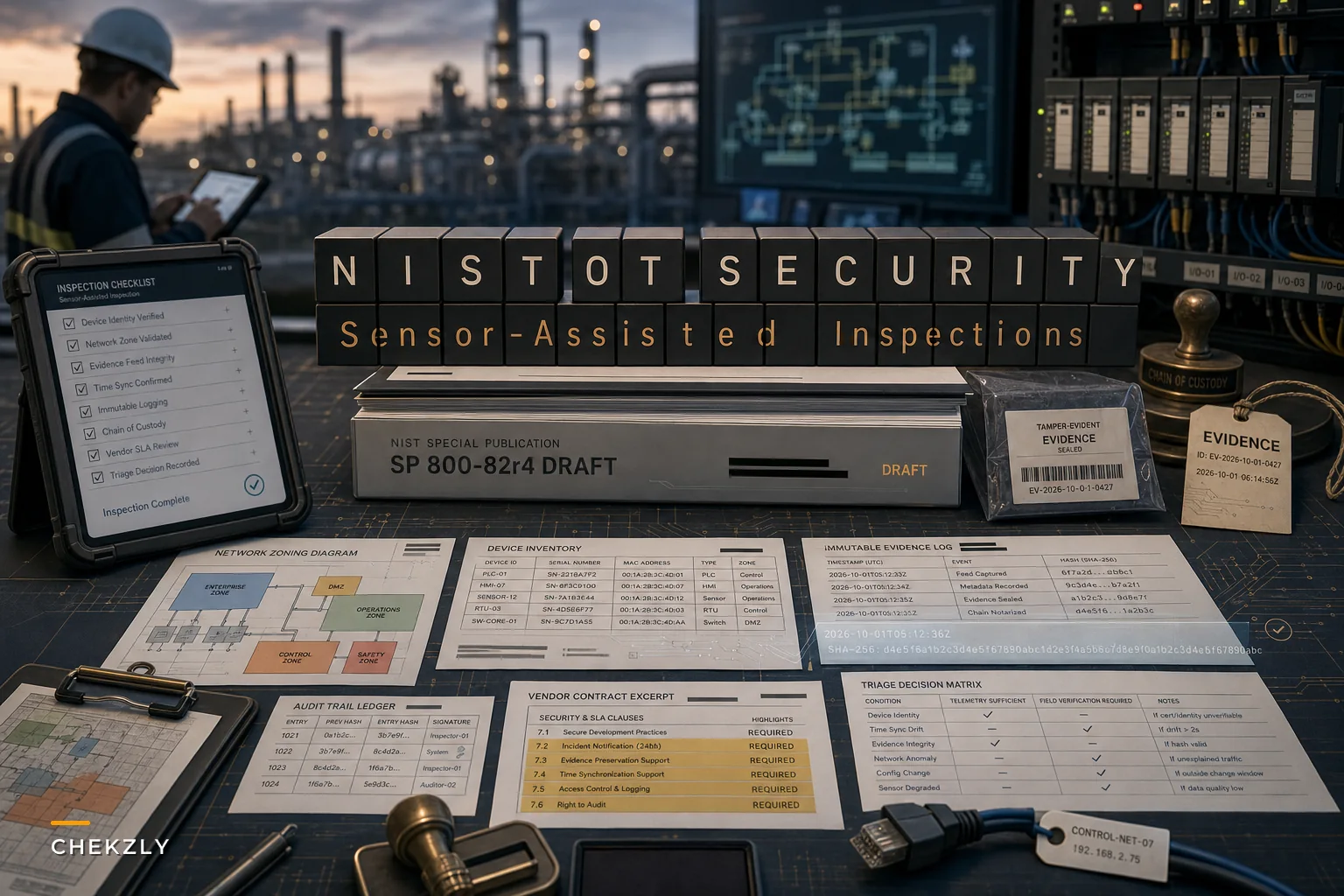

NIST dropped the initial public draft of SP 800‑82r4, its Guide to Operational Technology (OT) Security, on September 21, 2026. The draft announcement on the NIST CSRC site frames it as a refresh aligning OT protections with CSF 2.0 and zero-trust thinking, with a comment window running through November 30. If you run an inspection program, the comment deadline matters less than what the document signals: the sensors, controllers, and telemetry feeds you've folded into inspections are now squarely inside the security conversation — and so is the evidence they produce.
Most inspection managers treat the sensor side as an IT or facilities problem. It isn't anymore. The moment a vibration sensor, a thermal camera feed, or a building automation reading becomes part of your inspection record, that data's integrity becomes your audit problem. This isn't a summary of the draft. It's about what the shift exposes in how inspection programs handle sensor-sourced evidence, and what to actually do before an auditor or opposing counsel starts asking where a reading came from and who could have touched it.
The gap the draft quietly points at
Inspection programs spent the last few years getting good at collecting sensor data and pretty bad at defending it.
Think about the typical path a telemetry reading takes. A sensor on a pump sends a value over a network to a historian or gateway. That value gets pulled into a dashboard. Someone references it in an inspection report. The report gets signed off. Clean, fast, efficient.
-
Who had write access to that historian between the reading and the report?
-
Can you prove the timestamp on that reading wasn't adjusted?
-
Was the device authenticated, or could any node on that network have spoofed it?
For a lot of programs, the honest answers are "not sure," "no," and "probably not." That's the gap. The OT draft's push toward segmentation, stronger device authentication, and zero-trust assumptions is essentially a push toward answering those three questions cleanly. The security framing is new. The evidentiary weakness it exposes has been sitting in programs for a while.
Why "the sensor said so" stopped being good enough
There's a real difference between data that's useful for operations and data that's defensible as evidence. Programs blur these constantly.
Eliminate inspection delays and errors.
Chekzly helps you plan, execute, and document inspections efficiently and accurately.
- Real-time inspection tracking
- Automated report generation
- Compliance and checklist management
No credit card required
A reading that tells you something is drifting is operationally useful even if it's a little noisy — you send someone to look. But the same reading, cited in a compliance record as proof a condition was within tolerance at a specific time, carries a different burden. It has to be attributable, tamper-evident, and traceable back to a known device through a path you can actually describe.
What turns up across a lot of programs is that this distinction never gets written down. The same number gets used for both purposes, and nobody notices until the evidentiary use case gets challenged. The OT draft is a decent forcing function to separate these two roles deliberately — to decide, per data source, whether telemetry is a trigger for verification or a substitute for it.
That decision point is where most of the real work lives. It connects directly to the triage logic you should already have for sensor-assisted inspections and the integration patterns behind them — because the question of "when do we trust the sensor vs. send a human" is the same muscle, now under a security lens.
Telemetry as trigger vs. telemetry as evidence
Getting this wrong is where audits unravel.
| Dimension | Telemetry as a trigger | Telemetry as evidence |
|---|---|---|
| Purpose | Flags something worth checking | Stands in as proof of a condition |
| Integrity bar | Low — noise is tolerable | High — must be tamper-evident |
| Authentication need | Nice to have | Mandatory, device-level |
| Logging requirement | Basic event log | Immutable, time-synced, access-controlled |
| What happens if it's wrong | You send someone, no harm | Audit finding or inadmissible record |
| Verification follow-up | Always | Depends on your documented rule |
The mistake isn't using sensors. The mistake is letting a data source quietly migrate from the left column to the right column without upgrading its controls. A reading that was fine as a dispatch trigger shows up six months later as the sole proof of a condition in a formal record. Nobody signed off on that promotion. It just happened because it was convenient.
Your job is to make that promotion a deliberate, documented decision — and to know which sources are actually allowed to carry evidentiary weight.
A practical hardening sequence
You don't need to overhaul everything during a comment period. You need to know which sensor feeds touch your evidence chain and fix those first.
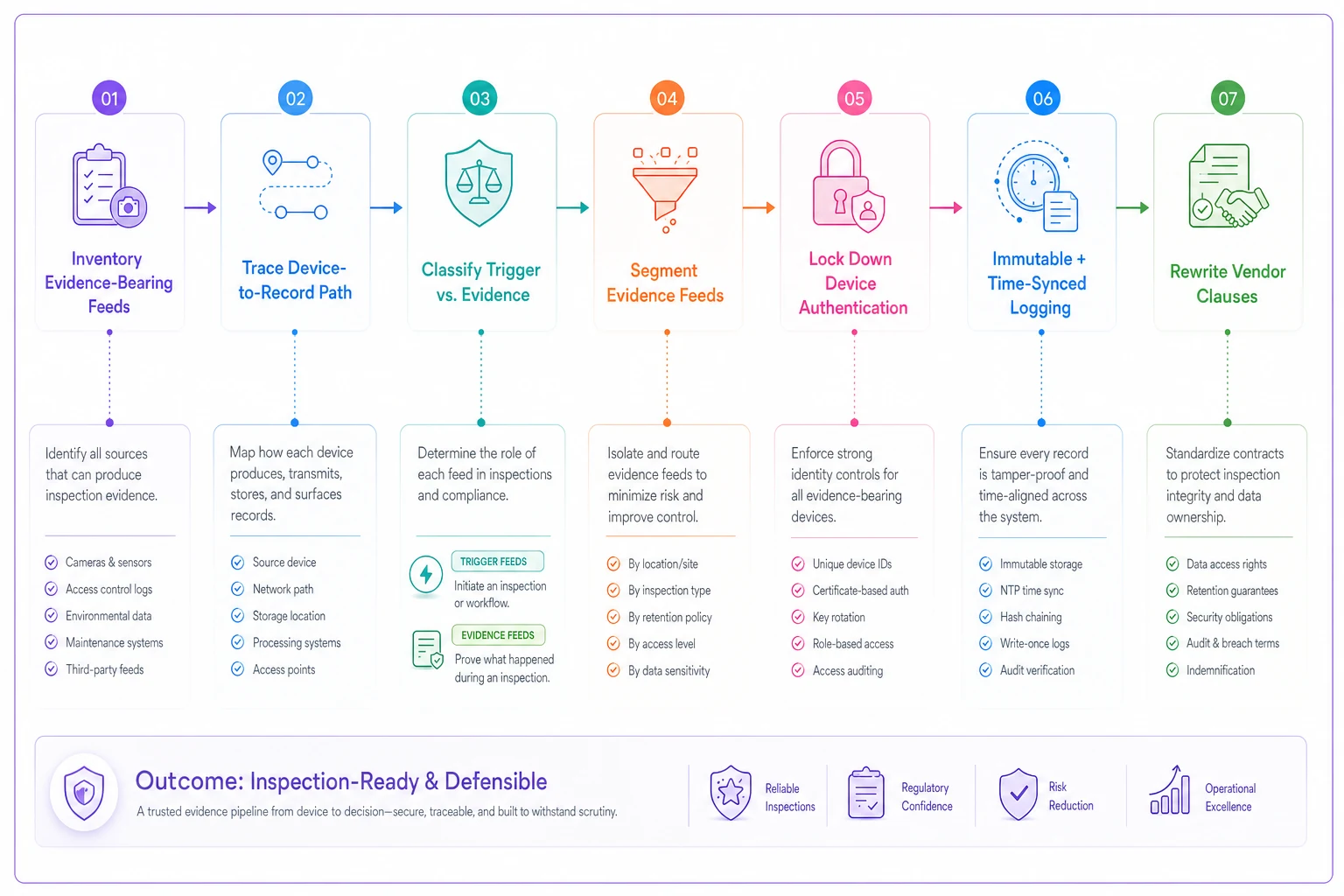
Here's a sequence that holds up:
-
Inventory your evidence-bearing feeds. Not every sensor. Just the ones whose output ends up cited in a record, a sign-off, or a regulatory submission. This list is almost always shorter than people expect — often somewhere around 15 to 30 feeds in a mid-size program, even when the total sensor count runs into the hundreds.
-
Trace the path for each one. From device to the moment a human references it. Write down every system it passes through and who has write access at each hop. The scary ones are feeds with four or five hops and shared service accounts along the way.
-
Classify trigger vs. evidence. Using the table logic above. If a feed is doing evidentiary work, flag it for the higher control bar.
-
Segment the evidence feeds. The OT draft leans hard on network segmentation for a reason. Evidence-bearing sensors shouldn't share a flat network with general building automation or guest-accessible systems. You don't need perfection — you need the evidence path isolated enough that you can describe who could reach it.
-
Lock down device authentication. If any network node can impersonate the device, the reading is spoofable, and a spoofable reading isn't evidence. Device-level identity is what lets you say "this came from that sensor."
-
Make the logging immutable and time-synced. Access logs and reading logs that can be edited aren't logs — they're suggestions. Write-once storage and a trusted time source turn a reading into something you can stand behind.
-
Rewrite the vendor clauses. More on this below. It's the step programs skip and regret.
The sequence matters. Programs that try to fix authentication before they've even identified which feeds carry evidentiary weight end up hardening the wrong things and still failing when a specific reading gets challenged.
Start with the feeds most frequently cited in reports — fixing those first gives the fastest reduction in evidentiary risk.
The sequence matters. Programs that try to fix authentication before they've even identified which feeds carry evidentiary weight end up hardening the wrong things and still failing when a specific reading gets challenged.
The vendor problem nobody wants to reopen
Most sensor feeds don't come from hardware you fully control. They come through integrators, building management vendors, or the device manufacturer's cloud. And contracts signed two or three years ago almost never contemplated evidentiary use.
A typical example: a facilities contract specifies 99.5% uptime for the sensor platform and nothing about data integrity, log retention, or breach notification windows for the telemetry itself. Uptime guarantees the data exists. It says nothing about whether the data can be trusted or whether you'll be told if it was tampered with.
-
Immutable log access — you can pull tamper-evident access and change logs for your evidence feeds on demand, not just a summary report.
-
Integrity breach notification with a defined window, separate from a general uptime SLA.
-
Device authentication guarantees — the vendor attests how devices are identified and what prevents spoofing.
-
Data custody terms — who can touch readings in transit and at rest, and whether anyone downstream can modify them.
-
Audit cooperation clauses — the vendor will support a reconstruction if a specific reading gets challenged.
Reopening vendor contracts is nobody's favorite task. But a comment period on federal OT guidance is exactly the kind of external event that gives procurement cover to ask for better terms at renewal.
A real scenario
A regional environmental compliance firm — the kind that does periodic emissions and discharge inspections across a few dozen industrial sites — had been leaning on continuous telemetry to cut site visits. Smart move on paper. They'd reduced routine visits by roughly a third and were feeling good about the efficiency.
Then a contested reading surfaced during a regulatory review. A discharge value cited in a formal report came from a flow sensor routed through a shared building network, logged in a historian that three vendor service accounts could write to, with no device-level authentication. They couldn't prove the reading hadn't been altered. They couldn't even cleanly show which physical device produced it, because two sensors on that site had been swapped during maintenance and the mapping records were loose.
The reading probably was accurate. That wasn't the point. They couldn't defend it, so it got thrown out — and the review widened to question other telemetry-sourced records from the same period. Remediation ran them a few months and a mid-five-figure spend.
The part that stung: almost all of it could've been handled quietly ahead of time. The efficiency gain from cutting site visits was real. They'd just never upgraded the evidence controls to match the weight they were putting on the data.
When leaning on telemetry actually makes sense
It makes sense when: the feed is authenticated at the device level, the path is segmented and logged immutably, you've documented the trigger-vs-evidence role, and you have a verification rule for cases where it matters. Under those conditions, telemetry carrying evidentiary weight is defensible and efficient.
It's a bad idea when: the feed rides a flat shared network, the logs are editable, device identity is assumed rather than enforced, or the vendor contract has no integrity terms. In that state, every record citing that feed is a latent audit finding.
Who should not do this yet: programs that can't produce a device-to-record mapping on demand. If you can't say with confidence which physical sensor produced a given reading, you're not ready to let that reading substitute for human verification — no matter how clean the dashboard looks.
Quick readiness checklist
Run through this before the comment period closes. If you can't check most of these, you know where your next quarter goes.
-
[ ] You have a list of every sensor feed that touches an evidence record
-
[ ] Each evidence feed has a documented path from device to record
-
[ ] Every evidence feed is classified as trigger or evidence
-
[ ] Evidence-bearing feeds are network-segmented from general systems
-
[ ] Devices producing evidence readings authenticate at the device level
-
[ ] Access and reading logs for evidence feeds are immutable and time-synced
-
[ ] Device-to-record mapping survives maintenance swaps and replacements
-
[ ] Vendor contracts include integrity, log access, and breach-notification terms
-
[ ] You have a written verification rule for when telemetry substitutes for a human check
-
[ ] You can reconstruct who could have touched a given reading, and when
Most programs fail four or five of these on the first pass. That's not a disaster — it's a prioritization list.
Where this leaves inspection managers
You can read the full SP 800‑82r4 initial public draft and submit comments before November 30 if you want to weigh in. But whether or not you do, the direction is set. Expectations for securing OT environments and the sensors feeding inspection programs are tightening, and the gap between collecting sensor data and defending it is going to get harder to ignore.
The programs that handle this well won't be the ones with the most sensors or the fanciest dashboards. They'll be the ones that drew a clear line between telemetry that triggers a look and telemetry that proves a fact — and built the authentication, segmentation, and immutable logging to back the second category. That line is cheap to draw now and expensive to draw during an audit.
The programs that handle this well won't be the ones with the most sensors or the fanciest dashboards. They'll be the ones that drew a clear line between telemetry that triggers a look and telemetry that proves a fact — and built the authentication, segmentation, and immutable logging to back the second category. That line is cheap to draw now and expensive to draw during an audit.
Ready to modernize your inspection process?
Join 500+ inspection teams using Chekzly to reduce paperwork, improve compliance, and accelerate reporting.