

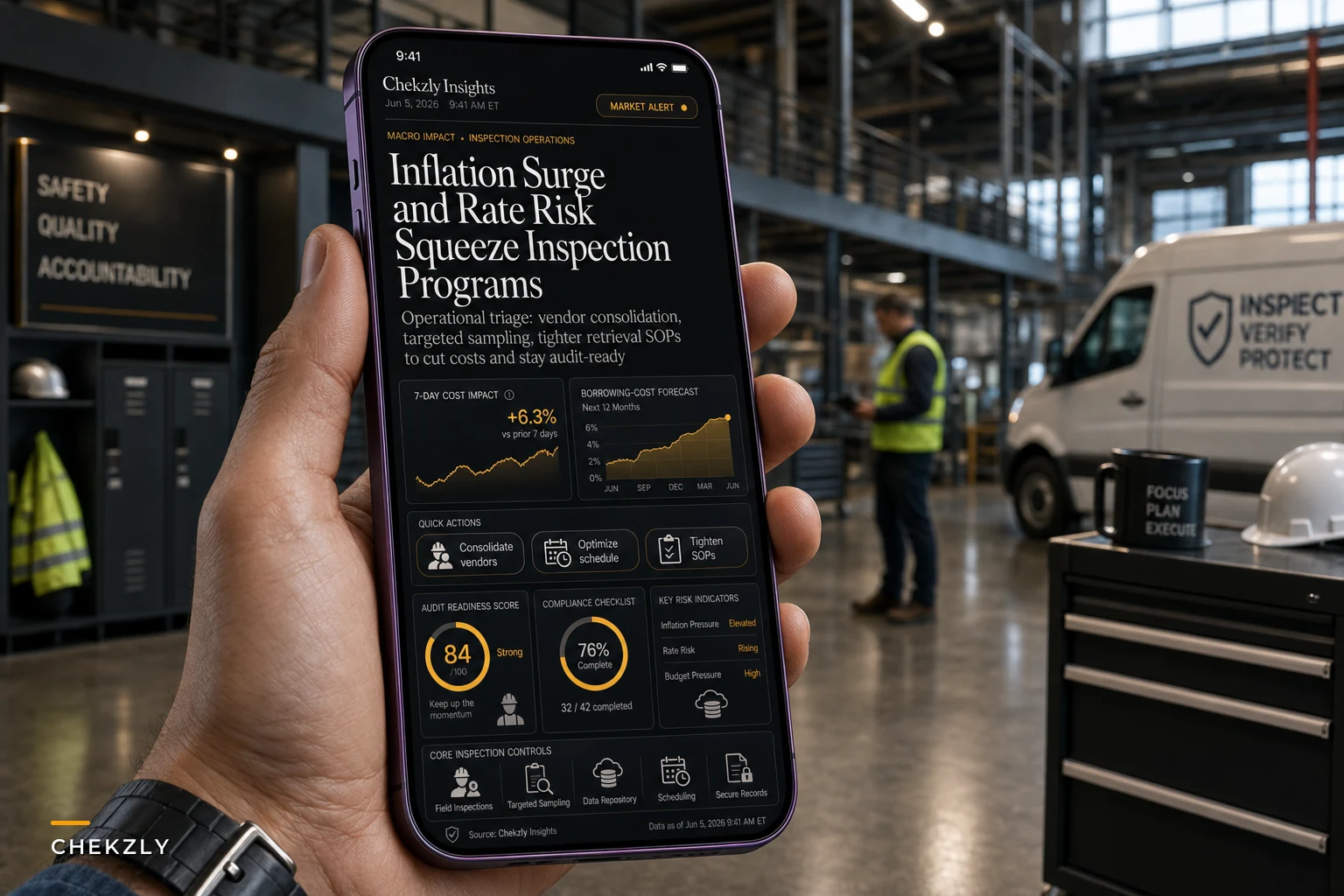

The latest economic data just landed like a rock in everyone's budget planning. According to the BEA's April release, PCE inflation jumped to 3.8% year-over-year, catching most economists off guard. Within 24 hours, Fed officials started floating the possibility of rate hikes again. Translation for inspection managers: that capital budget you were counting on just got harder to justify, and your CFO is about to start asking uncomfortable questions about operational costs.
Back in 2022, inspection teams got caught flat-footed when borrowing costs spiked. The smart ones survived by fundamentally rethinking their inspection program efficiency—not just trimming around the edges. The ones who waited for things to "normalize" ended up scrambling to explain compliance failures while operating with skeleton crews.
The Hidden Math Behind Your Inspection Budget Crisis
Most inspection managers look at their budget and see labor costs, equipment, and maybe software licenses. What they miss is the compound effect of inflation on their entire operational chain.
Your third-party inspection vendors are dealing with the same pressures. Their field techs want raises to keep up with inflation. Their vehicle costs are up 15-20% between insurance, fuel, and maintenance. They're passing these costs to you, but buried in "administrative fees" and "scheduling surcharges" that weren't there six months ago.
Your internal costs are climbing in ways that don't show up cleanly on expense reports. That inspector who quit last month? Replacing them now costs roughly 25% more than their predecessor made. The temporary staffing agency you rely on for surge capacity? They've quietly bumped their hourly rates by $4-6 per hour since January.
Inspection volumes aren't dropping. If anything, regulatory scrutiny tends to increase during economic uncertainty. Agencies know that companies under financial pressure might cut corners, so they ramp up enforcement. You're caught between shrinking resources and expanding requirements.
Why Traditional Cost-Cutting Makes Things Worse
The knee-jerk reaction is to slash wherever possible. Cut training budgets, delay equipment upgrades, push inspectors to cover more sites per day. A utilities inspection team I worked with tried this approach. They "saved" about $180k annually by stretching their inspection intervals and reducing quality reviews.
Eliminate inspection delays and errors.
Chekzly helps you plan, execute, and document inspections efficiently and accurately.
- Real-time inspection tracking
- Automated report generation
- Compliance and checklist management
No credit card required
Six months later, they got hit with a $2.3 million fine for missed inspections at critical infrastructure points. The investigation revealed systemic record-keeping failures that might have been caught with proper quality checks. The inspection manager lost their job, and the company ended up spending triple their "savings" on emergency remediation and legal fees.
You can't simply do less and hope nobody notices. But you also can't keep operating like money grows on trees.
Restructuring for Efficiency Without Sacrificing Coverage
Successful inspection managers approach this differently. Instead of cutting blindly, they restructure their programs around risk concentration and operational leverage.
Start with your inspection distribution. Most programs follow a rigid schedule—every site gets inspected at the same frequency regardless of risk profile. This wastes massive resources on low-risk locations while potentially under-serving high-risk sites. A manufacturing client restructured their 1,800-site inspection program around risk tiers:
Risk-Based Inspection Tiers:
| Risk Level | Sites | Previous Frequency | New Frequency | Inspector Hours Saved |
|---|---|---|---|---|
| Critical | 12% | Monthly | Bi-weekly | -156 hours |
| High | 23% | Monthly | Monthly | 0 hours |
| Medium | 41% | Monthly | Quarterly | 984 hours |
| Low | 24% | Monthly | Semi-annual | 691 hours |
Net result: 1,519 inspector hours freed up annually while actually increasing coverage on critical sites. The key was using historical incident data to properly categorize risk—not just guessing based on site size or revenue.
The economics work when you accept that not all inspections deliver equal value.
The Vendor Consolidation Opportunity Nobody Talks About
Most inspection programs accumulate vendors like barnacles on a ship hull. You've got one company handling environmental inspections, another for safety audits, a third for equipment certifications. Each vendor has their own scheduling system, reporting format, and billing structure. The administrative overhead alone probably costs you 10-15 hours per week.
During budget crunches, consolidation becomes powerful. Not just fewer vendors, but strategically selected partners who can handle multiple inspection types. The economics work because multi-service vendors can optimize route density—their inspector handles three different inspection types at your site in one visit instead of three separate trips.
But consolidation needs ironclad service level agreements. Specify turnaround times, report formats, corrective action procedures. Without these, you'll save money but lose control over your inspection quality.
A food processing company reduced their inspection vendors from eleven to three. They saved roughly $280k annually just on administrative overhead and trip charges. More importantly, they gained a unified reporting system that made compliance audits significantly smoother.
Building Your Recession-Proof Inspection Framework
Companies that thrive during budget constraints treat inspection data as an operational asset, not just a compliance checkbox.
Think about the information flowing through your inspection program. Every inspection generates data about equipment condition, process adherence, safety practices, maintenance needs. Most organizations file these reports and forget them until an auditor asks.
Smart inspection managers mine this data for cost savings. They spot equipment degradation patterns before failures occur. They identify training gaps before incidents happen. They catch vendor performance issues before they become systemic problems.
A practical framework for extracting value from your existing inspection data:
Phase 1: Centralize Your Data (Weeks 1-4)
Pull all inspection reports into a single repository. Don't worry about fancy systems yet—even a well-organized shared drive beats having reports scattered across email inboxes and filing cabinets. Tag each report with basic metadata: location, inspector, date, inspection type, critical findings.
Phase 2: Pattern Recognition (Weeks 5-8)
Look for repeat findings across sites. If multiple locations show the same equipment issue, you've probably got a systemic problem that needs addressing at the procurement or maintenance level. One pattern we commonly see: facilities using the same problematic vendor or equipment model that consistently fails inspections.
Phase 3: Predictive Insights (Weeks 9-12)
Start tracking time-to-failure for critical findings. If a "minor equipment degradation" finding typically progresses to equipment failure within 60 days, you can justify preventive maintenance that costs far less than emergency repairs.
Phase 4: Operational Integration (Ongoing)
Feed insights back into operations. When inspection data shows that Location A always has issues after shift changes, you can address the root cause instead of just documenting the same problem monthly.
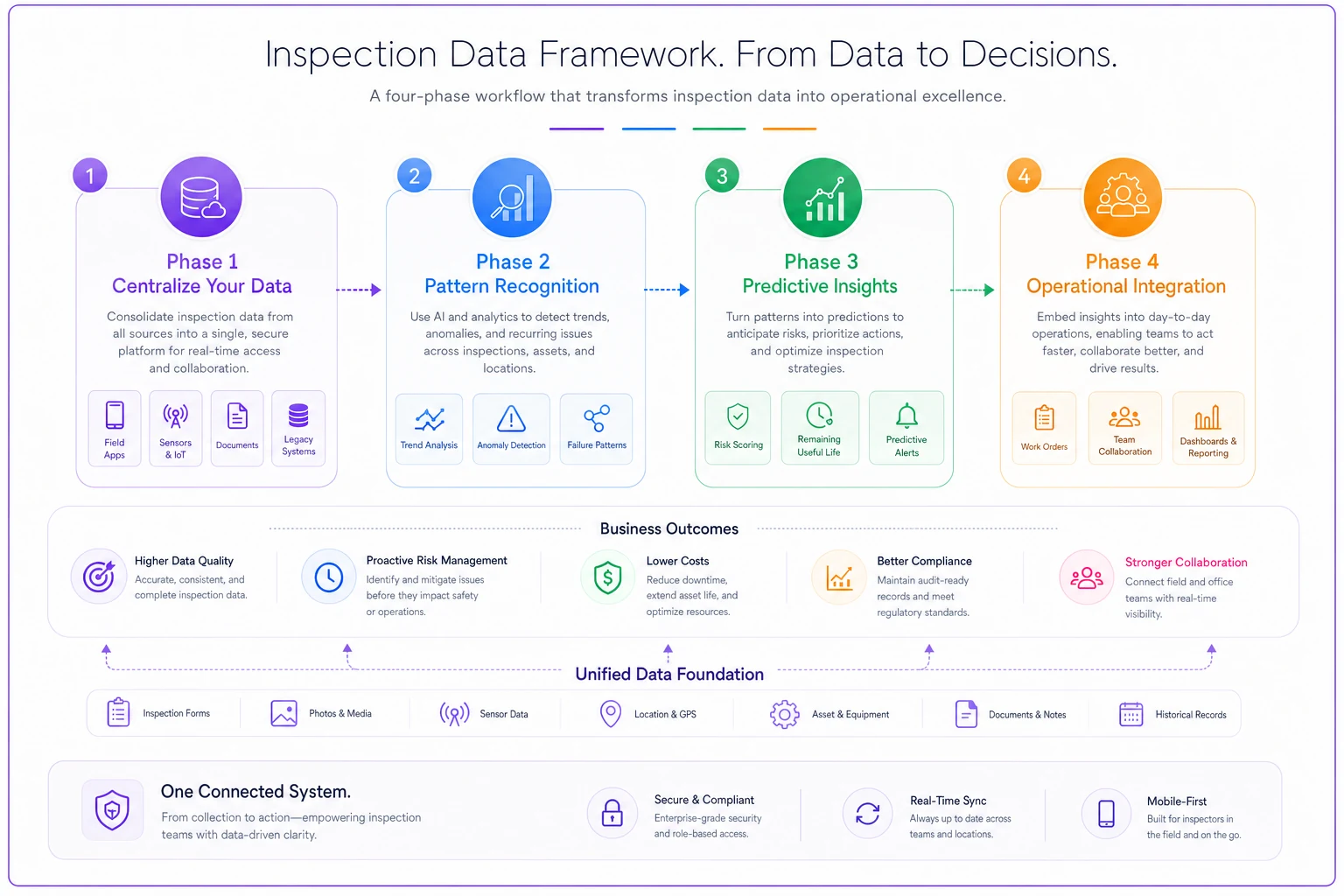
This visual summarizes the four-phase workflow and how insights flow from reports into operations.
This framework works because it builds on existing data rather than requiring new investments.
The Technology Question: When Automation Actually Saves Money
Every software vendor right now is pushing AI and automation as the solution to budget constraints. Most of it is noise, but there are specific areas where technology genuinely improves inspection program efficiency.
The biggest wins come from eliminating repetitive administrative work. If your inspectors spend 20-30% of their time on scheduling, report formatting, and data entry, that's pure waste. Modern inspection platforms can automate most of this, but only if you've already standardized your processes.
Route optimization is another legitimate use case. When you're running multi-site inspections, optimal routing can reduce drive time by 15-25%. For a team covering 50+ sites weekly, that translates to real labor savings and reduced vehicle costs.
But beware of over-automation. Companies implement elaborate AI systems for inspection scheduling, only to realize their inspection requirements are too dynamic for rigid automation. They end up spending more time overriding the system than they save from automation.
The sweet spot is typically partial automation—let technology handle the routine stuff while humans manage exceptions and complex decisions. This approach typically reduces administrative burden by 40-60% without sacrificing flexibility.
Standardize processes before automating to avoid creating more manual work.
Modern AI-powered operational software excels at pattern recognition across large datasets, but struggles with the nuanced judgment calls that experienced inspectors make daily.
Making Your Case to Leadership
When budgets tighten, every department fights for resources. Inspection programs often lose because managers can't articulate value beyond "we need this for compliance." That's not compelling when revenue-generating departments are also asking for money.
Frame your inspection program as risk mitigation and cost avoidance. Calculate what similar companies have paid in fines for inspection failures. Document how your program prevents operational disruptions. Show how inspection data drives maintenance decisions that extend equipment life.
Inspection Program ROI Components:
-
Direct fine avoidance (use industry averages if you don't have internal data)
-
Reduced insurance premiums from strong safety records
-
Prevention of operational shutdowns
-
Extended equipment life through predictive maintenance
-
Reduced legal liability from documented compliance
A regional transportation company used this approach to actually increase their inspection budget during a hiring freeze. They showed that every dollar spent on inspections saved approximately $4.70 in avoided costs—hard to argue with that math.
The key is speaking in terms of financial impact rather than operational necessity.
The Staffing Reality Check
Fed officials are signaling that rate hikes might continue if inflation persists. For inspection teams, this means the hiring environment will stay challenging for the foreseeable future. You're competing for technical talent against industries that can pay more, and training new inspectors takes months.
The solution isn't to lower standards or overwork existing staff. Focus on retention and productivity instead. An experienced inspector operating at 85% capacity performs better than a burned-out inspector at 100% or a new hire at 60%.
Consider implementing staggered scheduling that gives inspectors predictable time off. One inspection team reduced turnover from 35% to 12% annually just by guaranteeing no weekend work on a rotating basis. The scheduling complexity was worth keeping experienced inspectors.
Cross-training becomes critical too. When every inspector can handle multiple inspection types, you gain tremendous scheduling flexibility. This doesn't mean everyone becomes an expert at everything, but basic competency across domains prevents single points of failure.
The math is simple: replacing an inspector costs roughly 6-8 months of their salary when you factor in recruitment, training, and productivity ramp-up.
Quality Control Without Quality Control Budgets
Traditional quality programs involve dedicated QC inspectors reviewing a percentage of all inspections. When budgets shrink, QC often gets cut first—seems redundant to inspect the inspections, right?
This is dangerously short-sighted. Without quality checks, inspection drift occurs. Standards slowly decay, reports get sloppy, and critical issues slip through. By the time you notice, you've got systemic problems that take months to correct.
The alternative is distributed quality control. Build quality checks into your standard workflow instead of treating them as separate activities. Require photo documentation for critical checkpoints. Implement peer review rotations where inspectors check each other's reports. Use exception reporting to flag unusual findings for review.
A chemical plant inspection team maintained quality during a 30% budget reduction by implementing "buddy audits"—inspectors reviewed each other's reports on a rotating basis. This caught errors while building team knowledge through exposure to different inspection styles.
The approach works because it distributes the quality burden instead of eliminating it entirely.
Planning for Extended Pressure
Budget constraints rarely resolve quickly. If inflation stays elevated and rates keep rising, we could see 18-24 months of financial pressure. Your inspection program needs to be sustainable at reduced resource levels, not just temporarily patched.
This means making structural changes now rather than hoping for conditions to improve. Renegotiate vendor contracts with longer terms in exchange for better rates. Invest in training that increases inspector productivity. Standardize processes to reduce complexity.
Document everything. When budgets eventually recover, you'll need to show what was cut and why restoration is necessary. Without this documentation, temporary cuts become permanent, and your program slowly degrades.
Most companies make the mistake of treating budget constraints as temporary inconveniences rather than opportunities to build more efficient operations.
The Path Forward
Rising costs and budget pressure expose weaknesses in inspection programs that have been hidden during good times. The organizations that adapt quickly—restructuring around risk, consolidating vendors, leveraging data, and improving efficiency—will emerge stronger.
Those still trying to operate 2019-style inspection programs with 2026 budgets will find themselves explaining failures to regulators and executives. The choice is pretty clear, even if the execution is challenging.
The inspection managers who succeed in this environment aren't the ones who cut the most or spend the least. They're the ones who fundamentally rethink how inspection programs create value, then restructure operations to deliver that value more efficiently.
For teams looking to scale their inspection operations while managing tighter budgets, our guide on operational blueprints for multi-site teams walks through specific frameworks for maintaining quality across distributed locations without proportionally scaling costs.
The economic headwinds are real, but they're also forcing long-overdue operational improvements in inspection programs. The teams that embrace this transformation will find themselves not just surviving the budget crunch, but building more resilient, efficient operations for the long term. The alternative—hoping things get better while doing nothing different—is a recipe for compliance failures and career-limiting events.
The economic headwinds are real, but they're also forcing long-overdue operational improvements in inspection programs. The teams that embrace this transformation will find themselves not just surviving the budget crunch, but building more resilient, efficient operations for the long term. The alternative—hoping things get better while doing nothing different—is a recipe for compliance failures and career-limiting events.
Ready to modernize your inspection process?
Join 500+ inspection teams using Chekzly to reduce paperwork, improve compliance, and accelerate reporting.