


The August 2026 numbers landed hotter than most people expected. Nonfarm payrolls climbed by 162,000 with unemployment holding at 4.1%, according to CNBC's coverage of the BLS release. Good news for the economy. For anyone managing a roster of certified inspectors, it's more of a warning.
When the labor market runs warm, the people you rely on start getting recruited harder. Your NDT techs, your API-certified inspectors, your electrical and structural people — they're exactly who competing firms and contractors are scrambling to lock down. A tighter market doesn't just push wages up. It means faster turnover, longer gaps on open shifts, and contractors quoting rates that make your quarterly budget look optimistic.
So skip the macro commentary. What actually changes for your operation this quarter, and what should you do about it?
What the tight market actually breaks in an inspection program
The obvious pain is hiring. The less obvious — and more expensive — pain is what happens to coverage when you can't hire fast enough.
The pattern is pretty consistent. You lose one certified inspector to a competitor offering $8k–$12k more annually. The opening sits unfilled for six to ten weeks because the certification pool in your region is thin. Your remaining inspectors absorb the extra load — overtime, rushed jobs, a slow creep of missed inspection windows. Then a second person, already burned out, starts taking recruiter calls.
The compliance risk hides inside that chain. When a certified inspector leaves and you backfill with a contractor or a less-experienced hire, you're not just filling a headcount slot. You're potentially putting someone in front of an audit-relevant inspection who hasn't been signed off on your competency standards. That's how findings happen.
A tight labor market exposes a weakness most programs already had: they treat inspector capacity as a fixed resource instead of something they actively manage. When there's slack in the market, you can paper over gaps by hiring quickly. When there isn't, every structural weakness in your onboarding, cross-training, and scheduling gets loud.
The six moves worth making this quarter
Not all of these apply to every program. Pick based on where your bottleneck actually is.
Eliminate inspection delays and errors.
Chekzly helps you plan, execute, and document inspections efficiently and accurately.
- Real-time inspection tracking
- Automated report generation
- Compliance and checklist management
No credit card required
1. Shorten your time-to-productive, not just time-to-hire
Most managers focus on filling the seat. The bigger lever is how long it takes a new hire to work independently on audit-relevant inspections. If that ramp is 90 days, you're carrying dead weight through a period where you can least afford it.
The way to compress this is a competency-based onboarding path — new hires get cleared for specific inspection types in stages rather than waiting for a blanket sign-off. Someone might be cleared for routine visual inspections in week two while still shadowing on the more complex certification-bound work. This is exactly the kind of staged, evidence-backed ramp we broke down in our guide on turning new hires into audit-ready inspectors, and it matters far more when replacements are scarce.
The mistake most programs make: treating onboarding as a documentation exercise instead of a scheduling asset. A well-structured ramp lets you deploy partial capacity early, which is worth quite a bit when full capacity is still weeks away.
2. Build a real cross-training matrix before you need it
Most teams "cross-train" informally — meaning someone knows a bit about someone else's route. That falls apart the moment a certified person walks.
A proper matrix maps every inspector against every inspection type and certification you run, and flags where you have single points of failure. When you can see that only one person on the team is qualified for a specific pressure-vessel inspection, you know exactly where the program is fragile.
| Inspection type | Primary qualified | Backup qualified | Single point of failure? |
|---|---|---|---|
| Routine visual / general | 6 inspectors | 4 | No |
| API-certified vessel | 2 inspectors | 0 | Yes — high risk |
| Advanced NDT (UT/RT) | 3 inspectors | 1 | Watch closely |
| Electrical compliance | 4 inspectors | 2 | No |
The row that should concern you is the one with a zero in the backup column. In a hot market, that's the certification a competitor can pull out from under you and leave you non-compliant for weeks. Cross-training a backup before you lose the primary is dramatically cheaper than emergency contractor rates after the fact.
Cross-train a backup before you lose the primary; it's dramatically cheaper than emergency contractor rates.
3. Renegotiate vendor and contractor agreements now, not mid-crisis
Contractor rates move fast when certified staff get scarce. If your third-party agreements don't address rate caps, surge pricing, or SLA guarantees, you'll find that out at the worst possible moment — usually when you're already short-staffed and don't have leverage.
Lock in the things that protect you:
-
Rate ceilings or capped escalation clauses for the contract term
-
Guaranteed response windows so a busy contractor can't quietly deprioritize your work
-
Certification verification requirements written into the agreement, not assumed
-
Right to audit contractor credentials on demand
Programs that skip this tend to sign a clean-looking master agreement during a soft market, then absorb 30–40% rate increases when things tighten because nothing in the contract prevented it.
4. Tighten scheduling before you add headcount
A surprising amount of "we need more inspectors" is actually "our scheduling wastes the inspectors we have." When the market's tight, squeezing more usable hours out of your existing team is often faster and cheaper than hiring.
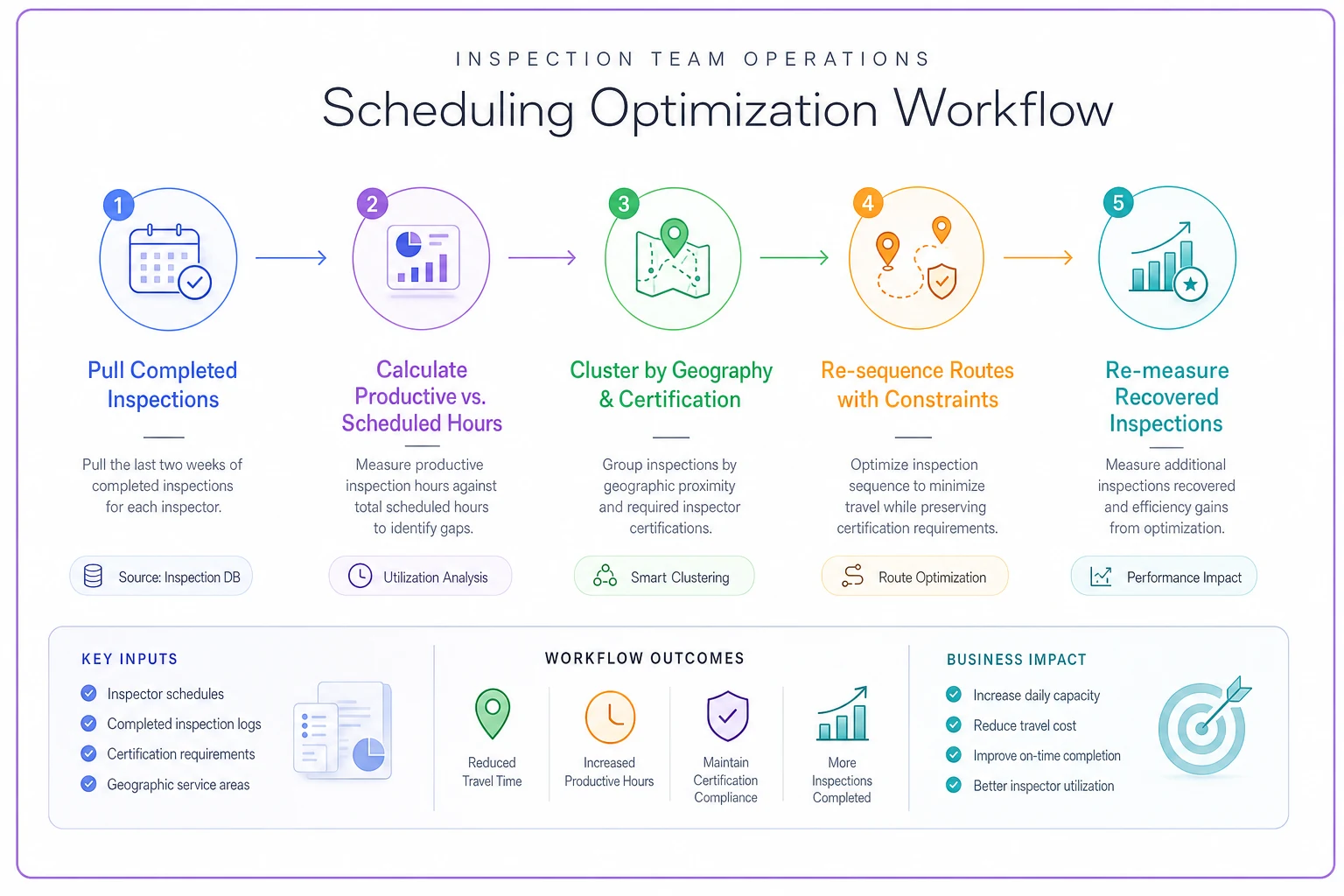
Look hard at travel time, route batching, and how many inspections a person actually completes versus their theoretical capacity. If inspectors are spending a third of the day driving between poorly sequenced sites, fixing that is roughly equivalent to adding partial headcount without the hiring cost.
-
Pull two weeks of actual completed inspections per inspector, including travel and admin time.
-
Calculate real productive hours versus scheduled hours — the gap is your hidden capacity.
-
Cluster inspections by geography and required certification so people aren't crisscrossing regions.
-
Re-sequence routes to cut dead travel, keeping certification match as the hard constraint.
-
Re-measure after two weeks and see how many additional inspections you recovered.
Even a modest recovery — two to three extra inspections per inspector per week — adds up fast across a team and buys breathing room on hiring pressure.
A visual of the scheduling workflow can make it easier to coordinate the steps on the operations side.
5. Treat retention as a scheduling and workload problem, not just a pay problem
Wage pressure is real, and sometimes you have to meet the market. But a lot of turnover in tight markets isn't purely about money — it's the burnout that comes from being short-staffed. People leave overloaded teams for teams that look more stable, even at similar pay.
The operational move: watch overtime concentration. When the same two or three people are eating all the overtime because they hold the rare certifications, they're your highest flight risk and your hardest to replace. Spread the load, invest in the cross-training from move two, and you reduce the burnout that tends to drive the next departure.
6. Centralize your credential and competency records so nothing slips
This sounds administrative until it isn't. When you're hiring fast, onboarding partial-capacity inspectors, and leaning on contractors, the risk of someone performing an inspection outside their current certification climbs quickly. Expired certs, lapsed re-certifications, someone signed off on the wrong inspection type — these are exactly the findings auditors look for.
In a stable market you might catch these manually. In a churny one, you probably won't. AI-assisted operational software that tracks certifications, expiry dates, and competency sign-offs earns its keep here — not as a shiny feature, but as a guardrail. Automated flags on upcoming expirations and hard blocks on assigning inspectors to work they aren't cleared for removes a whole category of human error during the exact period when human error spikes.
Manual credential tracking breaks under hiring pressure. And a broken credential system is an audit finding waiting to happen.
A real scenario: a mid-size multi-site inspection team
Consider a regional inspection firm running roughly 40 inspectors across four sites. Heading into a tight quarter, they lost two API-certified inspectors within about six weeks — both to competitors offering meaningfully higher pay.
Their exposure before making any changes looked rough: certification-bound inspections in one region depended on a single remaining qualified person. Contractor quotes to cover the gap came in around 35% above their normal blended rate. Time-to-fill for a certified replacement was tracking past eight weeks.
What they actually did wasn't dramatic. They pulled a cross-training matrix and identified two mid-level inspectors close to qualifying for the vessel work, then fast-tracked their competency sign-off using a staged onboarding path. They re-sequenced routes at the two busiest sites and recovered somewhere around 10–12 inspection slots per week across the team. And they renegotiated their contractor agreement to cap surge pricing before signing additional coverage.
The result over the following quarter wasn't a miracle — it was stability. They avoided the worst of the contractor premium, kept their inspection windows intact, and stopped the burnout spiral that had put two more people at flight risk. No single move fixed it. The combination held coverage together while they hired at a reasonable pace.
When these moves make sense — and when they don't
Cross-training and credential centralization make sense for almost everyone in this market. There's very little downside to knowing where your single points of failure are and preventing out-of-certification assignments.
Aggressive schedule re-sequencing makes sense if travel and route inefficiency are real — but if your inspectors are already tightly routed, you'll spend effort for little gain. Measure first.
Renegotiating vendor contracts mid-term isn't always possible, and pushing too hard can sour a relationship you'll need. Time it around renewal windows where you actually have leverage.
Very small teams — two or three inspectors — can probably skip the formal competency matrix. That's overkill at that scale. The priority there is simply making sure your credential tracking is clean and your one contractor relationship is solid.
Bottom line
A stronger jobs report isn't just an economic headline — the BLS employment data reflects real pressure that lands directly on anyone trying to keep certified inspectors staffed and compliant. The programs that weather this well won't be the ones that outbid everyone on salary. They'll be the ones managing capacity deliberately: staged onboarding that produces usable inspectors faster, cross-training that eliminates single points of failure, tight scheduling that recovers hidden hours, and credential tracking that doesn't crack under hiring pressure.
The tight market didn't create these weaknesses. It just made them expensive.
Ready to modernize your inspection process?
Join 500+ inspection teams using Chekzly to reduce paperwork, improve compliance, and accelerate reporting.