

Most inspection teams didn't plan to run virtual inspections. They inherited them. Travel budgets got cut, a site went into lockdown, a client pushed for faster turnaround, and suddenly someone's holding a phone up to a boiler while an inspector watches from three states away. The problem isn't that guided virtual inspections don't work—it's that teams treat every remote inspection the same way, then get surprised when one falls apart under scrutiny.
The failure almost never happens during the inspection itself. It happens six weeks later, when a claim gets disputed, an auditor pulls the file, or a regulator asks a simple question: how do you know the person on the other end showed you the actual asset? And the honest answer, buried in a folder of shaky video, is "we don't, really."
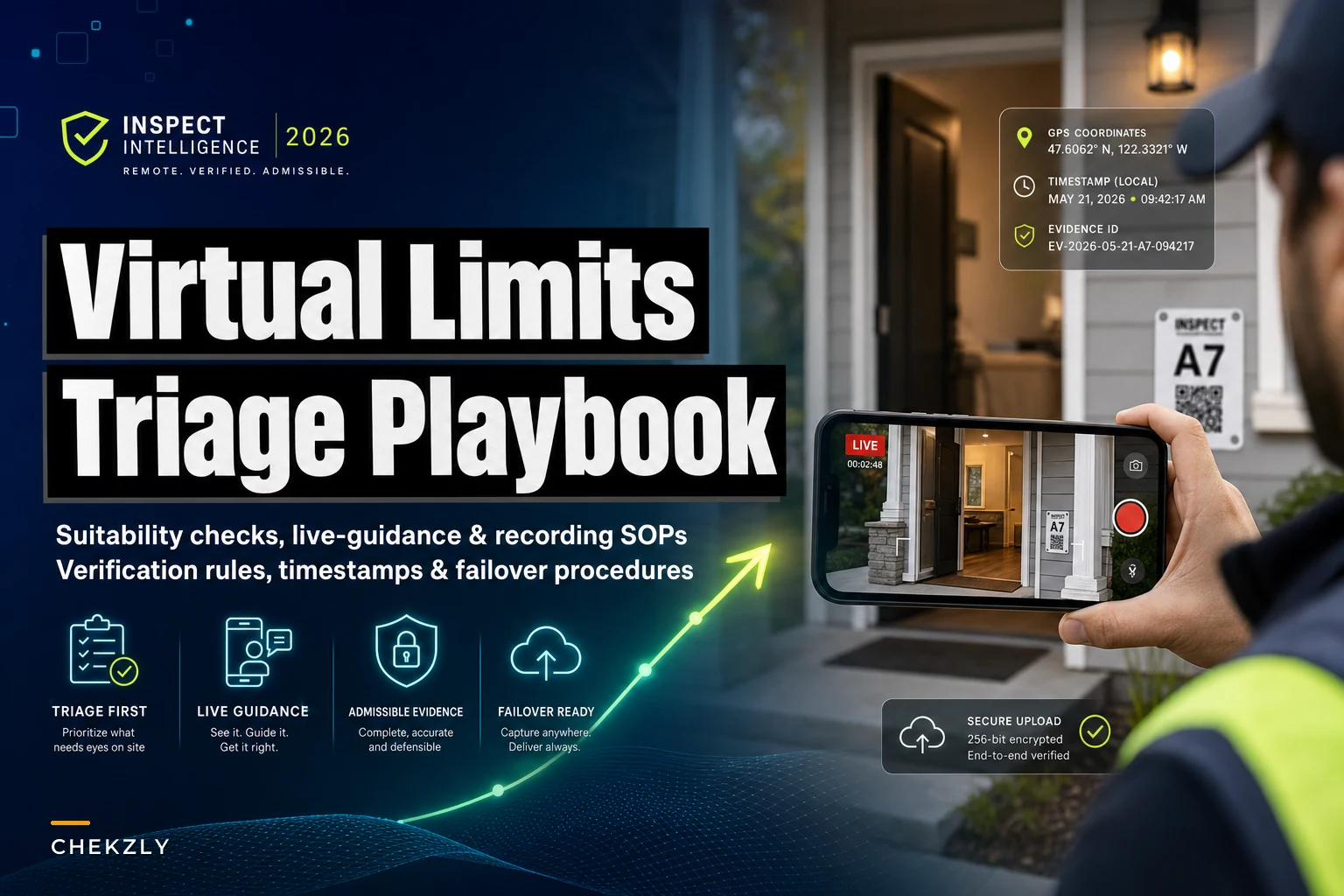
So this is a triage-first playbook. Not "how to do virtual inspections" in the abstract—that's too broad to be useful. This is about the decision layer: which jobs are safe to run remotely, how to guide them so the evidence holds, and what your fallback rules are when something goes sideways mid-call.
Start with triage, not scheduling
The mistake behind almost every downstream problem is treating remote suitability as a scheduling question instead of a risk question. Someone in ops looks at the calendar, sees an inspector is booked solid, and reroutes a job to remote because it's convenient. Nobody asks whether that specific inspection should be remote.
A suitability check has to happen before the appointment is even offered as virtual. And it's not one question—it's a short set of them that sort inspections into three buckets: clearly fine for remote, clearly not, and conditional (remote only if certain things are true on the day).
| Factor | Remote is defensible | Remote is risky | Remote should be refused |
|---|---|---|---|
| Consequence of a miss | Low—cosmetic, documentation, routine re-check | Moderate—could affect a claim | High—life safety, structural, regulated pass/fail |
| Asset accessibility | Fully visible, well-lit, reachable by camera | Partially obstructed | Requires physical test, torque check, or entry |
| Who's holding the camera | Trained staff or vetted contact | Unknown site contact | Nobody reliable on site |
| Verification of identity/location | Confirmable (badge, GPS, known contact) | Weak | None |
| Regulatory acceptance | Explicitly allowed for this inspection type | Grey area | Explicitly requires in-person |
The pattern that shows up repeatedly: teams handle the "clearly fine" bucket without issues, run into disasters on the "clearly not" bucket, and quietly bleed money on the conditional bucket because nobody ever defined what the conditions actually were. That middle bucket is where a playbook earns its keep.
When remote actually makes sense
Remote holds up well when the inspection is essentially observational and the consequence of error is contained. Re-inspections to confirm a previously documented fix. Routine condition checks on equipment you've physically inspected before. Documentation verification—serial numbers, labels, placarding. Progress checks where you're confirming a stage was reached, not certifying final integrity.
Eliminate inspection delays and errors.
Chekzly helps you plan, execute, and document inspections efficiently and accurately.
- Real-time inspection tracking
- Automated report generation
- Compliance and checklist management
No credit card required
Take a property maintenance company managing around 40 sites under a recurring contract. They moved their quarterly "confirm the last repair still holds" checks to guided virtual. These were assets already inspected in person during the initial survey. The consequence of a miss was low, the site had a maintenance lead who could hold a camera steadily, and there was a physical baseline to compare against. That's the sweet spot: comparing today against a known, documented past—not making a first-time judgment call from a phone screen.
When remote is a bad idea
Remote falls apart the moment the inspection requires a physical action the inspector can't perform or verify. You can't feel a wobble through a video feed. You can't confirm a moisture reading you didn't take. You can't verify a torque spec someone else claims they applied. And you can't always confirm you're even looking at the right asset at the right location.
-
The inspection is a regulated pass/fail that determines legal occupancy, operation, or certification
-
Life-safety systems are involved and your standard requires functional testing
-
There's no vetted person on site to operate the camera
-
Identity or location can't be independently confirmed
-
The client is specifically requesting remote because an in-person inspection previously failed
That last one is the quiet trap. When a site pushes hard for virtual right after a bad result, it's sometimes because remote makes it easier to control what the camera sees. That's not paranoia—it's a documented pattern in disputed inspections. It should raise your suitability bar, not lower it.
Live-guidance scripts: the part everyone skips
What separates a defensible guided virtual inspection from a folder of unusable clips is this: the inspector was actively directing the capture in real time, not passively watching whatever the site contact decided to show.
A live-guidance script isn't a formality read-out. It's a spoken sequence that establishes identity and location on the recording, forces continuous framing so there are no suspicious cuts, and narrates what's being verified so the audio track itself becomes part of the evidence.
-
Open on identity. Camera on the site contact's face, then their ID or badge, then a slow pan to a fixed location marker—a unit number, an address plate, a permanent sign. Inspector states date, time, site, and personnel out loud.
-
Establish continuity. Inspector asks the contact to keep recording running without stopping and restarting. "Walk from the door to the panel without cutting the video." Gaps in the timeline are the first thing a challenger points to.
-
Guide each capture point. For each item, the inspector names it, asks for a wide shot for context, then a close shot for detail. "Show me the whole unit, now move in on the model plate, hold it steady for five seconds."
-
Verify, don't assume. When something can't be confirmed visually, say so on the recording: "I cannot confirm the internal condition from this view—flagging for in-person follow-up." That one sentence protects you later.
-
Close on the same location marker. Pan back to the fixed marker before ending. The start and end are now anchored to the same physical place.
The audio narration is doing quiet legal work throughout. A silent video shows what the camera saw. A narrated video shows the inspector actively controlling and interpreting what was captured. When a file gets challenged, that difference matters a lot.
Recording and verification SOPs
Guiding the inspection well is wasted if the recording itself is weak. A lot of the same discipline from in-person capture carries straight over here. If you've already got standards for admissible photos and video—metadata, naming, and camera settings that survive audits, your remote SOP should inherit them, not reinvent them.
The additional layer remote demands is identity and location verification, because you weren't physically there. These should be non-negotiables in any remote SOP:
-
Record the full session, not just clips. The unedited continuous file is your defense against "you only showed the good parts."
-
Capture two independent location signals. A visible fixed marker on camera plus a device-level signal (GPS pin, timestamped location share). One can be faked; two together are much harder.
-
Log who held the camera and confirm identity on the recording. Not in a separate note—on the file itself.
-
Timestamp against a trusted source, not the phone clock. Phone clocks drift and can be manually changed. Anchor to a server-synced time.
-
Store the raw file before anyone touches it. Any annotation happens on copies. The original stays untouched with its metadata intact.
Require the on-camera identity and the fixed marker to be captured at both the start and end of the session to strengthen continuity.
The verification step people forget: cross-check the location signal against what you expected. If the GPS pin lands two miles from the site address, you found a problem before it became a dispute. Teams that skip this are essentially trusting that the person on the call is where they say they are—which is exactly the assumption a challenge will target.
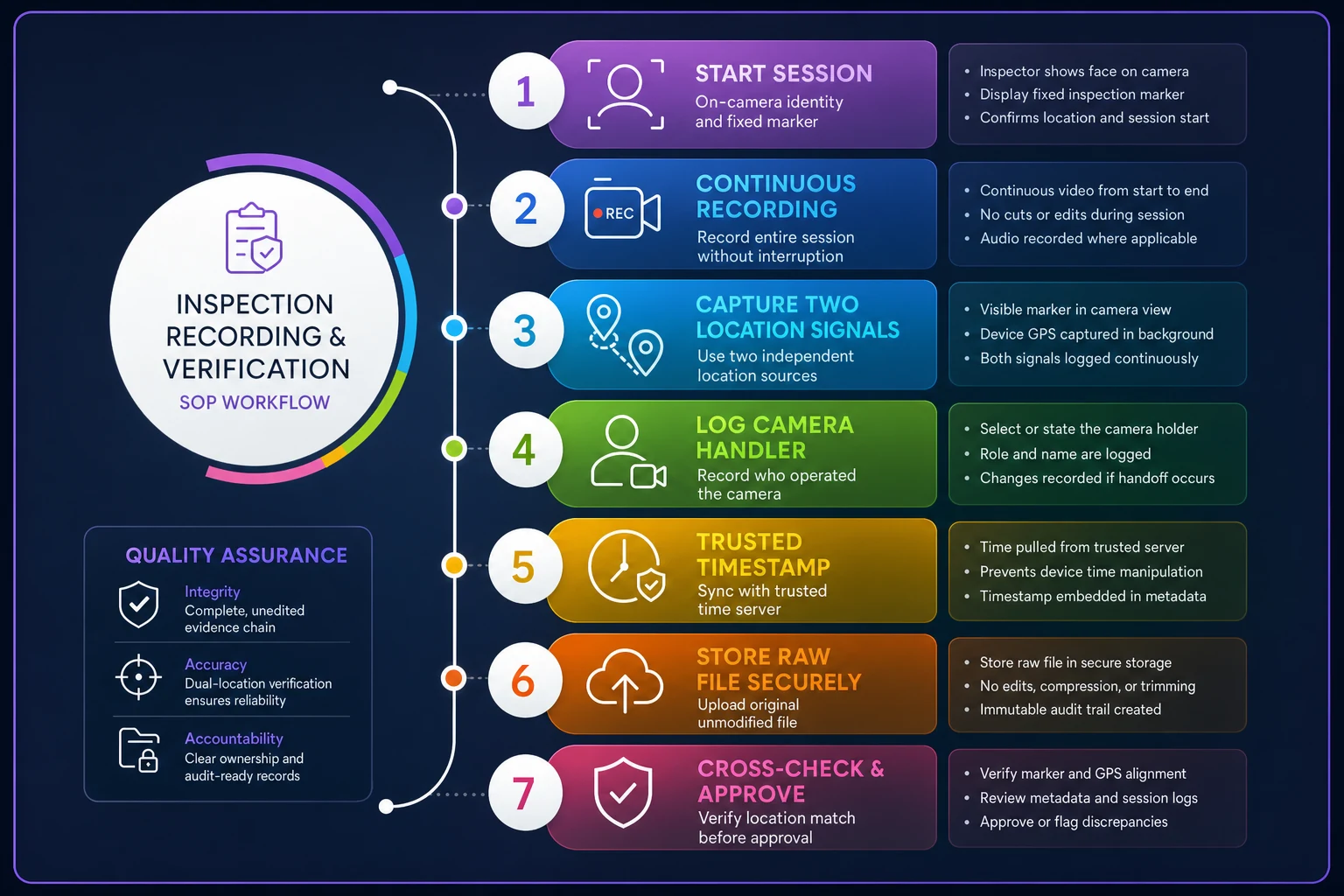
A quick visual of the verification workflow helps teams follow the steps consistently during a live call.
Failover rules: what happens when the call breaks
Most playbooks don't have this section. It's also the one that saves you. Something will go wrong mid-inspection—the connection drops, the lighting's unusable, the site contact can't reach the asset, or the inspector realizes the view is being managed. You need pre-decided rules so the field team isn't improvising a legal decision on the fly.
Failover rules should be explicit and, frankly, a little boring:
-
If the feed drops repeatedly or for too long, the session is voided, not resumed. Restarting creates a timeline gap you can't defend. Rebook.
-
If a required capture point can't be shown clearly, that point converts to a mandatory in-person follow-up. The remote inspection becomes partial, not complete, and the record reflects that.
-
If identity or location can't be confirmed, stop. Do not proceed and "sort it out later." An inspection you can't attach to a verified person and place is a liability, not a record.
-
If the inspector suspects the view is being controlled, flag and escalate. The continuous-framing requirement usually surfaces this—when someone keeps cutting away from something, that's your signal.
A partial, honestly-flagged remote inspection is far more valuable than a "complete" one built on gaps you papered over. Auditors and adjusters don't punish "we couldn't verify X remotely, so we followed up in person." They punish silent assumptions dressed up as findings.
A real scenario
A mid-sized commercial equipment inspection firm—roughly a dozen field inspectors, several hundred inspections a month—started pushing about a third of their routine re-inspections to guided virtual to cut windshield time. For the first quarter it looked like a win: travel costs dropped noticeably and throughput climbed.
Then a client disputed a re-inspection tied to a warranty claim. The file was a single stitched-together video with no identity confirmation, a phone timestamp, and a two-minute gap right where the disputed component should have been. There was no way to prove whose hand was holding the camera or that the footage matched the site. The firm ate the claim—a mid-four-figure hit—and, worse, the client demanded all their remote inspections be redone in person, wiping out most of the savings for that account.
What they changed wasn't the decision to go remote. It was the triage and evidence discipline. They built the three-bucket suitability check, so pass/fail and warranty-linked jobs stopped defaulting to virtual. They adopted the continuous-recording rule and the on-camera identity and location open-and-close. They added a failover rule that a dropped feed voids the session. Over the next couple of quarters, disputes on remote jobs dropped to near zero, and they kept most of the travel savings because they were running remote only on jobs that could actually hold up.
The lesson wasn't "remote is risky." It was "undisciplined remote is risky, and nobody had drawn the line."
The line to draw
Guided virtual inspections aren't a lesser version of in-person work, and they're not a universal replacement either. They're a specific tool with a specific safe operating range, and the whole game is knowing where that range ends. Triage decides whether you're inside it. Live guidance and recording SOPs make the evidence hold. Failover rules keep a bad day from becoming a bad file.
If your team is running remote inspections without a written suitability check and a failover rule, you're not actually doing guided virtual inspections—you're doing unguided ones and hoping nobody asks how you know what you claim to know. Write the rules down before a dispute forces you to.
If your team is running remote inspections without a written suitability check and a failover rule, you're not actually doing guided virtual inspections—you're doing unguided ones and hoping nobody asks how you know what you claim to know. Write the rules down before a dispute forces you to.
Ready to modernize your inspection process?
Join 500+ inspection teams using Chekzly to reduce paperwork, improve compliance, and accelerate reporting.