

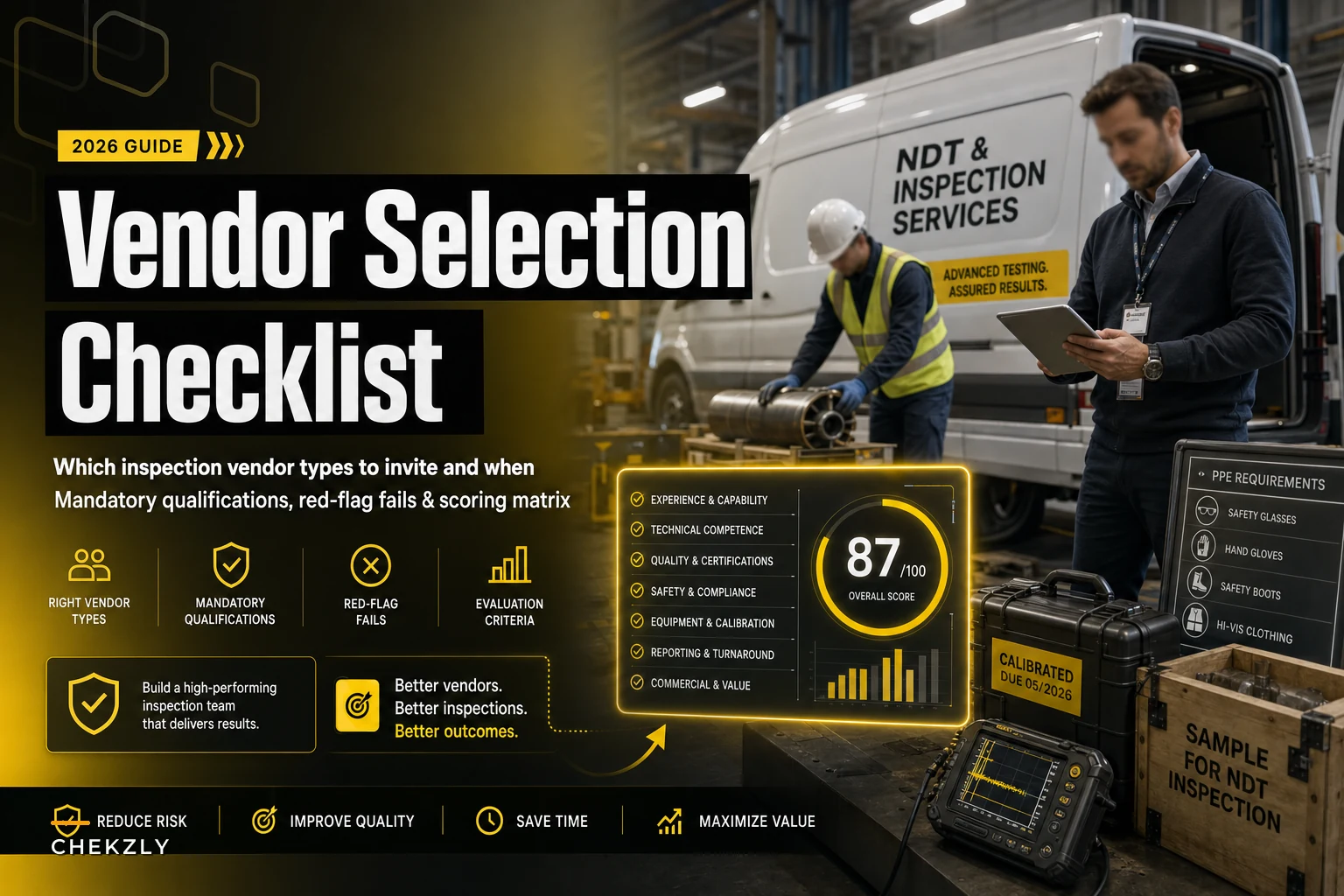

Most inspection RFPs go wrong before anyone reads a single bid. The invite list is wrong. Someone pulls up the vendor list from the last procurement cycle, adds two firms a colleague recommended, and sends out the pack. Three weeks later you're comparing a boutique NDT shop against a turnkey integrator against a university lab, and none of the bids line up because none of those vendors should have been in the same RFP to begin with.
This guide is only about that front end: which vendor categories exist, when each one actually fits, what you must demand before they're allowed to bid, and how to score them without getting fooled by a polished proposal. It deliberately skips contract clauses, acceptance QA mechanics, and SLA structures — those belong in the award and contracting stage, covered separately in the guide on buying inspection services without regret. Here, we stay firmly in the pre-award zone.
The six vendor categories, and why mixing them wrecks your evaluation
The single most common mistake is treating "inspection vendor" as one market. It isn't. There are roughly six distinct types, each built for a different job, priced differently, and carrying a different risk profile.
| Vendor type | Best suited for | Typical cost posture | Main risk to watch |
|---|---|---|---|
| Independent inspection firms | Routine third-party verification, regulatory sign-off, impartial witnessing | Mid-range, per-day or per-report | Thin specialist depth on exotic assets |
| Specialist NDT providers | Weld integrity, corrosion mapping, UT/RT/MT/PT, pressure equipment | Higher per-technician, method-specific | Scope creep; may lack broader reporting |
| OEM service teams | Proprietary equipment, warranty-linked inspections, firmware-dependent assets | Premium pricing, limited flexibility | Conflict of interest; can't be impartial on their own kit |
| Laboratory / testing houses | Material sampling, metallurgy, chemical analysis, destructive testing | Per-sample, turnaround-based | Field coordination gaps; not a site presence |
| Engineering consultancies | Fitness-for-service, root cause, design-review-linked inspection | Day-rate, senior-heavy | Expensive for volume; may subcontract the hands-on work |
| Turnkey integrators | Multi-site programs, bundled inspection + data + reporting | Program-level pricing | Opaque subcontracting; you lose visibility of who's actually inspecting |
The operational pattern that trips people up most often: a turnkey integrator and an independent firm can both technically "do" a pressure vessel inspection, but one is selling you a managed program and the other is selling you a competent inspector for the day. Score them on the same matrix with the same weights and the integrator wins on "capability breadth" every time — then you discover the actual field work is subcontracted to a two-person shop you never vetted.
The fix is upstream. Decide the vendor type you want before you write the RFP, and ideally run separate RFPs (or at least separate scoring tracks) when the work genuinely spans categories.
When to invite each type
Invite independent inspection firms when you need impartial verification that will stand up to a regulator or a client's audit, and the asset types are reasonably standard. These are your default for witness inspections, vendor surveillance, and anything where impartiality is the core deliverable.
Eliminate inspection delays and errors.
Chekzly helps you plan, execute, and document inspections efficiently and accurately.
- Real-time inspection tracking
- Automated report generation
- Compliance and checklist management
No credit card required
Invite specialist NDT providers when the technical method is the whole point — Phased Array UT on a weld seam, or corrosion-under-insulation profiling. Don't invite them for broad program work; they'll either decline or quietly subcontract the parts outside their lane.
Invite OEM service teams when the equipment is proprietary and the inspection depends on manufacturer tooling, calibration data, or warranty terms. But be clear on the impartiality problem: an OEM inspecting its own installed base cannot credibly sign off that its product is non-compliant. For warranty work, fine. For independent verification, that's a structural conflict.
Invite laboratory / testing houses when the core output is analytical — material certs, metallurgical failure analysis, coating thickness confirmation via sampling. They're not a substitute for a site inspector; they're the lab bench behind one.
Invite engineering consultancies when the inspection feeds a decision that needs engineering judgment: fitness-for-service, remaining-life assessment, or root-cause investigation. Too expensive for routine volume, but worth it when the output needs to be a defensible engineering opinion.
Invite turnkey integrators when you genuinely have a multi-site, high-volume program and want a single accountable party. The trade-off is visibility. If you go this route, pre-qualification has to dig through the integrator into their subcontractor roster — otherwise you're pre-qualifying a sales team, not the people who'll be in the field.
When combining types in one RFP is a bad idea
If your scope needs both an engineering consultancy for fitness-for-service and an NDT provider for field data, resist the urge to make them compete in one evaluation. Either run two RFPs, or explicitly structure it as "prime + named specialist" and pre-qualify both. What you don't want is five bidders interpreting the boundary differently, because then you can't compare prices at all.
Mandatory pre-qualification items (the non-negotiables)
Before scoring anything, there's a pass/fail gate. Miss any of these and the vendor doesn't get scored — they're out. Keeping this gate strict is the single biggest time-saver, because it stops you from agonizing over a beautifully written bid from a firm whose insurance lapsed.
-
Valid operating licenses for the jurisdictions where work will happen — including the specific province/state/country, not just a head-office registration.
-
Current accreditation or certification relevant to the scope
ISO/IEC 17020 for inspection bodies, ISO/IEC 17025 for labs, and personnel certifications (e.g., ASNT/PCN levels for NDT, API for pressure equipment inspectors).
-
Insurance — general liability and professional indemnity, at coverage levels appropriate to your asset risk, with the certificate attached and the expiry date visible.
-
Safety record
recordable incident rate (TRIR/LTIR) for the last three years, plus any regulatory citations. A vendor that won't share this is telling you something.
-
Sample deliverables
at least two redacted real reports of the type you're buying. Not a template — a real finished product from a real job.
-
Named personnel and their certs for the people who would actually be on your site, not a generic "our team is qualified" paragraph.
Demand named inspector-level credentials at pre-qual, not after award.
That last point deserves emphasis. A pattern that shows up repeatedly: the firm's corporate accreditation is spotless, but the individual who shows up has a cert that expired four months ago, or isn't certified in the specific method the job needs. Demand named inspector-level credentials at pre-qual, not after award.
The Pre-Qualification Questionnaire (PQQ)
Keep the PQQ short enough that good vendors actually complete it properly and long enough that it filters out the ones who can't. Here's a workable structure.
Section A — Company and legal
-
Legal entity name, registration number, and parent company (if any)
-
Jurisdictions you're licensed to operate in
-
Years operating in the specific inspection scope of this RFP
Section B — Accreditation and technical capability
-
List all relevant accreditations with scope and expiry (attach certificates)
-
Which specific methods/scopes from our RFP can you deliver in-house vs. subcontracted?
-
Named personnel proposed for this work, with individual certifications and expiry dates
Section C — Safety and risk
-
TRIR/LTIR for the last three years
-
Any regulatory enforcement actions, suspensions, or accreditation withdrawals in the last five years
-
Insurance coverage types and limits (attach certificates)
Section D — Impartiality and conflicts
-
Declare any commercial relationship with the asset owner, OEM, or installer of the equipment being inspected
-
Describe how impartiality is maintained when you inspect equipment you've previously serviced
Section E — Subcontracting
-
Will any part of this scope be subcontracted? If yes, name the subcontractor(s) and attach their accreditations
-
What percentage of the field work, by hours, is performed by your own employees?
Required attachments checklist:
-
- [ ] Accreditation certificates (company-level)
-
- [ ] Individual personnel certifications for named staff
-
- [ ] Insurance certificates with visible expiry
-
- [ ] Three-year safety statistics
-
- [ ] Two redacted sample reports matching the RFP scope
-
- [ ] Signed conflict-of-interest declaration
-
- [ ] Subcontractor accreditations (if applicable)
If an attachment is missing, reject rather than chase. A vendor that can't pull together their own insurance certificate on time is a preview of how they'll handle your documentation during an audit.
A simple visual workflow helps reviewers follow the PQQ path and reduces errors.
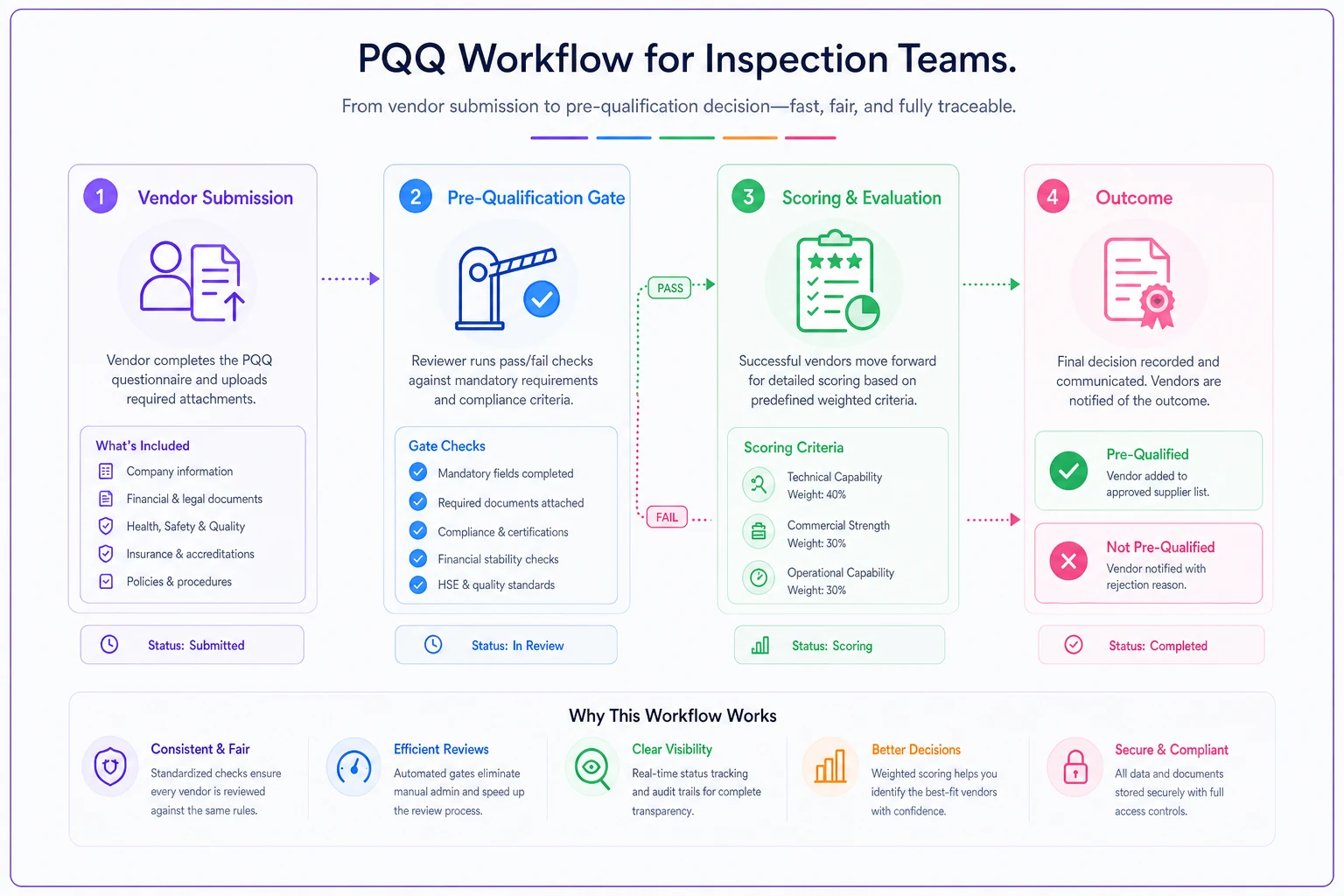
Keep the graphic straightforward: submission → documents checked → pass/fail → scoring.
A sample scoring matrix (with weights and red-flag fails)
Once vendors clear the mandatory gate, score the survivors. The weights below are a starting point for routine third-party inspection work — shift them for your context. For specialist NDT, push technical capability higher. For a turnkey program, push subcontracting transparency and multi-site management higher.
| Criterion | Weight | What a strong answer looks like |
|---|---|---|
| Technical capability for this scope | 25% | Named methods delivered in-house, matching our asset types exactly |
| Relevant accreditation depth | 15% | Scope of accreditation covers our work, not adjacent work |
| Personnel qualifications | 15% | Named inspectors with current, scope-matched certs |
| Safety record | 15% | TRIR trending flat or down, no serious citations |
| Impartiality / conflict posture | 10% | Clean declaration or a credible firewall explanation |
| Sample deliverable quality | 10% | Reports that are clear, traceable, and audit-ready |
| Subcontracting transparency | 10% | Full disclosure, named subs, high in-house percentage |
Red-flag fail criteria — any one of these ends the evaluation regardless of total score:
-
Expired or missing accreditation discovered during scoring
-
Named site personnel whose certs don't cover the required method
-
Refusal to disclose subcontractors or the in-house work percentage
-
Undeclared conflict of interest surfaced during reference checks
-
Sample report that can't trace a finding back to a measurement or standard
Why red-flag fails override the weighted score: a vendor can land 88% on paper and still be disqualifying on one item. Averaging hides exactly the risks you most need to catch. A polished report plus an undisclosed OEM relationship is worse than a plain report from a genuinely independent firm.
RFP logistics that quietly determine bid quality
Site access. If bidders can't see the site or representative assets, their prices are padded guesses. Offer a structured site visit window, or at minimum a detailed asset register with photos. Vendors who've actually seen the conditions bid tighter and argue less later.
Sample sizes. State the expected inspection volume as a range — "roughly 180–220 welds across three units" — and say whether that's firm or indicative. Vagueness here produces either sandbagged prices or lowball bids that balloon on day one.
Evidence of impartiality. For independent verification work, ask bidders to describe a specific case where they issued an adverse finding against a paying client. It's a sharper test than any declaration form. Firms that can't produce one may never have actually said "no" to a client.
Subcontracting rules. State plainly whether subcontracting is allowed, requires pre-approval, or is prohibited for the core field work. Make bidders name subs at bid time. The gap between "we might use partners" and "here are our three named subs with their accreditations attached" is the gap between a managed program and a surprise.
Reference checks. Ask for references from jobs that went wrong — a finding that was disputed, a schedule that slipped. How a vendor's reference describes a problem tells you more than three glowing reviews of routine work.
A short real-world scenario
A regional pipeline operator ran an RFP for recurring pressure-equipment inspections across four sites. Their original invite list had seven vendors — two independents, two NDT specialists, one OEM team, and two turnkey integrators — all scored on one matrix. The integrators topped the scores on "capability breadth," and one nearly won.
During reference checks, the evaluation team found the leading integrator subcontracted around 70% of field hours to firms the operator had never seen. One of those subs had an accreditation that didn't cover a method in scope. That was a red-flag fail.
They restructured: a separate track for the specialist NDT work, independents scored only against independents. The re-run added about three weeks up front. What it avoided was the far more expensive version — discovering the subcontracting gap mid-audit, after signing. The winning independent firm cost a bit more per report day but came with named, in-scope inspectors and zero subcontracting on the core work. Over the first year, disputed findings dropped noticeably compared to the prior contract, mostly because the people doing the work were actually the people who'd been vetted.
Where tooling helps (without turning this into a software problem)
The grind in all of this is tracking certificates, expiry dates, insurance, and subcontractor accreditations across a growing vendor list — and keeping it current between RFP cycles. Spreadsheets rot fast here; an insurance cert that was valid at bid time quietly lapses two months into the contract and nobody notices until the auditor does.
This is the narrow spot where AI-assisted operational platforms earn their place: flagging credentials approaching expiry, cross-checking named-personnel certs against the methods in scope, surfacing undeclared relationships by matching vendor and sub records. It doesn't make the judgment call — a human still decides who's invited and who's out — but it removes the manual tracking that causes the expired-cert-on-site failure in the first place. Used this way, the automation tightens the pre-qualification gate rather than replacing the thinking behind it.
Pulling it together
The vendors you invite determine the quality of every decision downstream. Get the categories right, gate hard on the mandatory items, let red-flag fails override polished scores, and structure the logistics so bids are grounded in reality instead of guesswork. The time you spend on the invite list and the PQQ is the cheapest risk reduction in the entire procurement — far cheaper than discovering mid-audit that your "best" bidder was selling you someone else's uncertified inspector. Once the right vendors are at the table, the contracting side — clauses, acceptance QA, and SLAs — is where you lock the win in, and that's a separate discipline worth treating with the same care.
Ready to modernize your inspection process?
Join 500+ inspection teams using Chekzly to reduce paperwork, improve compliance, and accelerate reporting.