

This post is specifically about writing procurement inspection services SLA terms that force deliverables, not descriptions. Not vendor selection in general — that's a separate problem. The focus here is the specific clauses, acceptance criteria, and negotiation moves that make a vendor legally accountable for the evidence they produce, not just the service they claim to perform.
The contract you sign decides whether the vendor delivers evidence or excuses
Most bad inspection vendor relationships don't fall apart on day one. They surface about four months in, when you request the raw evidence package for an audit and the vendor emails back a PDF summary with three blurry photos and a line that says "full records available on request." You request them. Two weeks pass. Then you learn the calibration certs weren't retained, the inspector who signed the report left the company, and the "chain of custody" the sales rep promised was never actually written into the contract.
That gap — between what the salesperson described and what the contract actually obligates — is where nearly all procurement regret lives. And it's preventable if you treat the contract as your primary QA instrument instead of a formality you sign after you've already picked a vendor.
Why "service delivered" and "evidence delivered" are two different contracts
Most inspection service contracts are written around activity. The vendor agrees to perform X inspections per month at Y sites. Payment triggers on completion of the inspection. Everyone moves on.
Eliminate inspection delays and errors.
Chekzly helps you plan, execute, and document inspections efficiently and accurately.
- Real-time inspection tracking
- Automated report generation
- Compliance and checklist management
No credit card required
The problem: an inspection can be "completed" and still be worthless. A completed inspection with missing metadata, no calibration reference, an unsigned report, or photos that won't survive scrutiny is not an asset — it's a liability you paid for. When the audit comes, you're the one holding the bag, not the vendor, because your contract said "perform the inspection" and they did.
The fix isn't a longer contract. It's shifting the payment and acceptance triggers from activity completed to evidence accepted. That single reframe changes every downstream clause. Suddenly the vendor has a financial reason to hand over complete, structured, audit-ready deliverables — because that's what gets them paid.
If you've already dealt with the pain of unreliable inputs, a lot of this will feel familiar. The credential and QA-sampling side of vendor risk is covered in Avoid unreliable vendor data: contract terms, credential checks and QA sampling for third-party inspections. This post picks up where that leaves off — the actual clause language and acceptance mechanics.
The mandatory evidence deliverables list (put this in the contract, not the SOW appendix)
The biggest mistake is burying evidence requirements in a statement of work that's referenced but not really enforceable. Deliverables that matter belong in the body of the agreement, tied directly to acceptance and payment.
-
Structured inspection record in an agreed machine-readable format (not just a rendered PDF) — so you can ingest, search, and audit it
-
Inspector identity and current credential reference attached to each record, including cert expiry date at time of inspection
-
Calibration reference for every instrument used, with cert ID and valid-through date
-
Timestamped media with intact capture metadata — no re-exported, stripped-metadata files
-
Chain-of-custody trail for any physical samples or transferred artifacts
-
Signed sign-off from a named, credentialed inspector with a verifiable digital signature and timestamp
-
Version reference of the checklist/form used, so you know which revision produced the finding
That last one matters more than people expect. If a vendor is running an outdated checklist revision, your findings become inconsistent across the program — and you often won't know why until it's already a problem. The mechanics of keeping form versions straight are worth understanding on your own side too. Lost versions, audit headaches: checklist version control and rollback rules for compliance goes deep on how version drift quietly corrupts a records program.
A useful rule: if a deliverable isn't on this list and isn't in the contract, assume you will not receive it, no matter what the sales deck promised.
Sample SLA clauses that actually have teeth
Vague SLAs are decoration. "Vendor will provide timely, high-quality inspection reports" is unenforceable because "timely" and "high-quality" mean nothing measurable. Every SLA clause needs a number, a measurement method, and a consequence.
Below is a breakdown of weak clauses versus enforceable ones for the terms that actually cause disputes.
| Clause area | Weak version (avoid) | Enforceable version (use) |
|---|---|---|
| Delivery time | "Reports delivered promptly after inspection" | "Complete evidence package delivered within 48 hours of on-site completion; late packages incur a 5% fee credit per business day" |
| Evidence completeness | "Reports will be thorough" | "Each package must contain all mandatory deliverables (Schedule A); packages missing any item are rejected and unpaid until cured" |
| Rework | "Vendor will address issues" | "Corrections to a rejected package delivered within 3 business days at no charge; second rejection of same item triggers root-cause report" |
| Credential validity | "Inspectors are qualified" | "No inspection may be performed by an inspector whose credential expires within 30 days without prior written approval" |
| Data retention | "Records kept as required" | "Vendor retains full raw evidence for 24 months and provides export within 5 business days of request in agreed format" |
| Personnel change | "Vendor manages staffing" | "Any change to the assigned lead inspector requires 10 days notice and re-verification of credentials" |
The pattern is simple: a measurable threshold, a defined window, and a remedy that costs the vendor something. If a clause has no remedy attached, it's a suggestion.
One clause people consistently forget: the export-on-request term. You will eventually part ways with a vendor, or need to move records into an audit. If your contract doesn't obligate them to hand over your raw evidence in a usable format within a defined window, you can be held hostage at exactly the worst moment.
Acceptance QA criteria: how you decide a package passes
An SLA without an acceptance procedure is just a wish list. You need a written, repeatable way to decide whether a delivered package is accepted, rejected, or accepted-with-conditions. Without it, quality erodes slowly — packages getting a little worse each month until nobody catches it until it's already a crisis.
Here's a practical acceptance process worth adopting for incoming vendor packages:
-
Automated completeness check — Does the package contain every mandatory deliverable? Missing any item triggers automatic rejection, no human review needed.
-
Metadata validation — Do the media files carry intact capture timestamps and location data? Stripped or re-exported files fail.
-
Credential cross-check — Was the signing inspector's credential valid on the inspection date? Was the instrument cert in-tolerance?
-
Sample-based content review — Pull a percentage of accepted packages for a human to review against the checklist for substance, not just presence.
-
Disposition and log — Record accept / reject / conditional, with the reason, so you have a defensible trail of why each package was treated the way it was.
The acceptance workflow looks like this in practice.
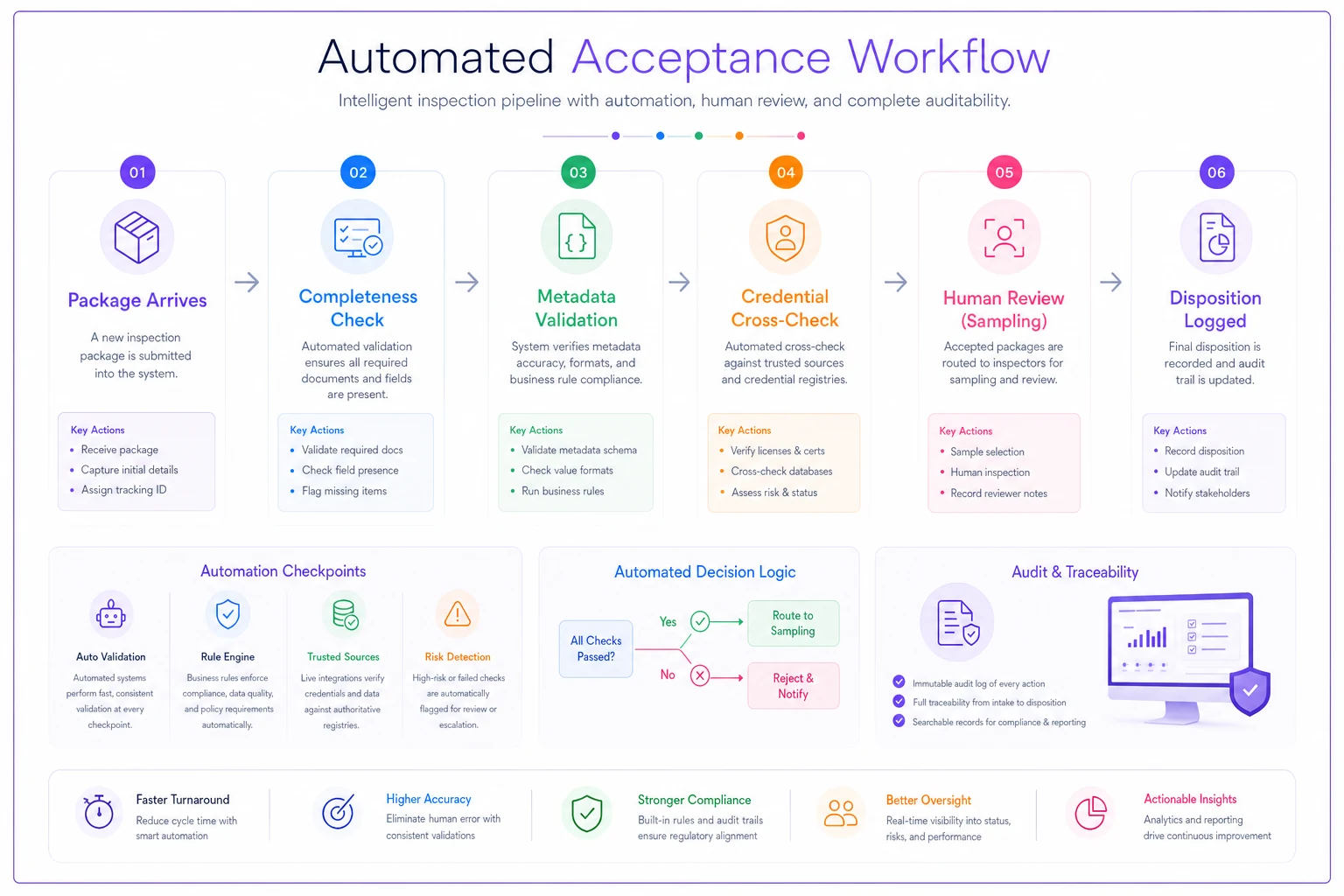
Steps 1 through 3 should never be a human's job. They're pass/fail checks against clear rules, and doing them manually means they get skipped whenever things get busy — which is exactly when bad packages slip through. This is where AI-assisted operational tooling earns its place: automatically validating completeness, flagging expired credentials, and catching stripped metadata the moment a package lands, so your team's review time goes to step 4, where actual judgment matters.
Automate the mechanical checks and route only exceptions to humans so your reviewers focus on substance, not paperwork.
The sampling rate on step 4 is a judgment call. A reasonable starting point is somewhere around 10–15% of accepted packages early in a vendor relationship, then scaling down as they earn trust and back up if reject rates climb.
A short real scenario
A mid-sized facilities inspection operation — multi-site, running roughly 260–300 third-party inspections a month across two vendors — kept passing audits more by luck than process. Their contract paid on inspection completion, and their acceptance workflow was one coordinator eyeballing PDFs when she had time, which wasn't often.
An internal audit found that around 18% of the prior quarter's packages were missing at least one mandatory item: an expired calibration cert here, a report signed by an inspector who'd since left there, media with no usable metadata in several others. None of it was recoverable, because the retention obligation had never been written into the contract.
They didn't switch vendors. They rewrote the agreement. Payment moved to evidence-accepted, not inspection-completed. They added a mandatory deliverables schedule, an export-on-request clause, and rejection remedies with actual cost implications. Then they put an automated completeness-and-credential check in front of the coordinator so nothing reached her desk until it had already cleared the mechanical gates.
Within about two months, the missing-item rate on accepted packages dropped to under 3%. And maybe more telling — one vendor's on-time delivery quietly improved once late-package fee credits became real. The coordinator went from firefighting to spending her time on the roughly 12% sample that actually needed a human eye.
Negotiation checklist for the actual conversation
Getting these terms into a contract means holding the line during negotiation, where vendors will push back on anything that shifts risk to them. Bring this to the table:
-
Ask for a sample evidence package before signing. If they can't produce a complete, well-structured example on request, that tells you everything about what you'll get in production.
-
Get the deliverables schedule agreed in writing before discussing price. Vendors negotiate price against a vague scope; lock the scope first.
-
Push payment triggers to acceptance, not completion. Expect resistance. This is the single most important term.
-
Insist on export-on-request with a defined format and window. Non-negotiable. This is your exit and your audit lifeline.
-
Tie rework to a clock and a free-correction obligation. "We'll fix it" means nothing without a deadline attached.
-
Nail down personnel-change notice. Inspector turnover is where quality silently degrades.
-
Define the retention period explicitly — and confirm who owns the raw evidence. It should be you.
If a vendor treats any of these as unreasonable, that's useful information. Vendors who run a tight operation usually don't flinch, because they already produce this stuff. The ones who push hardest on evidence obligations are often the ones who can't deliver them.
When this level of rigor makes sense — and when it's overkill
Not every inspection contract needs the full apparatus. If you're buying a handful of low-stakes inspections a year with no regulatory exposure, a heavyweight acceptance process will cost more in overhead than it saves.
Where it clearly pays off: any program feeding audits, regulatory filings, insurance claims, or legal proceedings. Anywhere the evidence might one day be scrutinized by someone who wasn't in the room. Anywhere you're running real volume across multiple sites or vendors and can't personally eyeball every package.
A single-site operation running a couple of internal-only inspections a month — where nobody outside the team ever looks at the records — probably doesn't need the full machinery. For them, a mandatory-deliverables clause and a simple completeness check is plenty. The sampling reviews and remedy schedules are more overhead than the risk justifies.
The bottom line worth remembering
The vendor's sales pitch describes a service. Your contract defines an obligation. When those two don't match — and they usually don't unless you force it — the gap becomes your problem months later, at the worst possible time, in front of an auditor.
Write the evidence deliverables into the body of the agreement, not the appendix. Make acceptance mechanical for the pass/fail checks and human only where judgment is actually needed. Tie payment to accepted evidence, not completed activity. Do that, and you stop buying inspections on faith and start buying them on proof.
The vendor's sales pitch describes a service. Your contract defines an obligation. When those two don't match — and they usually don't unless you force it — the gap becomes your problem months later, at the worst possible time, in front of an auditor.
Ready to modernize your inspection process?
Join 500+ inspection teams using Chekzly to reduce paperwork, improve compliance, and accelerate reporting.