


What never made sense to me about how most inspection programs handle audits: the date is known. ISO surveillance visits come on a fixed cycle. Regulator inspections follow predictable windows. Your accreditation body literally sends you the surveillance schedule in advance. And yet the six weeks before an audit look like a fire drill every single time — people digging through old folders, chasing signatures, rebuilding evidence that should have existed all along.
The problem isn't effort. Field teams work incredibly hard during those pre-audit weeks. The problem is that the whole readiness effort is compressed into a window that shouldn't exist. When you cram twelve months of evidence-keeping into six weeks, you get gaps, stale documents, and remediation items that can't actually be closed in time.
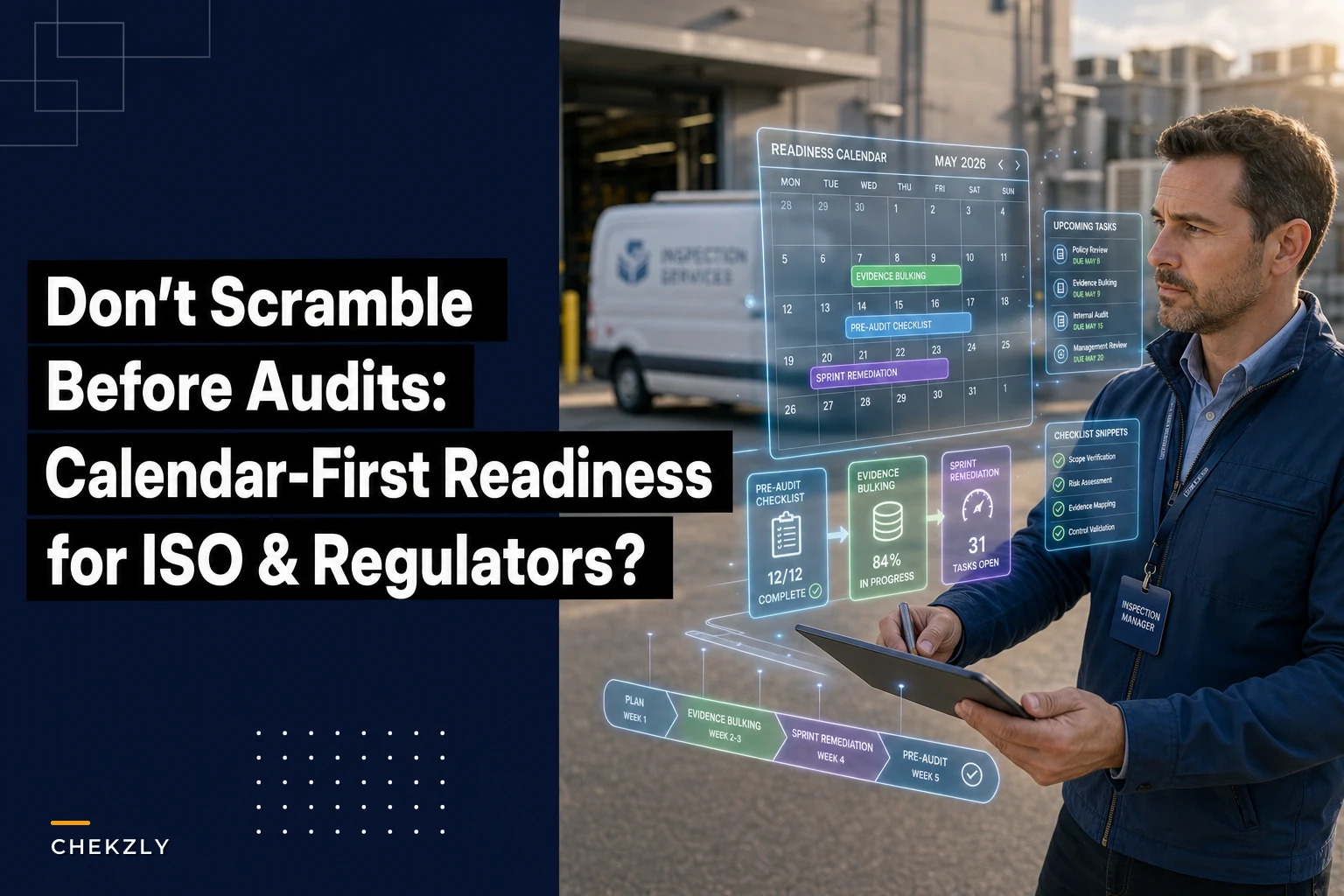
A calendar-first approach flips this. Instead of one giant readiness push before each cycle, you spread the work across the whole year in small recurring blocks. The audit stops being an event and becomes a checkpoint. This piece walks through exactly how to build that — the recurring pre-audit checklists, the evidence-bulking routines that quietly stack up proof over time, and the sprint remediation templates you use when something does slip.
Why the scramble happens (and it's not laziness)
The pre-audit panic almost always traces back to one structural issue: readiness work has no owner on the calendar. Everyone assumes it'll get picked up "closer to the date." Evidence collection is treated as a project instead of a habit.
In real operations, this usually happens when a program grows past a single site or a single audit type. One inspector managing one ISO cert can keep it all in their head. Add a second regulator with a different cycle, three more sites, and a couple of rotating field crews, and suddenly nobody holds the full picture of what's due when. The readiness knowledge lives in one person's memory, and that memory gets loaded frantically the month before the auditor arrives.
There's also a subtler cause. Most teams collect evidence reactively — they document a corrective action when a finding forces them to. But accreditation bodies increasingly want to see ongoing proof: that your calibration checks happened every quarter, that competency reviews ran on schedule, that your document control worked continuously. You can't fake continuity retroactively. If you didn't capture the March evidence in March, no amount of scrambling in October rebuilds it honestly.
The three moving parts of continuous readiness
A calendar-first plan has three components that work together. Miss one and you're back to scrambling.
Eliminate inspection delays and errors.
Chekzly helps you plan, execute, and document inspections efficiently and accurately.
- Real-time inspection tracking
- Automated report generation
- Compliance and checklist management
No credit card required
| Component | What it does | Cadence | Common failure |
|---|---|---|---|
| Recurring pre-audit checklists | Surface what's due, verify it exists | Monthly + quarterly | Only run once, right before audit |
| Evidence-bulking recipes | Capture proof as work happens | Continuous / per-activity | Evidence collected only when findings appear |
| Sprint remediation templates | Close gaps fast in fixed time-boxes | Triggered as needed | Open-ended fixes that drag for months |
The mistake most teams make is building one giant "audit prep checklist" and calling it a system. That single monster list is exactly the thing that creates the scramble — because you only run it when the audit looms. Breaking it into recurring smaller checks is what actually distributes the load.
Recurring pre-audit checklists: run them on a rhythm, not a deadline
The point of a recurring checklist isn't to prepare for the audit. It's to verify that you're already prepared, every month. If you're doing it right, the checklist should mostly come back clean.
Here's the structure that's held up across multi-site programs:
Monthly (light, 20–30 minutes per site):
-
Are all inspections from the last month logged with complete records?
-
Any expired or expiring certifications, calibrations, or licenses in the next 90 days?
-
Any open corrective actions past their target date?
-
New hires or role changes that need competency sign-off?
Quarterly (deeper, half a day):
-
Sample 8–10 completed inspection records and check them against the retrieval SOP — can you find everything an auditor would ask for in under two minutes?
-
Verify checklist versions in the field match the controlled master
-
Review the surveillance/inspection calendar for the next two cycles
-
Confirm evidence for any recurring requirements (training logs, equipment checks) is filed and dated
The quarterly record sampling is the one people skip, and it's the most valuable. Auditors don't review everything — they pull samples. So you should too. If your quarterly sample keeps coming up clean, your full record set is probably fine. If the sample has gaps, you've found a systemic problem four to nine months before an auditor would. Getting your record system tight enough to survive that sampling is its own discipline, and it's worth building deliberately — the approach in building an audit-ready inspection records system with metadata and retrieval SOPs pairs directly with this quarterly check.
Worth flagging: the value of these checklists collapses if they're not tied to specific owners with specific due dates. A checklist that "the team" is responsible for is a checklist nobody runs. Assign each recurring check to a named person, and route it so it can't be silently skipped.
Assign each recurring check to a named person, and route it so it can't be silently skipped.
A checklist that "the team" is responsible for is a checklist nobody runs. Assign each recurring check to a named person, and route it so it can't be silently skipped.
Evidence-bulking recipes: capture proof while the work is fresh
"Evidence bulking" just means stacking up proof continuously so you never have to reconstruct it. The word "recipe" is deliberate — you want a repeatable set of steps that produces the same evidence output every time an activity happens.
A typical recipe looks like this. Say your accreditation requires proof of quarterly equipment calibration. The reactive version: someone calibrates the equipment, moves on, and the certificate sits in an inbox until audit season. The recipe version:
-
Technician completes calibration
-
Photo of the calibration label + the certificate uploaded to the equipment's record, same day
-
Record auto-tagged with equipment ID, date, next-due date, and technician name
-
Next-due date drops onto the calendar as a future task
-
Monthly checklist confirms the record exists
The whole point is that step 2 happens during the work, not months later. Evidence captured at the moment of the activity is more accurate, better dated, and impossible to lose in the pre-audit chaos.
A few recipes worth standardizing:
-
Competency evidence every training session or supervised inspection produces a signed sign-off attached to the inspector's record immediately. This is far easier when your onboarding already builds documentation in — the workflows in turning new hires into audit-ready inspectors feed this recipe cleanly.
-
Corrective action closure every closed finding produces a before/after record and a verification note, not just a status change.
-
Document control every checklist revision logs who changed what, when, and why — so version questions never require detective work.
The pattern behind all of these: make the evidence a byproduct of the work, not a separate task. Separate tasks get deferred. Byproducts happen automatically.
This is where operational software earns its place quietly. A workflow platform with AI-assisted automation can watch for the calibration record and, if it doesn't appear within a day of the logged calibration, flag it — before it becomes a gap. It can auto-tag records with the metadata your retrieval SOP needs, and drop next-due dates onto the calendar without anyone remembering to. None of that is flashy. It just means the evidence stack builds itself in the background instead of relying on someone's discipline every single time.
Here's a simple visual of the evidence-bulking workflow.
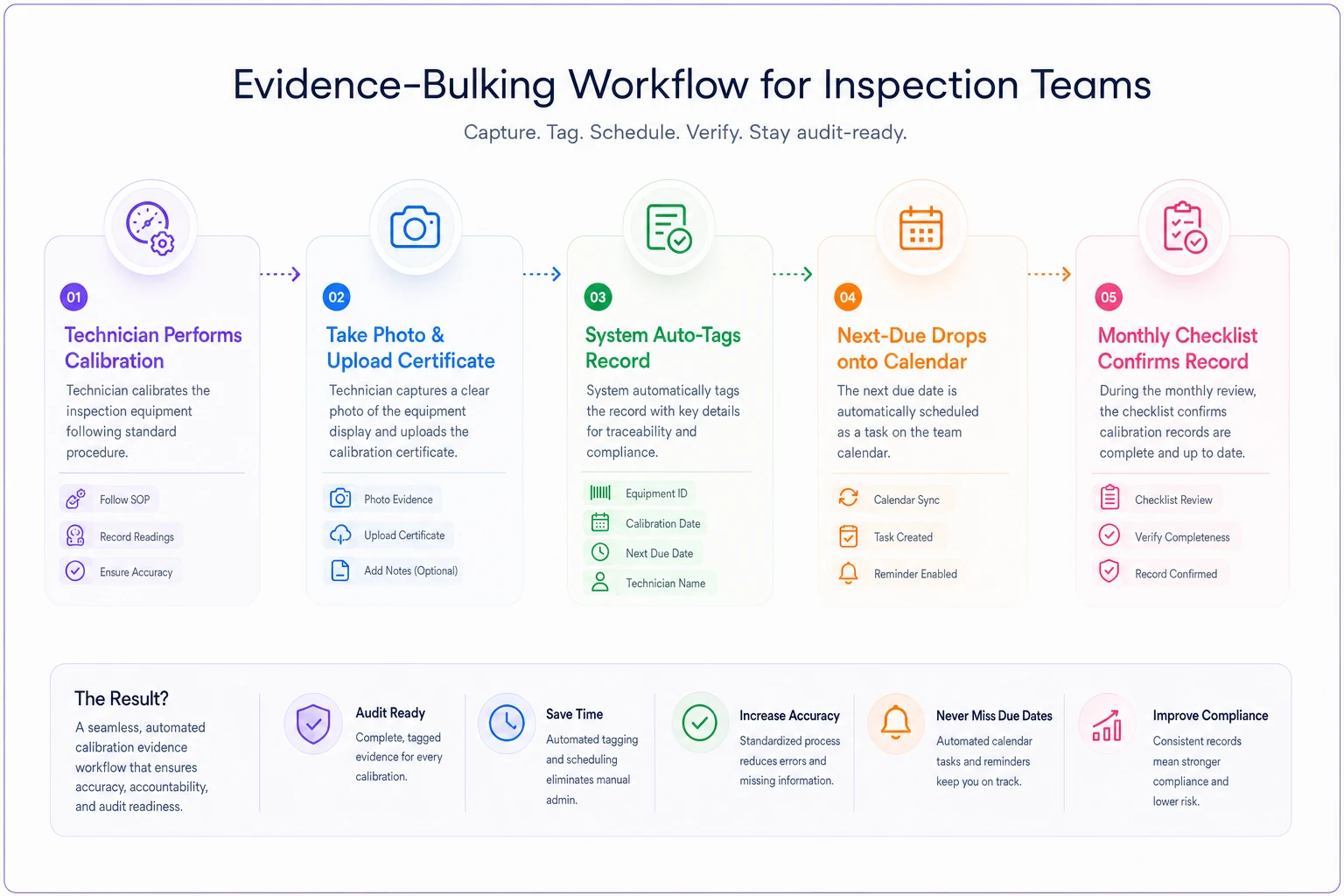
That visual maps to the recipe steps above and helps teams implement the automation points in order.
Sprint remediation templates: fix gaps in fixed time-boxes
Even with good habits, gaps happen. A site misses a calibration. A new regulation adds a requirement you weren't capturing. The difference between a mature program and a scrambling one is how fast and how cleanly those gaps close.
Open-ended remediation is the trap. "We'll fix the documentation problem" with no deadline means it drifts for months and reappears as a finding. Sprint remediation puts every gap into a fixed time-box — usually one or two weeks — with a defined output.
A sprint remediation template has five fields, and that's deliberately all:
-
The gap — stated as what an auditor would see, not vaguely
-
Root cause — one sentence, not a theory
-
Fix + owner — who does what
-
Evidence of closure — the specific record that proves it's done
-
Sprint window — start and end date, no open-ended entries
The "evidence of closure" field is the one that changes behavior. It forces you to define proof, not just completion. "Retrained the crew" isn't closure. "Signed retraining record for all six field techs, dated and filed" is closure.
A quick real scenario
A mid-sized environmental testing outfit — three labs, around 40 inspection and field staff — kept passing their ISO surveillance audits but with a repeating pattern of minor nonconformities every cycle, usually 4 to 6 per visit. Almost all of them were documentation gaps: missing calibration records, competency sign-offs that couldn't be located, checklist version mismatches between sites.
Their prep was the classic scramble: roughly five weeks of overtime before each surveillance visit, pulling records together. Two people were more or less pulled off normal work for that stretch.
They switched to a calendar-first setup — monthly light checks, a quarterly record sample, evidence recipes for calibration and competency, and a two-week sprint template for anything that surfaced. It wasn't dramatic overnight. But by the next surveillance cycle, the pre-audit period dropped from five weeks of overtime to something closer to a normal week with a couple of days of final review. Minor nonconformities fell to one, then zero the cycle after. The interesting part wasn't the audit result — it was that the labs stopped dreading the calendar entry.
When calendar-first makes sense — and when it doesn't
This approach is worth the setup effort when you have multiple audit cycles, multiple sites, or recurring requirements with hard dates. The more moving parts and the more predictable the cadence, the more the distributed model pays off.
It's genuinely overkill if you're a single site with one annual audit and a handful of requirements you can track on one page. In that case, a good annual checklist run a couple of months early is enough — building recurring monthly infrastructure would be more overhead than the problem justifies.
Who should not do this: teams that haven't yet fixed their underlying records and version control. If you can't reliably find and trust your evidence today, spreading collection across the calendar just spreads the mess. Get the record system and version discipline solid first — the calendar layer sits on top of that foundation, not in place of it.
The mindset shift that actually matters
The whole thing comes down to one change in how you think about audits. A scrambling program treats readiness as preparation for an event. A calendar-first program treats readiness as a continuous state you maintain — and the audit is just when someone external checks it.
That shift is what kills the six-week fire drill. When your evidence builds itself as work happens, your checklists run on a monthly rhythm, and your gaps close in tight sprints, the surveillance visit stops being a crisis. The auditor shows up, pulls samples, finds them clean, and leaves. No overtime, no reconstruction, no dread on the calendar entry.
You already know the dates. That's the whole advantage. A program that scrambles is a program that decided to ignore the one thing it knew for certain.
Ready to modernize your inspection process?
Join 500+ inspection teams using Chekzly to reduce paperwork, improve compliance, and accelerate reporting.