
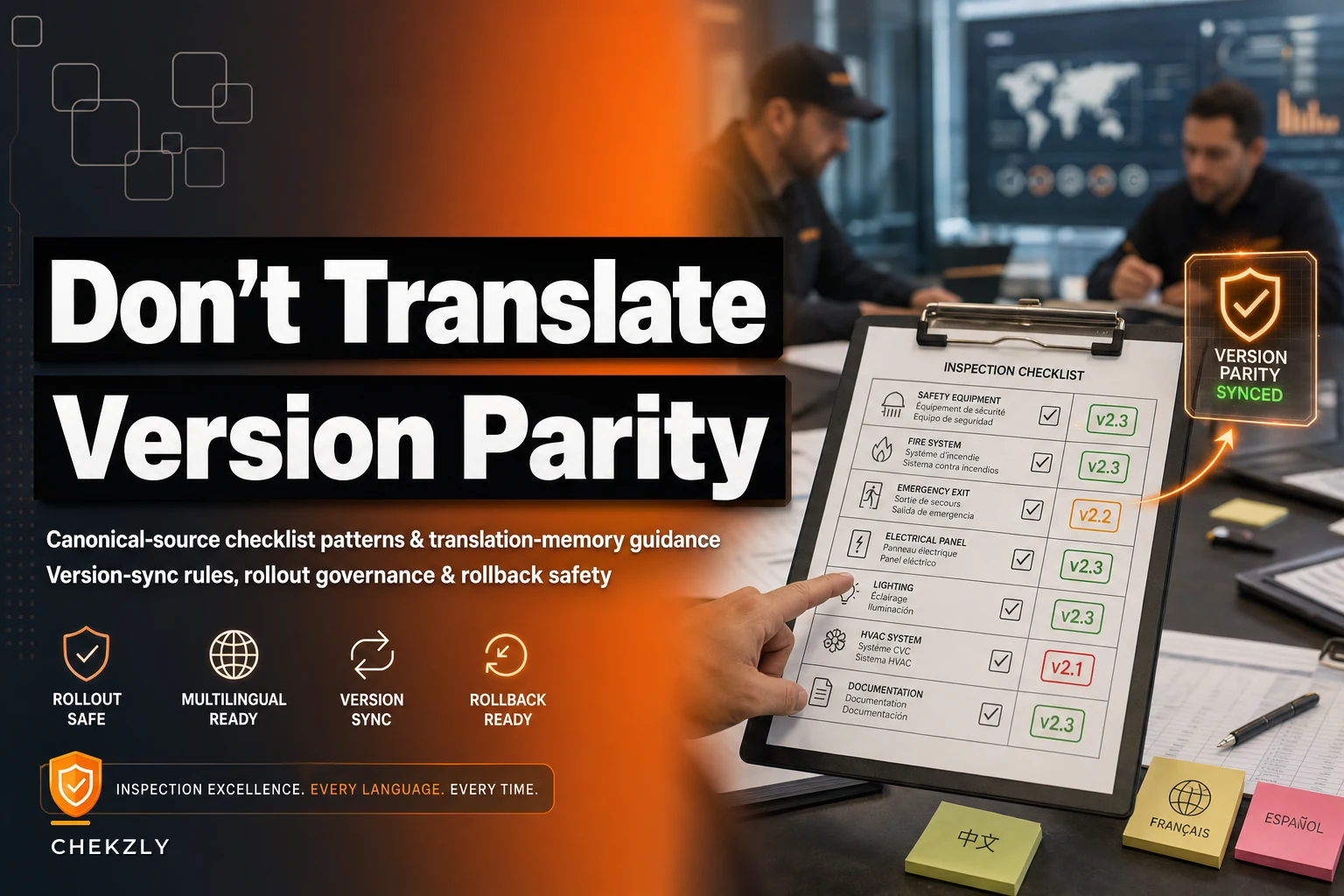

Most teams treat translation as a one-time project. You send the master checklist to a translator, get back a Spanish or Portuguese version, drop it into the field app, and move on. Six months later the English checklist has gone through four revisions, the translated one is still sitting on version 1, and nobody notices until an auditor pulls both and asks why the Tagalog version is missing the two questions that were added after a regulatory update.
That gap between your source checklist and its translated copies is where compliance quietly breaks. Not because anyone made a bad translation — but because the versions drifted apart and no one owned keeping them together.
This is a narrow problem, and it deserves a narrow, disciplined answer. Below is a pattern for running localized inspection checklists that stay in parity with the source, roll out safely, and roll back cleanly when a translation turns out to be wrong.
The specific failure: translations that live on their own timeline
Here's how it actually plays out in a multi-site operation running inspections in more than one language.
The English checklist is the working document. It's the one leadership edits, the one QA reviews, the one that gets updated when a client contract changes or a standard revision drops. Every edit goes there first because that's where the decision-makers are.
-
English checklist
version 7, updated last week
-
Spanish checklist
version 5, updated two months ago
-
Vietnamese checklist
version 3, updated last quarter
Three inspectors doing the "same" inspection are answering three different sets of questions. When you aggregate the results, you assume they're comparable. They're not.
Why this drift is almost invisible until an audit
The reason nobody catches version drift in translated checklists is that each language pool tends to be operationally siloed. Spanish-speaking inspectors talk to each other. English-speaking inspectors talk to each other. They rarely compare the actual content of their forms side by side — why would they? They assume the office keeps them aligned.
Eliminate inspection delays and errors.
Chekzly helps you plan, execute, and document inspections efficiently and accurately.
- Real-time inspection tracking
- Automated report generation
- Compliance and checklist management
No credit card required
And the forms look fine. A Spanish checklist with 40 questions doesn't announce that it's missing questions 41 and 42 that were added in the last revision. There's no red flag in the field. The inspector completes what's in front of them, signs off, and the record looks complete.
-
During an audit, when someone pulls records across languages and the question sets don't line up.
-
During a data review, when a KPI looks wrong and someone traces it back to a question that only exists in one language version.
-
After an incident, when the defense is "the checklist required X" and it turns out X was only in the English form.
This is closely related to the broader version-control discipline covered in checklist version control and rollback rules for compliance — but localization adds a multiplier. Every source revision now has to propagate to N languages, and each one is a separate opportunity to fall behind.
The core rule: one canonical source, everything else is a derivative
The single most important thing you can do is stop treating your language versions as independent documents. Pick one canonical source — usually English, or whatever language your regulators and contracts are written in — and treat every translated checklist as a derivative that must reference a specific source version.
That means every translated checklist carries two version numbers, not one:
-
Its own translation version
-
The source version it was translated from
So the Spanish checklist isn't just "Spanish v5." It's "Spanish v5, derived from English v5." The moment English moves to v7, the system knows the Spanish version is two source revisions behind. That gap becomes visible and trackable instead of silent.
Binding every translation to a source version is what turns invisible drift into a number you can actually report on.
What canonical binding looks like in practice
| Field | Purpose | Example |
|---|---|---|
| Source language | The authoritative version everything derives from | English |
| Source version | The exact source revision this translation matches | v7 |
| Translation language | The localized copy | Spanish |
| Translation version | Independent version of the translated file | v5 |
| Parity status | Auto-computed: does source version match? | Behind by 2 |
| Last verified | When a human confirmed the translation is accurate | 2025-01-14 |
When parity status reads anything other than "current," that language isn't cleared for use until it's reconciled. That's the whole discipline in one column.
Translation memory: stop re-translating the parts that didn't change
Most checklist revisions don't rewrite the whole form. They change two or three questions, add one, and clarify a response option. But the typical translation workflow sends the entire document back out for translation every time — which is slow, expensive, and introduces new inconsistencies in text that was already correct.
A better approach is to translate at the item level and keep a translation memory: a stored, approved translation for every individual checklist item, tied to the source text of that item.
-
If a source item's text is unchanged, reuse the approved translation. No rework, no re-review.
-
If a source item's text changed, flag only that item for re-translation.
-
If a source item is new, it enters the translation queue as untranslated.
This shrinks the translation task from "the whole form" down to "the three items that actually changed." It also prevents the slow corruption where a perfectly good translated question gets subtly reworded every revision because a different translator touched it.
A typical example: a facility inspection checklist has 52 items. A revision changes 3 and adds 1. With item-level translation memory, the localization work is 4 items, not 52. What used to be a two-week round-trip becomes a same-day update — and the 48 untouched items stay word-for-word consistent with every prior version.
Version-sync rules that actually hold
Binding translations to a source version only helps if you enforce what happens when they fall out of sync. These are the rules that keep the whole thing honest:
-
No source revision publishes without a translation plan. The moment you approve an English change, the derivative languages are automatically marked "behind" and enter the queue. You don't get to forget them.
-
Behind-parity forms are visibly flagged in the field app, not silently served. An inspector opening a checklist that's behind its source should see a clear status, and depending on your risk tolerance, may be blocked from using it entirely.
-
Parity is checked at assignment, not just at publish. When you assign an inspection, the system verifies the language version being assigned is current. A form that was fine last month may have drifted since.
-
A single "reconciliation owner" per language. Someone is accountable for closing the gap on Spanish, someone else for Vietnamese. Diffusion of responsibility is exactly why translations fall behind — everyone assumes someone else is watching.
The subtle mistake is thinking parity is a publish-time concern. It's not. Source checklists keep moving. A translation that was current when it published becomes stale the next time the source is edited. If you only check at publish, you'll miss it every time.
Rollout: never flip all languages at once
When a checklist revision is ready, the instinct is to push it live everywhere the moment translations are done. Resist that. The rollout pattern that survives real operations is staged, and it treats each language as a separate rollout with its own gate.
A workable sequence:
-
Publish the canonical source first. English goes live. Its derivatives are now officially "behind" and queued.
-
Translate only the changed and new items using translation memory.
-
Human-verify each translated item in context — not as a spreadsheet cell, but rendered inside the actual checklist, because meaning shifts with surrounding questions.
-
Pilot the translated version with a small field group before full release. A translated response option that reads ambiguously will show up as inconsistent answers fast.
-
Promote to full parity only after the pilot confirms the translation behaves the same as the source.
-
Lock the source-version binding so the record shows exactly which source revision this translation matched.
Here's a simple diagram of the staged rollout process.
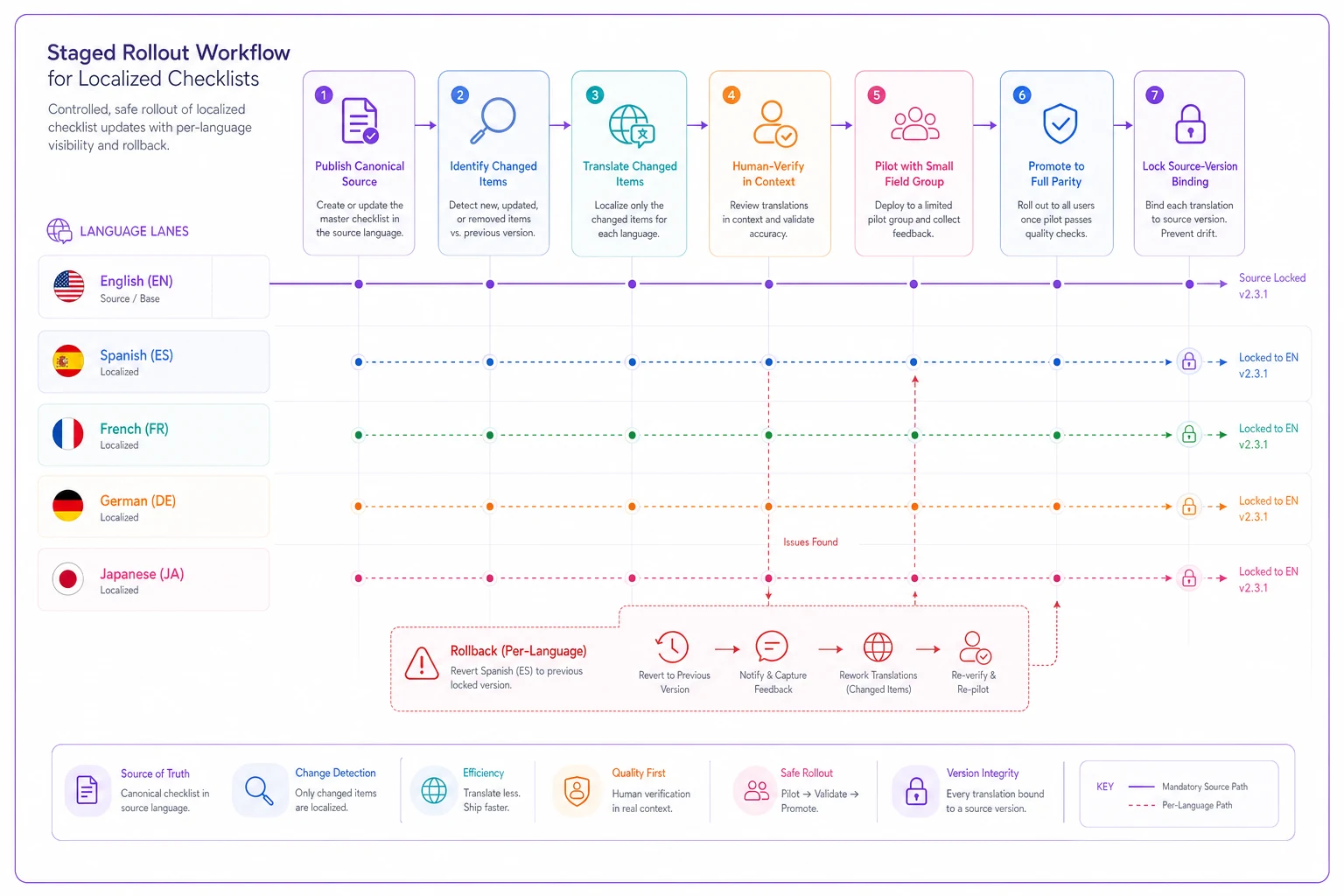
The reason to stage by language is that a bad translation isn't a bad form — it's a bad localized form. You don't want a mistranslated question in Portuguese to force a rollback of the English version that's working fine everywhere else.
Rollback governance: what to do when a translation is wrong
Translations fail differently than source checklists. A source rollback is usually about bad question design. A translation rollback is about a specific language copy that says something the source didn't mean — a mistranslated tolerance, an inverted pass/fail phrasing, a response option that changed meaning in the target language.
Because the failure is language-specific, the rollback should be too. You want the ability to roll one language back to its last-good version without touching the source or any other language.
-
Every published translation retains its last-good version, so you can revert a single language instantly.
-
Rollback of a translation does not roll back the source. They're independent. The Spanish form reverts; English stays put.
-
A translation rollback re-opens the parity gap — the reverted language is now behind again and re-enters the queue with the error flagged.
-
The reason for rollback is logged against the specific item, so the next translator sees exactly what was wrong and doesn't repeat it.
That item-level logging matters more than it sounds. Translation errors tend to recur on the same tricky items — the ones with regulatory terms, units, or negations. When you log the failure against the item, you build institutional memory about which questions are localization landmines.
When this level of rigor is worth it — and when it isn't
Not every operation needs full canonical-source governance. Be honest about where you sit.
This makes sense when:
-
You run inspections in two or more languages against the same standard.
-
Your results are aggregated across languages and compared as if they're equivalent.
-
You're audited, accredited, or contractually bound to a specific checklist version.
-
Regulatory or contract changes force periodic revisions you must propagate.
This is overkill when:
-
You have a single-language operation. Then you just need solid version control, not localization parity.
-
Your translated forms are informational only and never feed into a compliance record.
-
Your checklists change once a year and you have a handful of inspectors total.
Who should not attempt this yet: teams that haven't nailed single-language version control first. Localization parity sits on top of version control. If you can't yet answer "which version of the English checklist was this inspection done against," adding four more languages will only multiply the confusion. Get the foundation right first.
There's also a real relationship between form complexity and translation risk. The longer and denser a checklist, the more surface area for translation drift and the more items to keep in parity. If your forms are bloated, part of the fix might be structural — modularizing inspection forms to cut cognitive load also shrinks the translation and parity burden, because a modular form lets you localize and version-sync components independently instead of re-processing a monolithic document every time.
A real scenario: multi-site facility inspections in three languages
A regional facilities inspection group ran the same safety checklist across sites in English, Spanish, and Vietnamese, with roughly 60 inspectors split unevenly across the three languages.
Their process was the reactive one described earlier — English got edited whenever needed, translations got updated when someone complained. During an internal pre-audit review, they pulled a sample of completed inspections across languages and found the Spanish forms were missing two questions added in a revision about four months earlier, and the Vietnamese forms were missing four. Around a third of the non-English inspections in that window had been completed against outdated question sets. On paper, those inspections looked complete. In reality, they hadn't captured the newer required checks.
The fix wasn't a translation vendor change. It was governance. They designated English as the canonical source, bound every translated version to a specific English revision, and stood up item-level translation memory so only changed items got re-translated. They assigned one reconciliation owner per language and made behind-parity forms visibly flagged before assignment.
The measurable change: the propagation gap between a source revision and its translated versions went from "eventually, maybe" to a few days, tracked as an open number on a board. The next audit cycle, cross-language record pulls lined up — same questions, same versions, traceable source binding. The qualitative win was bigger than any single metric: they stopped discovering parity gaps during audits and started catching them the day a source revision published.
The takeaway
Localized inspection checklists don't break because translators are bad. They break because translated forms are allowed to live on their own timeline, drifting silently away from the source that your audits, contracts, and data actually depend on. Once you bind every translation to a specific source version, translate at the item level, and give each language a reconciliation owner and a clean single-language rollback path, the drift stops being invisible. Treat one language as canonical. Treat everything else as a derivative that owes it parity. Do that, and you'll stop finding out during an audit that three inspectors were answering three different versions of the same inspection.
Ready to modernize your inspection process?
Join 500+ inspection teams using Chekzly to reduce paperwork, improve compliance, and accelerate reporting.