


The moment an inspection package gets pulled into litigation, an insurance claim, or a regulator's records request, the signature on the final report stops being a formality. Someone on the other side is going to ask a very specific question: how do you know the person who signed this actually signed it, and how do you know the timestamp wasn't backdated?
Most field teams don't have a clean answer. They have a name typed into a box, or a scribbled finger-drawn squiggle on a tablet, and a date field that pulled from the device clock. That's fine right up until it isn't — and when it isn't, the whole package can wobble. Not because the inspection was bad, but because the proof of who signed and when falls apart under scrutiny.
This post is narrow on purpose. It's only about the signature and timestamp layer of inspection digital signature standards — what different types of e-signatures actually mean, which ones legal teams accept for inspection packages, and how to operationalize the right version in field workflows without turning every sign-off into a 20-minute ordeal.
The three tiers of e-signature, and why the difference matters in disputes
There's a lot of confusion about what counts as a "real" e-signature. Part of the problem is that most e-signature laws — ESIGN in the US, eIDAS in the EU — are deliberately permissive. Under ESIGN, an e-signature is basically any electronic mark made with intent to sign. A typed name qualifies. That's why teams assume they're covered.
But "legally valid as a signature" and "defensible when someone challenges it" are two different bars. In a dispute, the other side doesn't argue that typed names aren't signatures. They argue that this particular typed name could have been entered by anyone, that the timestamp came from a clock the signer controlled, and that the record was editable after signing. Those are evidentiary attacks, and that's where weak signatures lose.
Here's the practical breakdown legal teams tend to work with:
| Tier | What it looks like | What it proves | Where it holds up |
|---|---|---|---|
| Simple e-signature | Typed name, finger-drawn mark, "I agree" checkbox | Someone with device access indicated intent | Low-stakes internal sign-offs; falls apart under serious challenge |
| Basic + audit trail | Signature captured alongside login identity, IP, device ID, and a locked record | Links signature to an authenticated session and a tamper-evident record | Most commercial inspection disputes, insurance claims |
| Digital signature (cryptographic) | Signature bound to a certificate/key, cryptographic hash of the document | The document hasn't changed since signing, and the signer's key was used | Regulated environments, high-value litigation, cross-border |
The middle tier is where most inspection programs should live, and where surprisingly few actually do. You don't need PKI certificates for every plumbing inspection. You do need the signature tied to an authenticated identity and a record that can't be silently edited afterward.
The mistake that comes up constantly: teams jump straight to worrying about cryptographic digital signatures — expensive, complicated, overkill for 90% of their work — while completely ignoring the audit trail that would actually win the argument. The audit trail is the cheap, high-leverage fix. The certificate is the expensive edge case.
Why the timestamp is usually the weaker link, not the signature
Everyone obsesses over the signature. The timestamp quietly does more damage.
Eliminate inspection delays and errors.
Chekzly helps you plan, execute, and document inspections efficiently and accurately.
- Real-time inspection tracking
- Automated report generation
- Compliance and checklist management
No credit card required
In real operations, this plays out like this: an inspector finishes a site visit, drives back, and completes the report that evening — or the next morning — and the system stamps it with the moment they hit "submit." Now you have a report that says the inspection happened Tuesday but is signed and dated Thursday. Nobody did anything wrong. But a two-day gap between observation and attestation is exactly the kind of detail opposing counsel loves, because it opens the door to "so this was written from memory two days later?"
It gets worse with device clocks. A timestamp pulled from the inspector's tablet is only as trustworthy as that tablet's clock, which the inspector can change. If your timestamp source is the same device controlled by the signer, you've built a timestamp with a conflict of interest baked into it.
-
Server-side time, not device time. The authoritative timestamp should come from a system the field user can't set. When connectivity is spotty, the record should note both the local capture time and the server sync time, and flag the gap.
-
Two timestamps, not one. Capture when the observation happened and when the attestation was signed as separate fields. Conflating them is what creates the "signed two days later" ambiguity.
-
Timezone stored explicitly. A naked timestamp with no timezone is a landmine for multi-region teams. Store UTC plus the local offset.
A pattern worth keeping in mind: the signature answers who, the timestamp answers when, and the audit trail answers whether anything changed after. A weakness in any one of those three can sink the other two.
The audit attestation: what a defensible sign-off record actually contains
An "attestation" here means the bundle of evidence that stands behind the signature — the thing you hand to legal when they ask "prove this signature is real." Most teams have never actually assembled one, so when the request comes, they scramble to reconstruct it from logs that were never designed for that purpose.
A defensible attestation record for an inspection package should contain, at minimum:
-
Identity binding — the authenticated account that signed, not just a display name. Email, user ID, and the authentication method used (password, SSO, MFA).
-
Signature artifact — the captured signature image or typed value, plus a note of the signature method.
-
Document hash — a fingerprint of the exact document version that was signed, so any later edit is detectable.
-
Timestamps — observation time and attestation time, both with source (server vs. device) and timezone.
-
Session context — IP address, device identifier, and app/version. Not because IP proves identity, but because consistency across a signer's history is corroborating evidence.
-
Immutability marker — evidence that the record was locked at signing and any subsequent change created a new version rather than overwriting the original.
That last point ties directly into version control. If your platform lets someone quietly edit a signed report, your attestation is worthless — the signature applies to a document that no longer exists. This is the same discipline that comes up when building an audit-ready inspection records system with metadata and retrieval SOPs: the signature layer is only as strong as the records system underneath it.
Attestation — Inspection #INS-4471 Signer: m.torres@acme-inspect.com (User ID 3092) Auth method: SSO + MFA, session verified 2024-03-12 14:22 UTC Signature: drawn signature captured; method "touch" Document hash: SHA-256 a91f...e3c7 (v3, locked) Observation: 2024-03-12 09:40 local (UTC-05), device time Attestation: 2024-03-12 14:22 UTC, server time Session: IP 74.x.x.x, iPad, app v4.2.1 Record state: LOCKED at signing; 0 post-sign edits
The point isn't that every field is dramatic. It's that when you can produce this, the conversation with opposing counsel tends to end quickly. When you can't, it drags.
The field workflow problem: security vs. inspectors actually using it
Everything above is easy to specify and hard to operationalize, because inspectors work in basements, on rooftops, in dead zones, wearing gloves, in a hurry. The more airtight the signature process, the more likely field teams route around it.
A typical pattern: a program mandates MFA on every sign-off. Inspectors on a job site with no cell signal can't complete MFA, so they wait until they're back at the truck, or they share a logged-in device, or they get an admin to sign on their behalf "just this once." Every one of those workarounds destroys the identity binding you were trying to create. You end up with worse attestation than if you'd used a simpler method that people actually followed consistently.
The practical fix is separating authentication from signing:
-
Authenticate once, at the start of the shift or the start of the job, while connectivity is available. That establishes the identity session.
-
Sign within that authenticated session in the field, even offline. The signature inherits the already-verified identity.
-
Sync and server-timestamp on reconnect, with the gap between local sign time and server sync recorded transparently.
Authenticate at shift start so inspectors can sign offline without repeated MFA prompts.
The following shows the practical workflow from authenticate-to-sync and how the attestation gets assembled automatically.
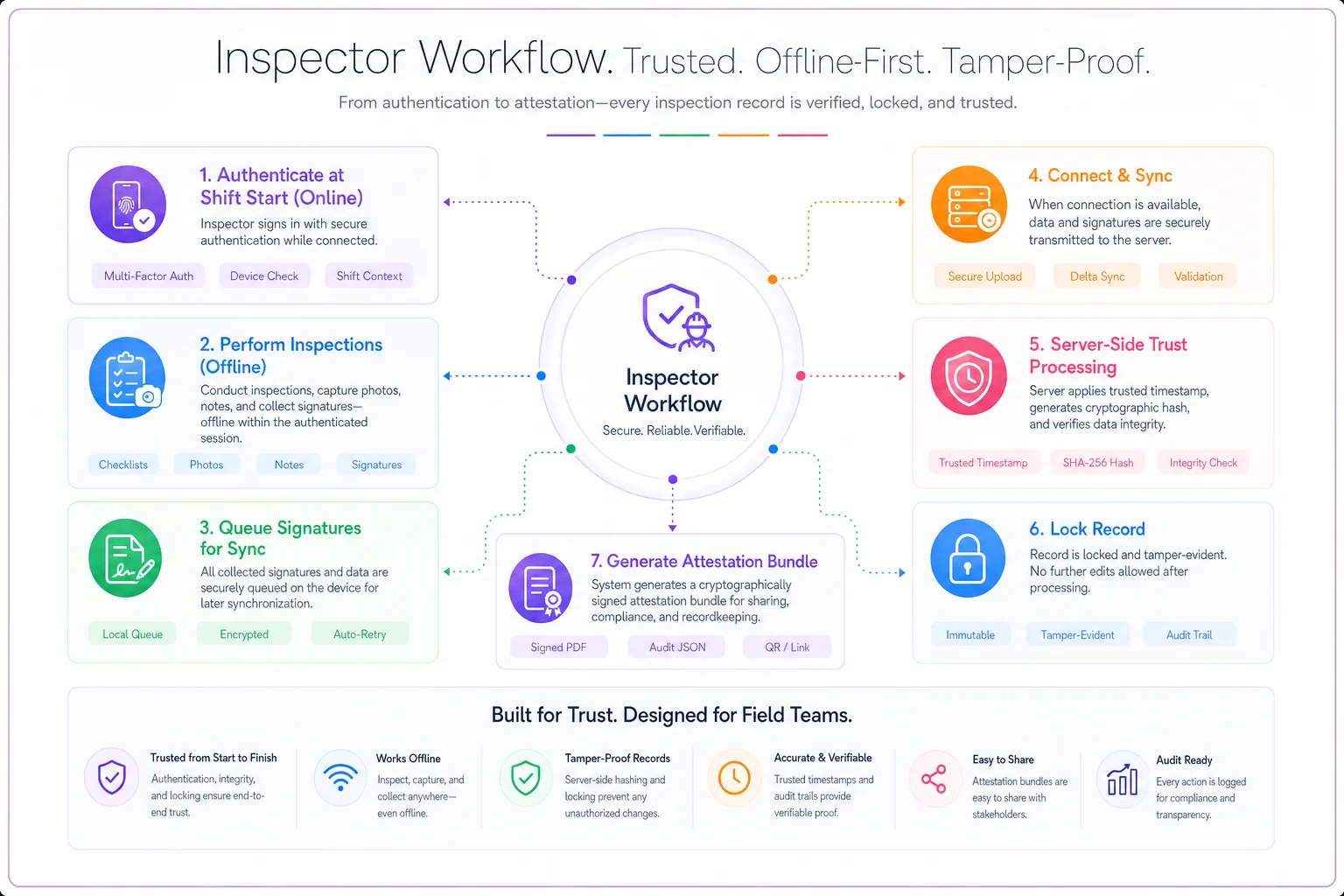
This keeps strong identity binding without forcing an MFA prompt at the exact moment someone's standing in a concrete vault with no signal. The offline gap gets documented rather than hidden, which is honestly stronger than pretending everything happened in real time.
One more field reality worth mentioning: signatures live next to photos and video in the same package, and the same admissibility logic applies to both. If you've already tightened up your field SOP for admissible photos and video with metadata and camera settings, the signature layer should follow the same principle — capture provenance at the moment of creation, lock it, and never let it be silently altered.
When cryptographic digital signatures actually make sense
There's a real decision to make here, and defaulting to the most complex option is a common and expensive mistake.
When full cryptographic digital signatures are worth it:
-
Cross-border work where eIDAS "qualified" or "advanced" signatures are contractually or legally required.
-
High-value assets where a single disputed inspection can trigger seven-figure claims — structural, pressure vessels, certain energy infrastructure.
-
Regulated sign-offs where a specific standard names the requirement outright. If a regulator or accreditation body specifies certificate-based signatures, that settles it.
When they're overkill:
-
Routine commercial and residential inspections where a basic signature plus a solid audit trail already clears the evidentiary bar.
-
High-volume, low-individual-stakes work where the friction of certificate management would tank field compliance.
Who should not rush into this:
-
Small teams without IT support to manage certificates and key rotation. A mismanaged certificate program creates new failure modes — expired certs, lost keys, signatures that can't be validated later — that are arguably worse than a clean basic-plus-audit-trail setup.
For most inspection programs, the honest answer is: get the middle tier airtight first. Authenticated identity, server timestamps, document hashing, locked records. That combination handles the overwhelming majority of real disputes. Reach for cryptographic signatures only when a specific contract, regulator, or asset value pushes you there.
A short real scenario
A mid-sized regional inspection firm — around 40 inspectors, mostly commercial property and equipment work — kept losing arguments not on the substance of their findings but on the paperwork behind them. In two separate insurance disputes over an 18-month stretch, opposing counsel challenged the sign-offs: typed names, device-clock timestamps, and reports that had been edited after signing with no version history. The firm couldn't prove the signed report matched what was actually attested to on-site.
They didn't buy fancy cryptographic infrastructure. They reworked the middle tier. Inspectors authenticated at shift start, signatures inherited that verified session, timestamps moved to server-side with the offline gap recorded, and every signed report locked into an immutable version with a document hash.
The next time a package got challenged — a slip-and-fall claim tied to a walkway inspection — their attorney generated the attestation record in a few minutes and the challenge to the signature went nowhere. The dispute got resolved on the actual facts of the inspection instead of dragging through a fight about whether the record could be trusted. Legal spend on records-authenticity questions dropped noticeably, and the pre-case scrambles mostly disappeared.
Where operational software fits
None of this requires sophisticated new technology so much as it requires the signature, timestamp, and lock to happen automatically at the moment of signing rather than being reconstructed later. That's the practical value of running inspections on a platform built for it — the identity binding, server timestamp, document hash, and record lock get captured as a byproduct of the normal workflow, and the attestation record assembles itself. Inspectors don't think about it. Legal gets a clean bundle on demand.
The failure mode of manual or loosely-integrated setups is that the evidence exists in scattered pieces — a login log here, a timestamp there, a report saved somewhere else — and someone has to stitch it together under deadline pressure, hoping nothing was overwritten. Operational software that treats the attestation as a first-class output removes that scramble. But the point isn't the tooling; it's the discipline the tooling enforces.
The takeaway for field teams
Strong inspection digital signature standards aren't about having the most sophisticated cryptography. They're about answering three questions cleanly and automatically: who signed, when did they sign, and has anything changed since. Get the middle tier right — authenticated identity, server-side timestamps, document hashing, locked records — and design the field workflow so inspectors don't have to fight it. Reserve cryptographic digital signatures for the specific cases that genuinely demand them.
The teams that struggle aren't usually the ones with weak inspections. They're the ones who did good work but can't prove, months or years later, that the signed record is the record.
Fix the signature and timestamp layer now, while it's a configuration decision, instead of during discovery, when it's an unwinnable argument.
Ready to modernize your inspection process?
Join 500+ inspection teams using Chekzly to reduce paperwork, improve compliance, and accelerate reporting.