

Most inspection programs don't fall apart because of a single bad decision. They fall apart because dozens of small, reasonable-looking changes pile up until nobody can trust the data anymore. Someone renames a field. A vendor tweaks their export. A new checklist version adds a required photo. Six weeks later the analytics dashboard shows a gap nobody can explain, and the audit team is asking why the same field means three different things across three sites.
That's the real problem an inspection data contract is supposed to solve — not the theoretical one about "data quality," but the messy operational one where your form builder, your field app, your vendor feeds, and your reporting layer all disagree about what a completed inspection actually looks like.
So let me walk through how this system breaks, because once you see the failure pattern, the contract design almost writes itself.
Where the cracks actually start
The interesting thing about inspection data is that the people producing it and the people consuming it almost never talk to each other. Field teams produce events — an inspection completed, a defect logged, a photo attached, a re-inspection triggered. Analytics, compliance, and management consume those events downstream, often months later, in aggregate.
Because there's a time gap and an organizational gap, nobody notices when the "contract" between producer and consumer quietly drifts. A field lead adds a dropdown value because it makes life easier on site. Totally reasonable. But downstream, that new value doesn't map to any existing category, so it silently gets bucketed into "other" — and now your defect-rate trend has a mysterious dip that took three months to surface.
In real operations, this usually happens because the form gets treated as the contract. It isn't. The form is a UI. The contract is the underlying event: what fields exist, what they mean, what's required, what type they are, and what stays stable even when the form gets redesigned.
This is the same category of failure we've written about in when inspection data governance breaks — except here we're going one level deeper, into the actual data structure that governance is supposed to protect.
Why "just standardize the form" doesn't hold up
Every inspection manager eventually tries to fix drift by locking down the form. Freeze it, control changes, require sign-off. It works for about a quarter.
Eliminate inspection delays and errors.
Chekzly helps you plan, execute, and document inspections efficiently and accurately.
- Real-time inspection tracking
- Automated report generation
- Compliance and checklist management
No credit card required
Then reality intervenes. A new regulation adds a required field. A client wants a custom section. A site with different equipment needs three extra checks. You either fork the form — now you have version parity problems — or you bolt fields onto the master, and now every site sees fields that don't apply to them. Both roads lead to the same place: your data schema becomes an accident of accumulated exceptions rather than something designed.
The mistake underneath all of this is treating the form and the data as the same thing. They're not. You want the form to change constantly — that's healthy, it means the program is adapting. You want the data contract to change rarely, and only under rules. The contract is the promise: "no matter how the form looks, a completed inspection will always contain these fields, with these meanings, and we won't break them without warning you."
Separate those two ideas and most of the pain goes away.
The minimal event model (start smaller than you think)
The biggest mistake I see teams make is trying to model everything up front. They build a 90-field schema that captures every possible scenario across every site, and it collapses under its own weight because half the fields are optional, inconsistently filled, or interpreted differently by each team.
A minimal event model does the opposite. You define the smallest set of events and fields that everyone downstream actually depends on, and you make those rock solid. Everything else is allowed to be messy and site-specific.
A workable core usually comes down to a handful of event types:
| Event | Core fields (stable) | Why it matters downstream |
|---|---|---|
inspection.started | inspectionid, siteid, inspectorid, templateid, templateversion, startedat | Anchors everything; ties the record to a specific form version |
inspection.completed | inspectionid, completedat, result, defect_count | Feeds throughput, pass/fail rates, cycle-time analytics |
defect.logged | defectid, inspectionid, category_code, severity, location | Powers trend detection and risk scoring |
evidence.attached | evidenceid, inspectionid, type, hash, captured_at | Audit trail and chain-of-custody |
reinspection.triggered | inspectionid, reasoncode, linkeddefectid | Closure tracking and repeat-failure analysis |
Notice what's not in there: the actual checklist answers. Those live in a flexible payload attached to the event, versioned separately. The core fields above are the contract. The checklist body is allowed to evolve. That split is the single most useful design decision in the whole thing.
Two rules make the minimal model actually work:
-
Codes, not labels.
category_code = ELEC-07is stable. "Electrical – exposed wiring" is a display label that can be reworded anytime without breaking analytics. Teams that store labels instead of codes end up rebuilding their reporting every time someone edits copy. -
Required means required forever. If a field is in the core contract, it's mandatory and always will be. If you're not sure it'll always be there, it doesn't belong in the core — it belongs in the flexible payload.
Map local labels to global codes as close to ingestion as possible so downstream teams never depend on mutable display text.
If you're not sure it'll always be there, it doesn't belong in the core — it belongs in the flexible payload.
Schema-versioning rules that don't create chaos
Once you've separated the stable contract from the flexible payload, you need rules for how the contract is allowed to change. Most programs get vague here and then regret it.
The distinction that matters is additive versus breaking.
-
Additive changes — adding a new optional field, adding a new defect category code, adding a new event type — don't break existing consumers. Old dashboards keep working; they just ignore the new stuff. These can roll out with light governance.
-
Breaking changes — renaming a field, changing a data type, making an optional field required, removing a value — will break something downstream, guaranteed. These need real governance and a migration window.
-
Major version bumps only on breaking changes (v2 → v3). Old and new run in parallel for a defined window.
-
Minor version bumps on additive changes (v2.3 → v2.4). No parallel period needed.
-
Every event carries its schema version. This is non-negotiable —
templateversionandschemaversionstamped on each record is what lets you reprocess historical data correctly. -
No silent reuse of codes. A retired defect code is retired forever. You never repoint
ELEC-07at a new meaning, because two years of historical records still carry the old one.
The pattern that destroys more datasets than anything else is the silent breaking change: someone changes a field's meaning without bumping the version, so old and new records look identical but aren't. No error, no warning — just quietly corrupted trend data that surfaces at the worst possible time, usually mid-audit.
Consumer–provider SLAs: who owes what to whom
This is the part that turns a nice schema into an operational system. A data contract isn't just a structure; it's an agreement about behavior. And that agreement has two sides.
What the provider (field/form side) owes consumers:
-
Advance notice before any breaking change — a fixed number of days, not "when we get around to it."
-
A parallel-run window where both old and new schema versions emit, so consumers can migrate.
-
Backfill guarantees
if a field was collected but not exposed, how far back can it be recovered.
-
Uptime and freshness
how quickly a completed inspection appears in the data layer.
What the consumer (analytics/compliance side) owes providers:
-
A declared dependency list — which fields and events they actually rely on. You can't protect what nobody has declared.
-
A migration commitment
they'll move off deprecated versions inside the window, not sit on v1 for two years and then complain when it's finally removed.
-
Feedback on data quality issues within an agreed timeframe rather than escalating months later.
A lightweight SLA table keeps everyone honest:
| Commitment | Provider target | Consumer target |
|---|---|---|
| Breaking-change notice | ≥ 30 days | Acknowledge within 5 days |
| Parallel-run window | 60–90 days | Migrate within window |
| Data freshness | Records available within 24h | — |
| Dependency declaration | — | Kept current each quarter |
| Backfill availability | 12 months minimum | Request within 30 days of gap |
The exact numbers matter less than the fact that they exist and everyone agreed to them. Without declared dependencies, every breaking change becomes a guessing game about who might get hurt.
Tying the contract to audit evidence
For inspection specifically, the data contract does double duty — it's also your audit backbone. Every core event should carry the metadata that makes it defensible later: who, when, on what template version, with what evidence attached and hashed.
This is where the minimal model pays off again. Because the core fields are stable and versioned, an auditor asking "show me every inspection under template v2.3 that logged an ELEC-severity defect but no attached photo" becomes a clean query instead of a two-week archaeology project. The contract makes evidence addressable.
Vendor feeds matter here just as much, because third-party data breaks contracts even faster than internal changes do. If you're pulling data from external inspectors, the terms and QA sampling approach in avoiding unreliable vendor data should extend directly into schema conformance: a vendor's feed either meets your event contract or it doesn't get ingested.
A short real scenario
A mid-sized facilities inspection outfit — around 40 inspectors across roughly a dozen sites — kept losing trust in its defect-trend reporting. Every quarter, someone in ops would flag a number that didn't match what the field teams knew was happening on the ground.
The root cause turned out to be exactly the drift problem: three sites had, over about eight months, added local dropdown values and reworded a handful of categories to match their own equipment. None of it went through any version control. Downstream, somewhere around 15–20% of logged defects were landing in "uncategorized," and the reporting team had been manually patching the gaps each month — a few days of cleanup per cycle.
They didn't rebuild anything dramatic. They pulled the reporting-critical fields into a small stable core, moved everything else into a flexible per-site payload, switched category labels over to fixed codes, and stamped every record with a schema version. Local teams kept their custom wording — it just mapped to stable codes underneath.
Within two reporting cycles, the "uncategorized" bucket dropped to low single digits and the monthly manual cleanup mostly disappeared. Nothing about the field workflow changed for inspectors. The fix was entirely in how the data was contracted, not in how the work was done.
Where an operational platform actually helps
None of this requires fancy tooling in principle — you could enforce it with discipline and spreadsheets. But at scale, the enforcement is the hard part, and that's where workflow platforms with built-in versioning earn their place. The useful capabilities are unglamorous: automatically stamping schema and template versions on every event, blocking a breaking change from publishing without a version bump, keeping deprecated versions running through a parallel window, flagging when a form edit would touch a declared core field.
The point isn't automation for its own sake. It's that a good platform turns the contract rules into something the system enforces by default, instead of something that depends on every field lead remembering the policy at 4pm on a Friday. When the tooling quietly refuses to let you rename a stable field without a migration path, the drift problem stops being a governance debate and becomes a non-event.
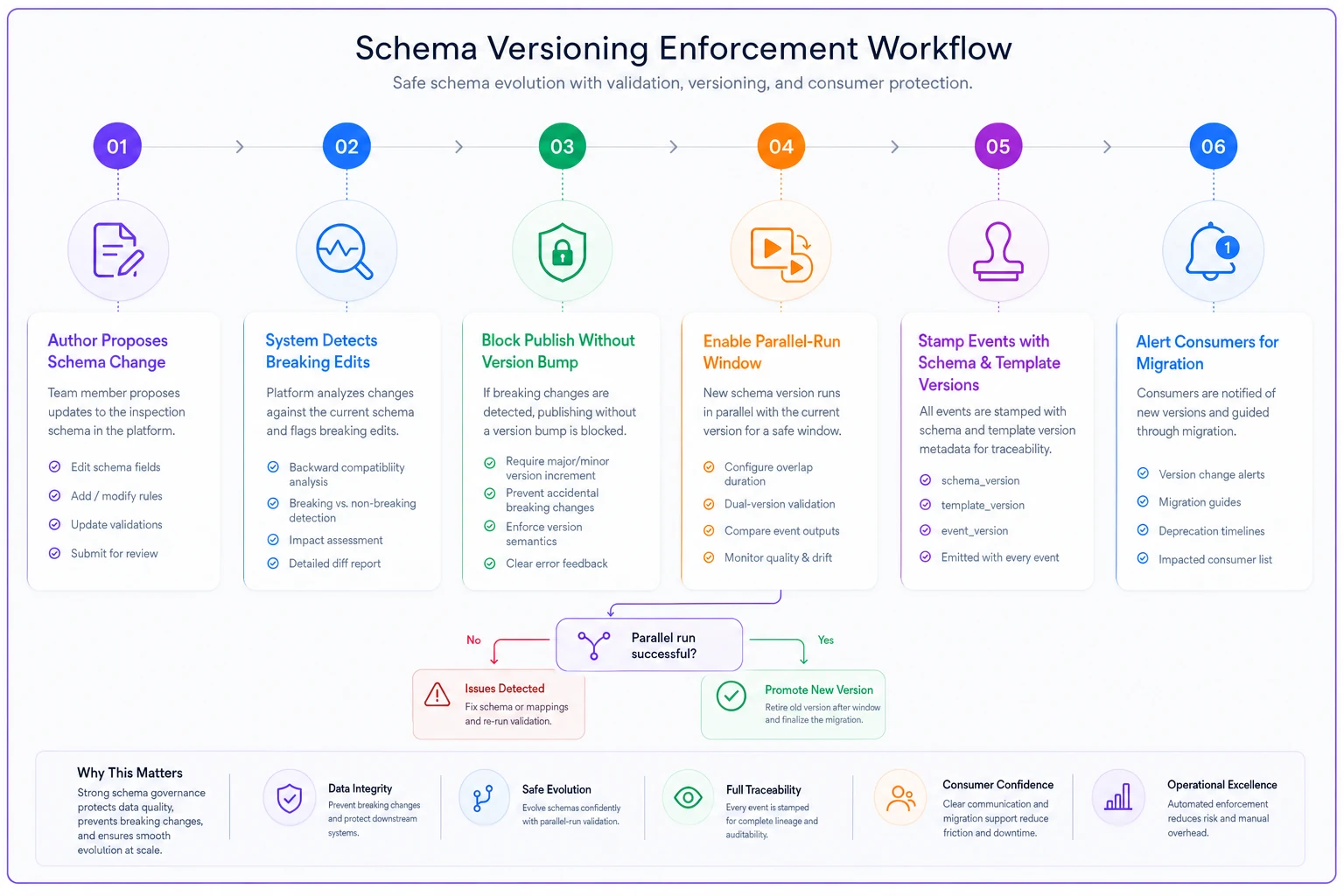
A simple workflow like this makes it obvious when a change needs governance and when it can be additive.
When this level of rigor makes sense — and when it doesn't
When it's worth it:
-
You run multiple sites or feed data to more than one downstream consumer.
-
Your inspection data supports audits, accreditation, or regulatory reporting.
-
You've already been burned by a mystery gap in your trend data.
-
You ingest third-party inspection feeds.
When it's overkill:
-
A single-site operation with one person doing both inspections and reporting. The contract lives in that person's head, and formalizing it adds friction with little payoff.
-
Very early programs still figuring out what they even need to measure. Lock the contract too early and you'll spend all your version bumps on churn.
Who should not start here:
If your forms are still changing weekly because the program is young, don't freeze a data contract yet — you'll just generate breaking changes constantly. Get the core measurements stable first, then draw the contract around the parts that have proven they'll last.
Pulling it together
Inspection data contracts aren't really a technical exercise. They're an operational agreement that keeps field flexibility and downstream reliability from constantly fighting each other. The forms should change all the time. The core data — the handful of events and fields everyone depends on — should change rarely, under clear versioning rules, with real notice to the people consuming it.
Get that separation right and most of the recurring headaches — the mystery dashboard gaps, the audit archaeology, the monthly manual cleanup, the vendor feeds that quietly break — stop being recurring. They become the occasional planned change instead of the constant background noise that erodes trust in your entire program.
Ready to modernize your inspection process?
Join 500+ inspection teams using Chekzly to reduce paperwork, improve compliance, and accelerate reporting.