

Most vendor QA programs die the same quiet death. Somebody builds a scorecard in a spreadsheet, fills it out for the first quarter, emails it to the vendor, and then nothing happens. The vendor says thanks, maybe fixes one thing, and six months later you're staring at the same defect categories. The scorecard existed. It just never did anything.
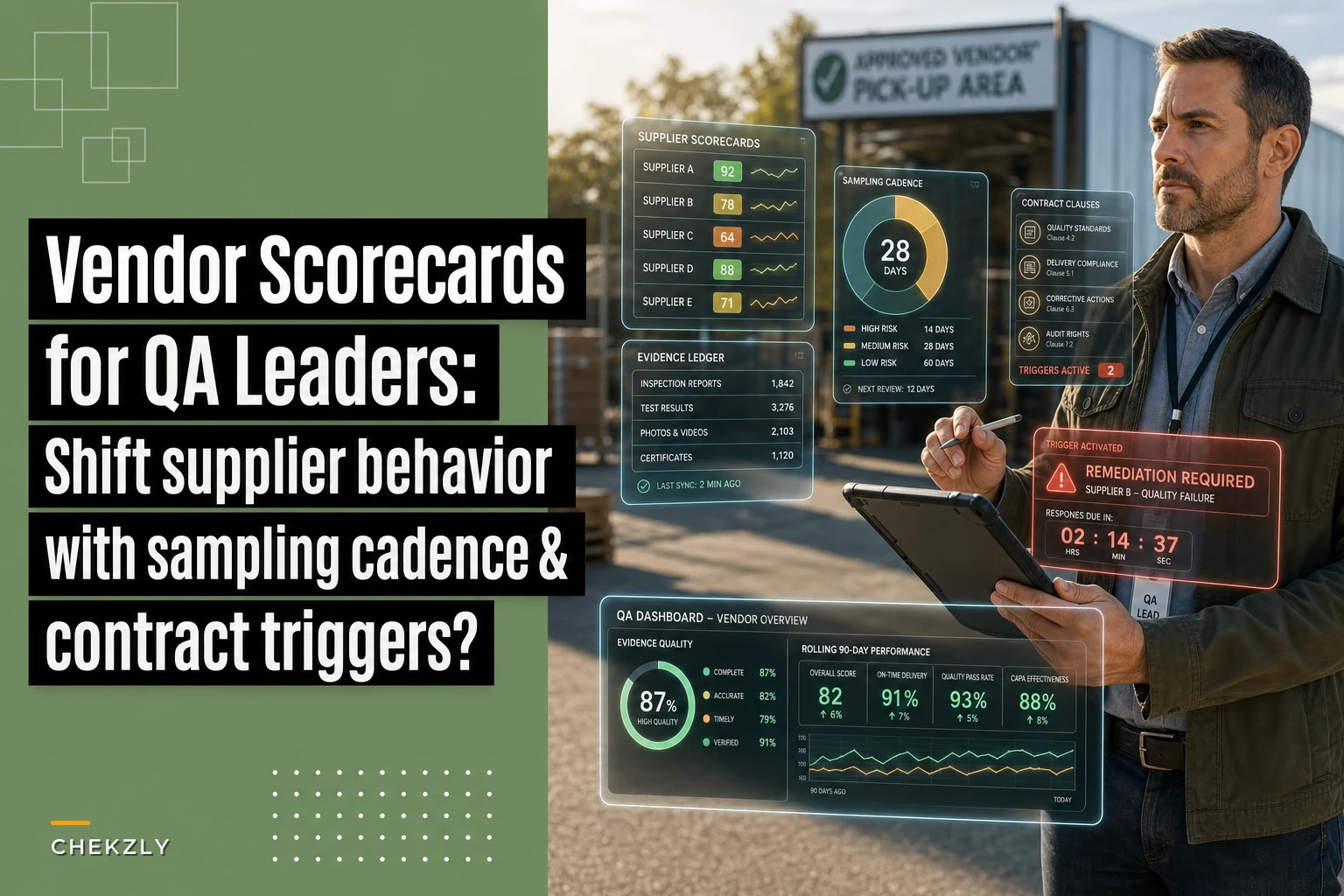
The difference between a scorecard that sits in a folder and one that forces improvement comes down to three things that almost nobody connects: the sampling cadence behind the numbers, the remediation triggers tied directly to contract language, and dashboards that put the right number in front of the right person before the next PO goes out. Get those three wired together and the scorecard stops being a report card and starts being a control.
This is specifically about that wiring. Not vendor selection, not credential checks — if you need the front-end of vendor data reliability, that's a separate problem covered in avoiding unreliable vendor data with contract terms and QA sampling. This piece assumes the vendor is already onboarded and you're trying to make their quality actually move.
Why most vendor inspection scorecards never change anything
The core failure is that the score has no teeth and no rhythm.
A scorecard gets built around whatever data is easy to pull — on-time delivery, first-pass rate, number of reinspections. Reasonable metrics. But the numbers come from inconsistent sampling. One month the field team inspected 40% of a vendor's lots because they were nearby; the next month they hit 8% because everyone was slammed. So the score swings, and when it swings the vendor has a perfect excuse: "Your data's noisy. We can't act on that."
They're not entirely wrong, and that's the problem. If your sampling isn't deliberate, every bad score is arguable. And a score that's arguable never triggers anything.
The second failure is softer but just as fatal. The scorecard lives in a world completely disconnected from the contract. The contract says the vendor will maintain a defect rate below some threshold, with some remedy if they don't. The scorecard measures a defect rate. But nobody ever draws the line between the two. So when the vendor's number blows past the contractual threshold, there's no automatic consequence — just a conversation, maybe, if someone notices.
A scorecard that can't point at a contract clause is just an opinion with charts.
Start with sampling cadence, not metrics
Everyone wants to design the metrics first. That's backwards. Your metrics are only as trustworthy as the sampling behind them, so the cadence is the foundation.
Eliminate inspection delays and errors.
Chekzly helps you plan, execute, and document inspections efficiently and accurately.
- Real-time inspection tracking
- Automated report generation
- Compliance and checklist management
No credit card required
The goal is a defensible, risk-weighted sampling plan where every vendor has a known inspection rate tied to their risk tier — and that rate holds steady enough that month-over-month comparisons actually mean something.
A practical tiering model looks like this:
| Vendor tier | Risk profile | Sampling cadence | Minimum sample per period |
|---|---|---|---|
| Tier 1 (critical) | Safety-relevant or single-source | Every lot or every shipment | 100% or AQL at tightened level |
| Tier 2 (standard) | Multiple sources, moderate impact | Rolling weekly sample | ~15–25% of lots |
| Tier 3 (low) | Commodity, easily replaced | Monthly skip-lot | ~5% with reduced inspection |
| Probation (any tier) | Recently triggered remediation | Tightened for defined window | Bumped one level above base |
The probation row is the one people forget, and it's the most useful. When a vendor trips a trigger, you don't just score them worse — you inspect them more. That tightened cadence is both a diagnostic (you find out fast whether they actually fixed anything) and a cost: more scrutiny is real work for them too.
One thing worth flagging from real operations: cadence drifts. Field teams quietly reduce sampling when they're busy, and nobody logs it. Three months later the score looks great and it's partly because you stopped looking. Whatever system holds your inspection records needs to capture planned vs. actual sample rate as a first-class field, not something you reconstruct after the fact.
Log planned vs. actual sample rate as a first-class field so you can prove the cadence rather than reconstruct it later.
If you can't prove you inspected at the rate you claimed, the whole scorecard is soft.
Design triggers that point directly at contract clauses
This is the part that turns a scorecard from passive to active. Every metric on the card should map to a specific contractual consequence, and the trigger condition should be stated clearly enough that it fires without debate.
A trigger isn't "the vendor's quality got worse." A trigger is a precise, pre-agreed condition. Build it in this order:
-
Define the metric and its source. Example
rolling 90-day lot defect rate, calculated from inspection records at the agreed sampling cadence.
-
Set the threshold that maps to the contract. The contract says ≤2.0% defect rate. Your trigger fires at 2.0%, not at "when it feels bad."
-
Specify the trigger window. A single bad lot shouldn't nuke a vendor. Something like "two consecutive sampling periods above threshold" or "any single period above 2× threshold."
-
Name the contractual remedy that activates. Tightened inspection at vendor cost, a corrective action request with a deadline, a hold on new POs, or a price-adjustment clause.
-
Assign the owner and the clock. Who gets notified, who issues the remediation notice, and how many days the vendor has to respond.
The reason this works is that the trigger and the remedy were negotiated before anyone was angry. When the number hits, there's nothing to argue about — the vendor already agreed to what happens next. You're not asking for a favor; you're executing a clause.
A realistic trigger-to-clause mapping might read:
-
Defect rate above contractual AQL for two consecutive periods → tightened inspection at vendor expense, CAR required within 10 business days.
-
Repeat defect in same category across three periods → mandatory root-cause review and on-site audit, vendor-funded.
-
Missed CAR deadline → PO hold until remediation plan accepted.
-
Falsified or missing certs → immediate escalation, separate from the quality score entirely.
That last one lives outside the normal scoring flow. Integrity failures aren't quality dips — they don't get averaged into a rolling number. They get their own fast lane.
Build the scorecard so the number is already attributable
A common and expensive mistake: the scorecard shows a blended score, and when a vendor contests it, nobody can decompose it back to the underlying inspections. You get a 72/100 and no way to show your work.
The scorecard needs to drill down to the lot and the checklist version used. This matters more than it sounds. If a vendor's defect rate jumped, the first thing a sharp vendor will say is "you changed the checklist on us." Sometimes they're right. If your checklist changed mid-period without clear version control, you've got an apples-to-oranges comparison baked into the score — which is exactly the kind of mess that comes from weak checklist version control and missing rollback rules. Every data point feeding the scorecard should carry the checklist version it was captured against, so you can honestly say the measurement standard held constant.
Structure the scorecard in layers:
-
Top layer composite score and tier, plus a clear flag for any active trigger.
-
Middle layer the component metrics — defect rate, first-pass yield, CAR closure time, reinspection rate — each shown against its contractual threshold.
-
Bottom layer the raw inspection records, filterable by lot, date, checklist version, and inspector.
The bottom layer is what makes the top layer credible. When you can go from "this vendor scored a 68" to "here are the eleven lots that drove it, captured on checklist v4.2, here are the photos" in under a minute, the vendor conversation changes completely.
A dashboard that drives action, not just awareness
Dashboards fail when they're built to inform instead of to prompt a decision. A vendor QA dashboard should answer one question first: who needs action this week, and what is it?
The useful layout puts triggered vendors at the top — not alphabetically, not by spend, but by what has an open consequence attached. A workflow that actually moves vendor quality tends to run like this:
A field team completes inspections at the planned cadence. Results flow into the vendor record with lot, checklist version, and defect category attached. The rolling metric recalculates automatically. When a metric crosses a contractual threshold, the dashboard surfaces that vendor at the top with the specific clause referenced and the remedy pre-filled — "defect rate 2.6% over two periods, CAR required by [date], owner: J. Patel." The QA manager issues the CAR with one action instead of rebuilding the case from scratch. The vendor's cadence auto-tightens to probation level. The clock on the CAR deadline starts and shows on the dashboard as a countdown. If the deadline slips, the PO-hold trigger lights up.
This is where AI-assisted operational platforms earn their place — quietly. The value isn't anything flashy. It's that the recalculation, the threshold check, the clause lookup, and the deadline tracking happen without a person remembering to do them. In real operations, triggers get missed not because people don't care but because recomputing rolling metrics across thirty vendors by hand is tedious, and tedious work gets skipped. Letting the system watch the thresholds and flag when something needs attention means the human spends time on the vendor conversation — not on the arithmetic that should have prompted it.
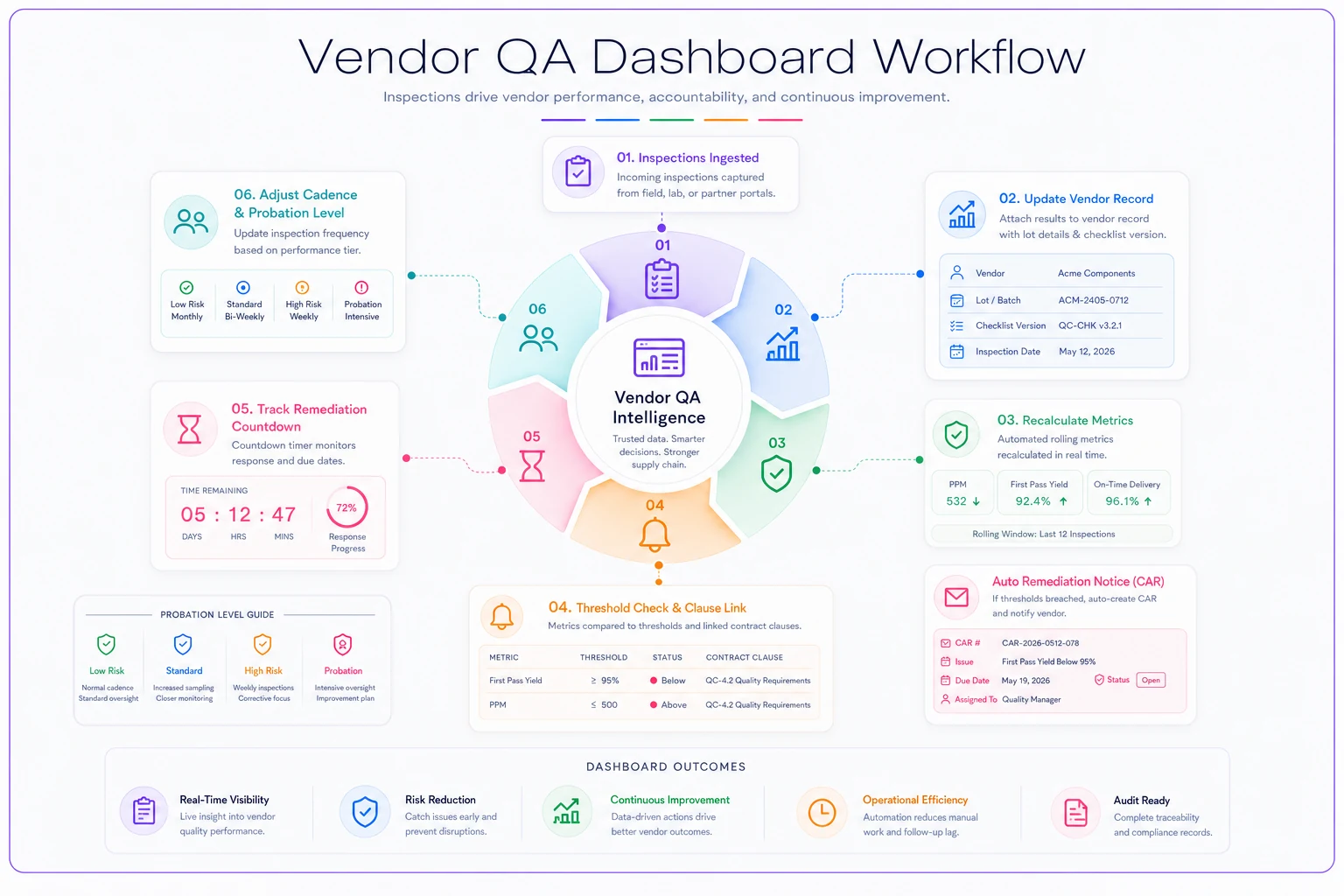
A short diagram like this helps stakeholders see how data, thresholds, clauses and remediation actions connect without stepping through spreadsheets.
That's the whole point of automation here. Not to replace judgment — to make sure judgment gets invoked at the right moment.
A real scenario
A mid-sized contract manufacturer sourcing machined components ran a scorecard in a spreadsheet for about a year. Three people maintained it, loosely. Their incoming defect rate on a key Tier 1 supplier hovered around 3–4%, well above the 2% in their supply agreement, but the score never forced anything because the numbers were inconsistent and nobody tied them to the contract's corrective-action clause.
They did two things. First, they fixed the sampling cadence — locked the Tier 1 supplier to 100% incoming inspection and started logging planned vs. actual rate. Second, they wrote explicit triggers mapped to the existing contract: two consecutive periods above 2% meant a mandatory CAR at the supplier's cost, with a 10-day clock.
The first trigger fired within about six weeks. Because the consequence was already in the contract, the supplier didn't argue — they ran the root cause, found a worn fixture, and replaced it. Over the next two quarters the defect rate settled to roughly 1.5–1.8%. Reinspection labor on that one supplier dropped by something like a third, and the arguments about "noisy data" basically stopped because every number traced back to a lot and a checklist version.
Nothing exotic happened. They just made the score mean something and gave it a deadline.
When this approach makes sense — and when it doesn't
This level of structure pays off when you have vendors you can't easily replace, contracts with real quality clauses, and enough volume that patterns actually form. If a vendor ships you a handful of lots a year, rolling metrics are statistical noise and you're better off with a straightforward pass/fail and a conversation.
Building trigger automation before the contract language exists is also a bad idea. If your supply agreements are vague — "vendor shall maintain reasonable quality" — there's nothing to trigger against, and you'll end up inventing thresholds the vendor never agreed to. Fix the contract first, then wire the scorecard to it. Building triggers on top of un-negotiated thresholds just creates fights you'll lose.
And skip the whole machine if you can't maintain sampling discipline. A scorecard built on inconsistent sampling will generate false triggers, and a few false triggers will destroy the credibility of the entire program faster than no program at all. The cadence has to hold before the consequences can.
The short version
A vendor inspection scorecard only changes behavior when three pieces lock together: a sampling cadence steady enough that the numbers are defensible, triggers written so they point at a specific contract clause and fire without debate, and a dashboard that surfaces the vendor needing action with the remedy already attached. Everything else is decoration.
If your current scorecard gets emailed out and nothing happens, the fix usually isn't better metrics. It's connecting the metrics you already have to a cadence you can prove and a consequence the vendor already signed.
If your current scorecard gets emailed out and nothing happens, the fix usually isn't better metrics. It's connecting the metrics you already have to a cadence you can prove and a consequence the vendor already signed.
Ready to modernize your inspection process?
Join 500+ inspection teams using Chekzly to reduce paperwork, improve compliance, and accelerate reporting.