
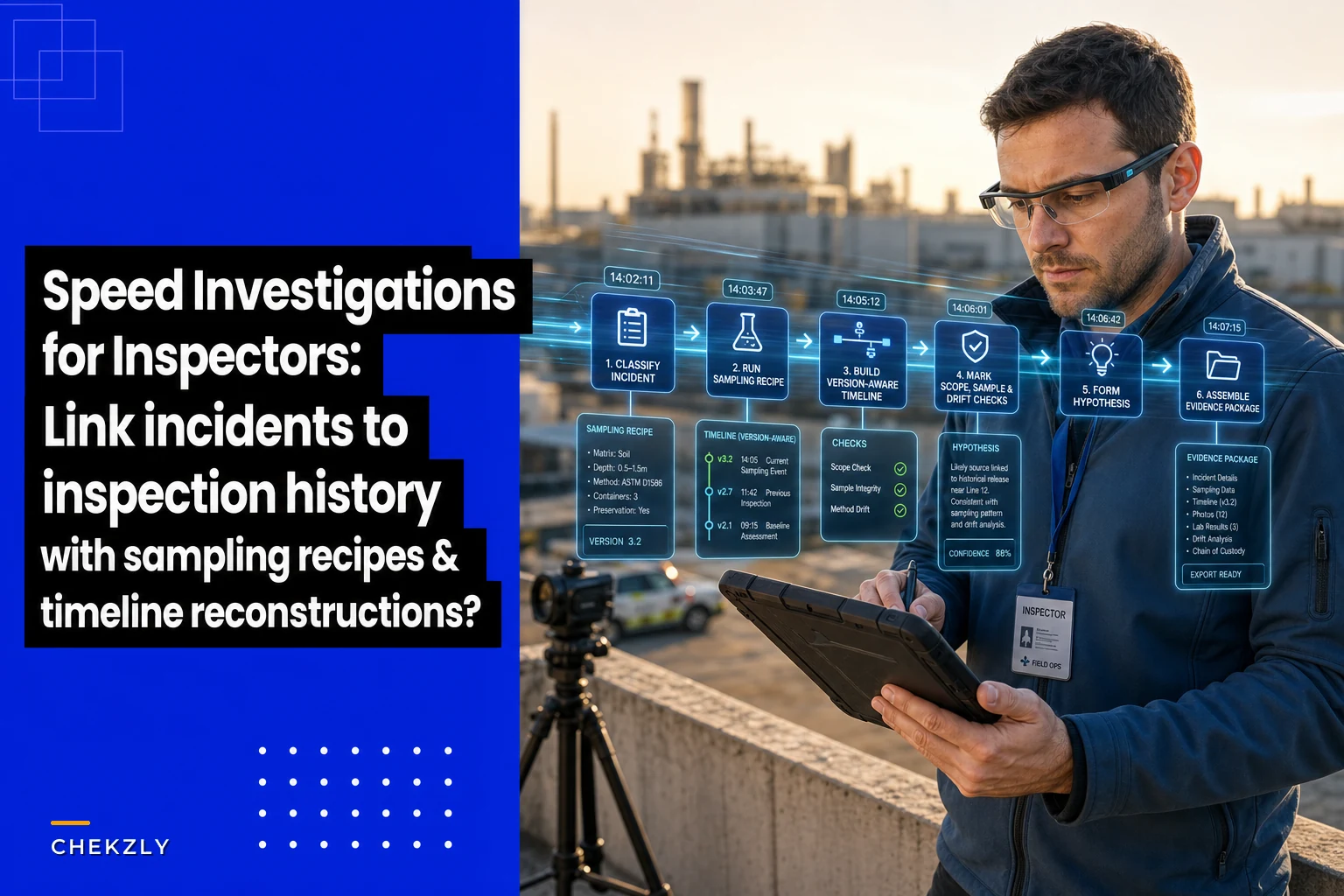

When something breaks, the first question is always "what did we already know about this?"
Most inspection incident investigations start from the wrong place. Something fails — a valve lets go, a coating peels early, a piece of equipment throws an out-of-spec reading that should have been caught — and the team scrambles to figure out what happened right before the failure. They pull the last inspection, read the report, and if it says "pass," they shrug and start looking for a fresh cause.
That's backwards. The failure almost never lives in the last inspection. It lives in the drift across the last four or five inspections, or in a sampling gap nobody flagged, or in a note buried in a report from eight months ago that was technically correct but quietly told you this asset was heading somewhere bad.
An investigation-first method flips the order. Instead of asking "what caused this," you first ask "what does our inspection history already say about this asset, this inspector, this failure mode, and this location?" You reconstruct what you knew and when you knew it. Root cause gets much faster to identify once you stop treating the incident as a blank slate.
Why the last-inspection reflex slows everything down
The reflex to grab the most recent report makes sense emotionally. It's the closest thing in time to the failure, so it feels most relevant. But inspection records aren't a single point — they're a trail, and the useful signal is usually in the shape of the trail, not the last dot.
Here's how it actually goes wrong. A team pulls the last inspection, sees a pass, and suddenly has a mystery. So they widen the search — but they widen it toward the equipment, the process, the vendor — anywhere except back through the inspection history itself. Two weeks disappear into interviews and physical teardown before someone thinks to line up the last six reports side by side. And when they finally do, the story is obvious: measurements were creeping toward the tolerance edge for a year, and every individual report was a legitimate pass.
The other reason this happens: inspection history is genuinely hard to assemble on short notice. Reports live in different formats, sampling records are separate from findings, photos are in one place and readings in another. Nobody's fault exactly — but when reconstructing "what we knew" takes three days of manual digging, investigators skip it and jump straight to fresh theories.
The core idea: link the incident backward before you look forward
An investigation-first approach has a specific opening move. Before anyone theorizes about cause, you build a linked history packet — every inspection, sample, and finding tied to the asset or asset class involved in the incident.
Eliminate inspection delays and errors.
Chekzly helps you plan, execute, and document inspections efficiently and accurately.
- Real-time inspection tracking
- Automated report generation
- Compliance and checklist management
No credit card required
Not the last one. All of them, or at least a defensible window.
The point is to answer three questions before you generate a single hypothesis:
-
Did our inspections ever touch the failure mode that actually occurred? Sometimes they didn't. That's a scope finding, not a cause finding, and it changes the whole investigation.
-
Was there drift? Readings trending toward limits, findings getting reclassified downward, re-inspection intervals quietly stretching.
-
Was there a sampling gap? The failed component or zone may never have been in a sample. If you were inspecting 1 in 20 welds and the bad one was in the other 19, that's your answer — and it has nothing to do with inspector competence.
Answering these first tells you which investigation you're actually running. A missed-defect investigation, a drift investigation, and a sampling-coverage investigation are three completely different exercises. Teams that skip the linking step often spend a week running the wrong one.
Retrospective sampling recipes
This is the part most teams don't have a repeatable method for. When an incident hits, you shouldn't be improvising which historical records to pull. You should have recipes — predefined pulls tied to the failure type.
A sampling recipe is just a saved definition of "when this kind of thing fails, go get exactly these records." Think of them as investigation-triggered queries you've written in advance, so nobody's guessing under pressure.
-
Asset-lineage recipe — every inspection of the specific asset, plus every inspection of its sibling assets (same model, same install batch, same environment). If three siblings show the same early drift, you're not looking at a one-off.
-
Inspector-consistency recipe — pull the failing asset's history grouped by which inspector performed each pass. You're not hunting for blame; you're checking whether findings shift systematically by who's holding the gauge. That's a calibration or training signal, not a "bad inspector" verdict.
-
Failure-mode recipe — across the whole program, every prior finding that matches this failure mode, regardless of asset. This tells you whether the incident is isolated or the visible edge of a pattern you've been under-catching everywhere.
-
Interval-drift recipe — the actual dates between inspections for this asset versus the scheduled interval. Slipped intervals hide in plain sight and quietly explain a lot of "sudden" failures.
Name and version your recipes so the pulled record sets remain auditable alongside checklist versions.
The recipe approach matters because pressure makes people sloppy. In the middle of a live incident, "pull the relevant history" is too vague and someone will pull too little. A named recipe with a defined record set removes the judgment call at the worst possible moment to be making judgment calls.
A quick comparison of how the two approaches play out
| Aspect | Last-inspection reflex | Investigation-first with recipes |
|---|---|---|
| First move | Read most recent report | Pull linked history via a recipe |
| Time to first useful signal | Often days | Usually hours |
| Common outcome | "Report said pass, cause unknown" | Drift / gap / scope issue identified early |
| Where investigators spend time | Fresh theories, teardown | Confirming a pattern the data already shows |
| Repeatability | Depends on who's leading | Consistent across incidents |
The difference in repeatability is what compounds over time. A team running investigation-first consistently builds a library of resolved patterns. The next similar incident takes half the time because someone's already documented what that drift signature looks like.
Timeline reconstruction that actually holds up
Once you've pulled the linked history, you build a timeline. Not a narrative summary — an actual dated sequence that puts inspections, findings, sample coverage, interval changes, and the incident on one line.
A usable reconstruction includes, for each entry:
-
The date and what type of event it was (inspection, re-inspection, finding, remediation, calibration event, interval change).
-
The measured values or the finding classification — the raw data, not a summarized "pass/fail."
-
Whether the failed component was in scope and in the sample for that event.
-
Who performed it and against which checklist version.
That last point catches people off guard. If your checklist changed between two inspections, a "pass" before and after the change might not mean the same thing — the earlier version may not have checked the thing that eventually failed. Version-aware timelines expose that instantly. Reconstructing what each pass actually covered depends heavily on having clean, retrievable records in the first place, which is why an audit-ready records system with real metadata and retrieval SOPs pays off most during an investigation, not during a routine audit.
The insight here: a good timeline usually shows you the root cause before you've formally named it. When you lay the readings out in order and see them marching toward the tolerance line while every report says pass, you don't need a theory. You need to explain why an accepted process let a known drift run to failure — which is a much sharper, faster question than "what happened."
A short workflow for running one of these investigations
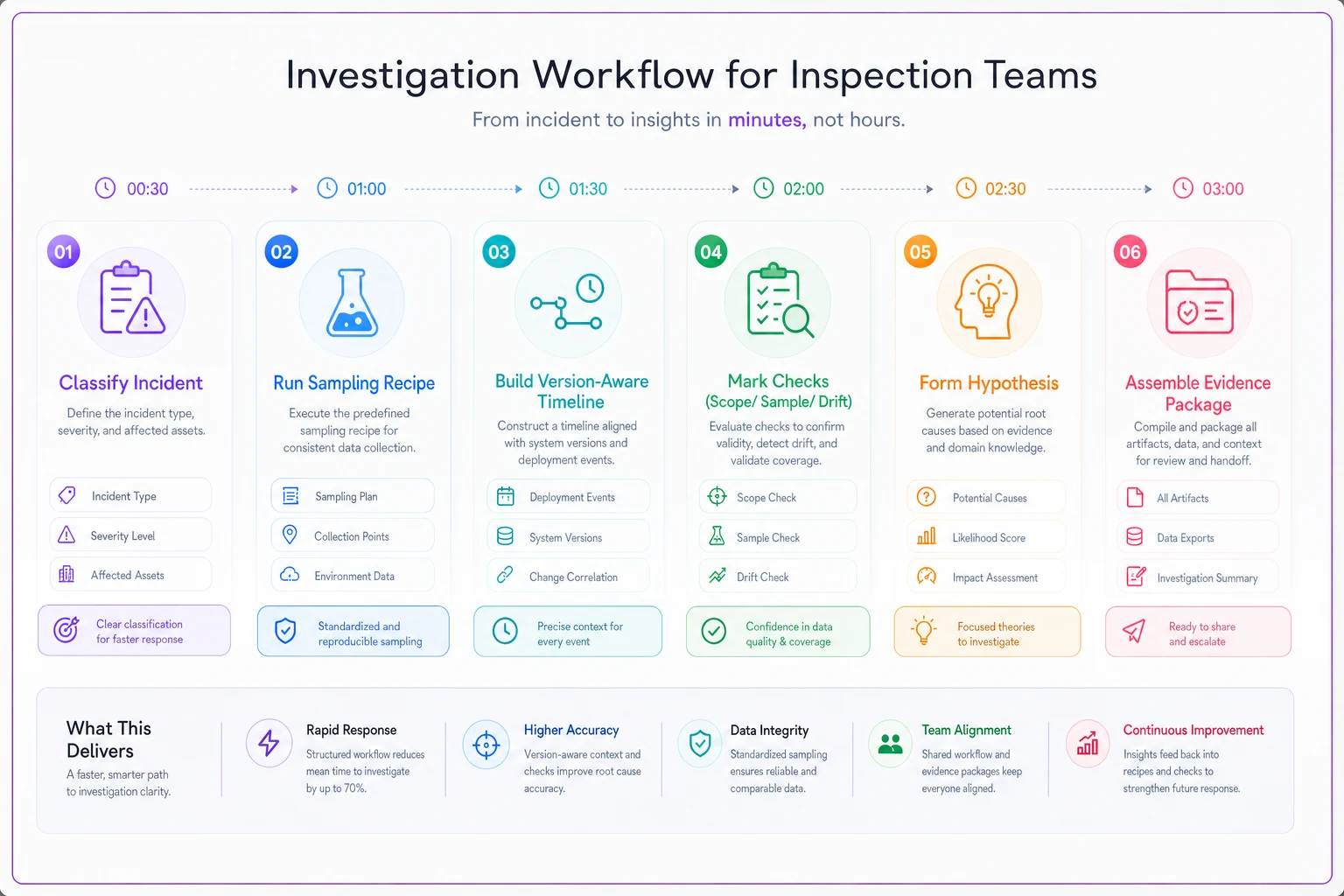
The sequence below keeps this from turning into a multi-week research project:
-
Classify the incident by failure mode within the first hour. This decides which sampling recipe you run.
-
Run the matching recipe to pull the linked history — asset lineage, siblings, matching failure modes, interval history.
-
Build the version-aware timeline from that pull. Raw values, not summaries.
-
Mark the three checks on the timeline
was the failure mode in scope, was the component in the sample, was there drift.
-
Form your hypothesis from the timeline, not before it. The pattern should already be visible.
-
Assemble the evidence package — timeline, source records, sampling justification, and the specific findings that support the conclusion.
Hypothesis generation is step five, not step one. That ordering is the whole method. Skipping to theories before the timeline is built is exactly how teams end up running the wrong investigation for a week.
A simple flowchart of these steps helps teams follow the order under pressure.
Hypothesis generation is step five, not step one. That ordering is the whole method. Skipping to theories before the timeline is built is exactly how teams end up running the wrong investigation for a week.
Evidence-package templates
The output of an investigation-first process is a package, and it's worth standardizing what goes in it. A repeatable template does two things: it speeds up the current investigation, and it makes past investigations searchable when a similar incident hits later.
A solid evidence package includes:
-
The reconstructed timeline as the centerpiece, with source records linked to each entry.
-
The sampling justification — which recipe was used, what records it pulled, and explicitly what was not pulled and why. Investigators forget to document the boundary of the search, and that boundary matters when someone questions the conclusion later.
-
The three findings answers — scope, sample coverage, drift — stated plainly.
-
The root-cause statement tied directly to specific timeline entries, not to general reasoning.
-
A "what our history missed" note — the honest section that says whether the inspection program had a real chance to catch this. This is where you find the corrective action for the program itself, separate from fixing the asset.
That last item is the one teams cut first and regret most. Fixing the failed asset closes the incident. Fixing the inspection gap that let it through is what prevents the next several. Feeding those "what we missed" notes back into your review cadence — the same cadence you'd track in a practical inspection analytics program — is how investigations actually improve the program instead of just documenting failures.
A real scenario
A mid-sized industrial services outfit ran periodic thickness inspections on process piping across a handful of client sites. A section failed roughly four months after its last inspection — which had, of course, passed. The initial reaction was exactly the reflex described above: pull the last report, see the pass, start questioning the inspector who ran it.
Instead they ran an asset-lineage pull and built the timeline. Six inspections over about three years, all passes. But laid out in sequence, the readings had been dropping in a steady, almost linear line the whole time — and the scheduled 12-month interval had quietly stretched to around 16 months on the last two cycles because of site access issues. No single report was wrong. The drift plus the slipped interval, together, ran the section past its usable margin before anyone re-checked it.
Reconstructing that took part of a day. A conventional teardown-first investigation would have probably run one to two weeks and likely landed on "inspector error" — which would have been both wrong and useless. The actual corrective actions — a drift-based flag when consecutive readings trend downward, and a hard rule that access-related interval slips get escalated instead of quietly absorbed — came straight out of the "what our history missed" note. Neither of those fixes touches the inspector at all.
When this method makes sense — and when it doesn't
It makes sense when you have any meaningful inspection history to reconstruct, when failures involve degradation or measurable conditions over time, and when you're running enough incidents that repeatable recipes save real effort. High-consequence assets basically demand it, because "inspection passed, cause unknown" is not an acceptable place for an investigation to stall.
It's overkill when the incident is plainly a one-time external event with no inspection relationship — someone drove a forklift into something, weather did damage, a brand-new asset failed on day one with no history to reconstruct. Forcing a full retrospective there just burns time.
Who should not lean on this too hard: teams whose historical records are too fragmented to reconstruct honestly. If you can't trust that the timeline you built is complete, the method produces confident-looking conclusions from incomplete data — which is worse than admitting you don't know. Fix retrieval and record integrity first, then adopt the method. A shaky reconstruction is more dangerous than no reconstruction, because people believe it.
The takeaway for how you run the next one
Next time an inspection-related incident lands, resist the pull toward the most recent report. Classify the failure mode, run the matching history pull, and build the timeline before anyone offers a theory. The pattern that explains the failure is usually already sitting in your records — spread across several inspections, a sampling boundary, or a slipped interval — waiting for someone to line it up.
Getting good at this isn't about better forensics on the failed part. It's about treating inspection history as evidence from the very first hour, and having the recipes and templates ready so nobody has to improvise the investigation while the pressure's on.
Next time an inspection-related incident lands, resist the pull toward the most recent report. Classify the failure mode, run the matching history pull, and build the timeline before anyone offers a theory. The pattern that explains the failure is usually already sitting in your records — spread across several inspections, a sampling boundary, or a slipped interval — waiting for someone to line it up.
Getting good at this isn't about better forensics on the failed part. It's about treating inspection history as evidence from the very first hour, and having the recipes and templates ready so nobody has to improvise the investigation while the pressure's on.
Ready to modernize your inspection process?
Join 500+ inspection teams using Chekzly to reduce paperwork, improve compliance, and accelerate reporting.