

Most inspection teams are actually decent at capturing near-misses now. Someone spots a frayed rigging strap, a missing lockout tag, a chemical drum stored two feet from an ignition source — they snap a photo, tap it into the app, and move on. The capture rate looks great on a slide.
The problem shows up three months later when a regulator or a client's safety lead asks a simple question: "You logged 47 near-misses last quarter. Show me which ones are closed, what you actually changed, and prove it." And the room goes quiet, because half those records dead-end at "reported." No corrective action linked. No re-inspection. No evidence the fix held.
That gap — between near-miss inspections that get logged and remediation that gets verified — is where most safety programs quietly leak credibility. This post is about the operational plumbing that closes it: templates that tie a near-miss to the inspection record, spawn a corrective action with an owner, and refuse to mark anything "done" until there's verification evidence attached.
The specific failure: capture is an event, closure is a process
Capturing a near-miss is a single moment — one person, one form, thirty seconds. Closing it is a chain that can span weeks, involve three different people, and require a physical return to the site.
Teams build workflows for the moment and improvise the chain.
A typical example: an inspector at a mid-size facilities contractor logs a near-miss — an extension cord run across a walkway, taped down but fraying. Photo attached, severity marked "medium." The app confirms submission. Everyone feels productive.
What should happen next: a corrective action gets generated, assigned to the site supervisor, with a due date and a required verification step. What actually happens: the near-miss sits in a "reported" bucket. The supervisor may or may not see it in a weekly export. The cord may or may not get replaced. And when the next inspector visits, they have no reason to check that specific spot, because nothing linked the near-miss to a follow-up inspection task.
Why it keeps happening
-
Capture tools and corrective-action tools live in different systems. The near-miss goes into an inspection app. The corrective action lives in a maintenance ticketing tool or, worse, a supervisor's text messages. No shared ID connects them.
-
"Closed" means "someone said they fixed it." Verification gets treated as a formality — a checkbox — not as a required piece of evidence with its own standard.
-
No one owns the chain end-to-end. The inspector owns capture. The supervisor owns the fix. But nobody owns confirming the fix happened and holds up. This is the same ownership vacuum that quietly sinks programs at scale — a problem worth reading about in the operational blueprint for when inspection programs fail to scale.
The record exists. The fix might exist. But nobody can prove the two are connected. That's the whole ballgame during an audit.
What a real linked template looks like
The fix isn't more software features. It's a template structure that makes the links mandatory instead of optional. Every near-miss record needs to carry the fields that force it forward.
Eliminate inspection delays and errors.
Chekzly helps you plan, execute, and document inspections efficiently and accurately.
- Real-time inspection tracking
- Automated report generation
- Compliance and checklist management
No credit card required
| Field | Purpose | Why it matters for closure |
|---|---|---|
| Near-miss ID | Unique reference | Everything downstream references this ID |
| Linked inspection record | Ties the observation to the inspection it came from | Auditors can trace context and conditions |
| Severity + hazard category | Drives priority and due date | A "high" auto-escalates; a "low" batches |
| Corrective action ID | The spawned fix task | The single most-skipped link |
| Assigned owner + due date | Accountability | No owner = no closure, ever |
| Verification method required | Photo, re-inspection, sensor reading, sign-off | Defines what "proof" means before the work starts |
| Verification evidence | The actual proof attached | This is the field that survives an audit |
| Closure status | Open / In progress / Verified-closed | "Verified-closed" is distinct from "reported fixed" |
The key move is that the verification method gets defined at capture time, not at closure time. If an inspector logs a frayed cord, the template already knows that closure requires a follow-up photo showing the cord replaced plus a re-inspection checkbox from a second person. Nobody negotiates the evidence bar after the fact.
The workflow, start to finish
Here's how a single near-miss should move through the system without any dead ends.
-
Capture. Inspector logs the near-miss during a routine inspection. The record auto-links to that inspection's ID and site. Severity gets set, which drives the due-date rule.
-
Auto-generate corrective action. The moment severity is saved, a corrective action spawns with a linked ID. This is not manual. If a human has to remember to create it, some percentage never gets created — and those are the ones that show up in audits.
-
Assign and notify. The action routes to the responsible role (not a named person who might be on leave — a role, like "site safety lead"). Due date is calculated from severity.
-
Define the evidence bar. The template already carries the required verification method for that hazard category. The owner sees exactly what proof they'll need to submit.
-
Remediate. The fix happens on-site.
-
Submit verification evidence. Owner attaches the required proof — a timestamped photo, a re-test reading, a second-person sign-off.
-
Verify and close. A designated verifier (someone other than the person who did the work) confirms the evidence meets the standard and marks the record verified-closed. If evidence is missing or weak, the record bounces back to step 5.
-
Feed the loop. The closed near-miss and its cycle time flow into the KPI dashboard.
That step 7 separation — verifier ≠ fixer — is the piece most teams skip, and it's the one that matters most. Self-certified closures are exactly what a sharp auditor pulls to test whether your program is real.
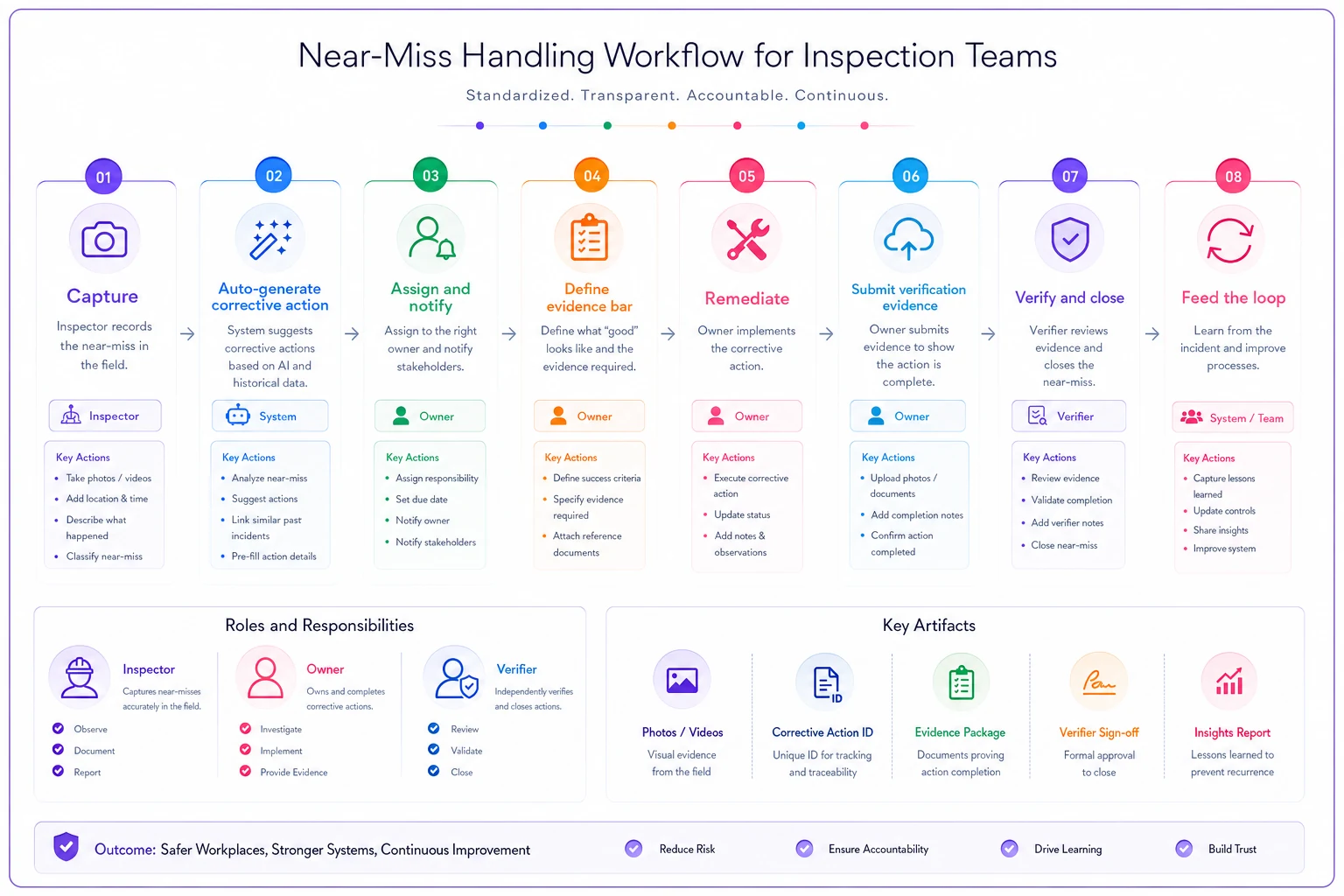
This visual maps the steps and roles so teams can see who owns each handoff.
Verification evidence standards: define "proof" before you need it
"Attach a photo" is not a standard. A blurry photo of a wall could be anything. The teams that survive audits cleanly write down, per hazard type, what counts as acceptable evidence.
-
What the evidence must show — the specific corrected condition, not a vague area shot
-
Timestamp and location metadata — so nobody can recycle an old photo
-
Who can verify — a role separate from the person who performed the work
-
A minimum verification action — e.g., "re-inspect within 5 business days" for anything severity-high
A quick but important distinction: a photo showing a new cord run overhead through a proper cable tray is verification. A photo showing the old cord with fresh tape is not — that's a temporary patch, and your standard should reject it as closure evidence. If your template treats both as "photo attached = closed," you've built a system that launders unfixed hazards into clean records.
Real scenario: a regional inspection firm cleans up its closure gap
Before: Over a quarter they logged around 130 near-misses. On paper, about 90 were marked "resolved." But when a large client asked for verification evidence during a contract review, they could produce solid proof for maybe 35 of them. The rest were verbal confirmations, missing photos, or corrective actions that had never been formally created. Cycle time from capture to verified closure was genuinely unknown — they couldn't measure it because "closed" wasn't a consistent state.
What they changed: They rebuilt the near-miss template to auto-spawn a linked corrective action on save, defined evidence standards for their five most common hazard categories, and split the verifier role away from the person doing the fix.
After: Roughly a quarter later, verified-closure evidence existed for around 85–90% of logged near-misses, up from that ugly ~27%. Median time from capture to verified-closed landed around 9 days for medium-severity items. The measurable win wasn't a revenue number — it was that the next client audit took a fraction of the prep time, because pulling evidence became a query instead of a scramble. The bigger shift was behavioral: supervisors stopped treating near-misses as paperwork and started treating them as tasks with a finish line.
KPIs that tell you the loop is actually closing
Capture rate is a vanity metric on its own. High capture with low verified-closure just means you're documenting hazards faster than you fix them. The dashboard needs to show the chain, not the event.
-
Verified-closure rate — verified-closed ÷ total near-misses. This is the headline number.
-
Capture-to-closure cycle time — median days, segmented by severity. High-severity items dragging past their due date is your first alarm.
-
Open-aging buckets — how many near-misses sit in 0–7, 8–30, 30+ day ranges. The 30+ bucket is where audit findings breed.
-
Evidence rejection rate — how often submitted proof gets bounced by the verifier. A rate near zero can actually mean your verifiers are rubber-stamping, not that your fixes are perfect.
-
Repeat-location rate — same hazard, same spot, recurring. Signals the corrective action treated a symptom, not a cause.
That last one is underrated. If the same frayed-cord location shows up three quarters running, your closures are technically valid and operationally worthless.
Track repeat-location rate by exact site tag or GPS to spot systemic issues rather than isolated fixes.
For structuring these into a coherent measurement layer rather than a pile of disconnected charts, the practical inspection analytics program breakdown on KPI taxonomy and review cadences is worth reading alongside this.
When this level of rigor makes sense — and when it doesn't
This isn't free. Building mandatory linked templates and separated verification adds friction to every near-miss. So be honest about fit.
When it makes sense:
-
You operate across multiple sites and can't personally verify anything
-
You're subject to client audits or regulatory review where evidence gets pulled
-
Your near-miss volume is high enough that "I remember that one" no longer works
-
Repeat incidents are showing up and you suspect closures aren't sticking
When it's overkill:
-
A single site with a hands-on supervisor who verifies everything personally the same day
-
Very low near-miss volume where a shared log genuinely suffices
-
Early-stage teams still fighting to get any capture happening — nail capture first, then build the closure chain
Who should NOT do this yet: teams that haven't defined severity consistently. If two inspectors rate the same hazard "low" and "high," your auto-generated due dates and escalations will be noise. Fix your severity rubric before you automate anything downstream of it.
Where operational software earns its place here
None of this requires fancy tooling — you can run linked closure on a well-designed spreadsheet if your volume is small. But the moment you're across dozens of sites, the manual version breaks in predictable ways: corrective actions that never get created, verifications that never get chased, aging items nobody's watching.
This is the narrow slice where an AI-assisted operational platform actually pulls its weight — not by making decisions for you, but by refusing to let the chain break. Auto-spawning the corrective action the instant a near-miss is saved. Flagging any record where the evidence field is empty past its due date. Surfacing the 30+ day aging bucket before an auditor does. Catching repeat-location patterns a human scanning a list would miss. The judgment stays with your verifiers; the software just makes sure nothing quietly falls out of the workflow.
The point isn't automation for its own sake. It's that "verified-closed" should be a state the system enforces, not a status someone types in hopefully.
The one thing to fix first
If you take a single action from this: stop letting "reported" and "resolved" be the only two states a near-miss can hold. Add verified-closed, define what evidence earns that status per hazard type, and make sure the person confirming the fix isn't the person who made it.
Everything else — the dashboards, the aging buckets, the auto-generated actions — is scaffolding around that one distinction. A near-miss program that captures beautifully and closes vaguely isn't a safety program. It's a very well-documented list of things you haven't finished yet.
If you take a single action from this: stop letting "reported" and "resolved" be the only two states a near-miss can hold. Add verified-closed, define what evidence earns that status per hazard type, and make sure the person confirming the fix isn't the person who made it.
Everything else — the dashboards, the aging buckets, the auto-generated actions — is scaffolding around that one distinction. A near-miss program that captures beautifully and closes vaguely isn't a safety program. It's a very well-documented list of things you haven't finished yet.
Ready to modernize your inspection process?
Join 500+ inspection teams using Chekzly to reduce paperwork, improve compliance, and accelerate reporting.