



An auditor doesn't reject your inspection record because the work wasn't done. They reject it because you can't prove when and where it was done. That distinction burns a lot of teams. The physical inspection was fine. The photos are clear. But the timestamp says 4:12 AM and the GPS coordinates land in a parking lot two blocks from the actual site — and now the finding is "evidence integrity cannot be established."
That's the whole problem in one sentence. Most timestamp and location verification failures aren't fraud. They're clock drift, offline devices, GPS bounce, and metadata that got stripped somewhere between the phone and the server. But an auditor treats "unverifiable" and "falsified" the same way when they're building their findings list.
This post is about the mechanics: which source do you trust when the device clock, the network, and the server disagree, and exactly what you write in your remediation notes when the metadata is missing entirely.
Three clocks, three stories, one record
Every inspection record is quietly stitched together from at least three time-and-place sources, and they rarely agree perfectly.
-
Device source — the phone or tablet's local clock and its onboard GPS. This is what the inspector actually experiences, but it's the least trustworthy. Clocks drift, users change time zones manually, and GPS indoors is a coin flip.
-
Network source — cell tower time, carrier location, or the timestamp the app gets when it briefly connects. More reliable for time, coarse for location.
-
Server source — when the record actually landed in your system. Extremely reliable, but it only tells you receipt time, not capture time. A record synced at 6 PM might have been captured at 9 AM.
The trap most teams fall into: they treat the device timestamp as the truth because it's the one printed on the photo. In reality, the device is the source you should trust least on time and most on location — and almost every team gets that backwards.
Here's a quick way to think about which source wins for which question:
| Question you're answering | Trust first | Trust second | Weakest |
|---|---|---|---|
| When was this captured? | Network (if online) | Server receipt (bounds it) | Device clock |
| Where was this captured? | Device GPS | Network/carrier location | Server (useless for location) |
| Was there tampering after capture? | Server hash/receipt | Network log | Device |
| Was the device offline during capture? | Server sync gap | Device queue state | Network |
The point isn't to memorize the grid. It's to stop treating the record as a single "the app said so" fact and start treating it as three independent witnesses you're cross-examining.
Why the three sources drift apart
In real operations, disagreement usually shows up in a handful of predictable ways.
Eliminate inspection delays and errors.
Chekzly helps you plan, execute, and document inspections efficiently and accurately.
- Real-time inspection tracking
- Automated report generation
- Compliance and checklist management
No credit card required
Offline capture and delayed sync. An inspector at a rural substation loses signal, completes six inspections, and everything queues on the device. When they hit wifi at the hotel that evening, all six upload at once — and the server receipt time for all six is 8:47 PM. If the device clock also drifted, there's no clean anchor at all.
Manual time-zone changes. Someone flies from Denver to Chicago, the phone doesn't auto-update, and every capture for a day is off by an hour. On paper it looks like inspections happened before the site opened.
GPS bounce in structures. Inside a warehouse, a parking garage, or near heavy steel, GPS can report a location 200–400 meters off. The inspector was standing on the right floor; the coordinates say they were across the street.
Metadata stripping. This is the quiet killer. Photos get pasted into a report, run through a compression step, or exported and re-imported — and the EXIF timestamp and geotag vanish. The image survives; the proof doesn't. We've covered how to keep this from happening at the point of capture in the field SOP for admissible photos and video, and most missing-metadata cases trace back to a workflow step that quietly re-saves the file.
The pattern underneath all of these: the failure happens after the inspection, in the handling, not during the work itself. That's actually good news, because handling is something you can control with process.
The verification hierarchy: what to trust, in what order
When you're reconstructing a record and the sources disagree, don't argue about which one is "right." Work down a fixed hierarchy so the decision is consistent and defensible. An auditor doesn't need you to be perfect — they need you to be consistent and documented.
-
Corroborated agreement. Two independent sources agree within tolerance (say, network time and server receipt gap both point to a 9–10 AM capture). Accept it. Note both sources.
-
Bounded reconstruction. No single confident source, but you can bound the answer. Server received at 8:47 PM, device queue shows capture was the first item, prior inspection at that site ended 9:05 AM per a separate log. You can state: "captured between 9:05 AM and the next queued event." Bounded is admissible. Precise-but-unverifiable is not.
-
Single trusted source. Only one source survived (e.g., network time is gone, but device GPS is intact and matches the assigned site). Accept the surviving source, explicitly flag the missing ones.
-
External anchor. No internal source is trustworthy. Fall back to independent evidence: a gate badge scan, a vendor sign-in sheet, a work order timestamp, a nearby sensor reading. Tie the record to something outside your own app.
-
Unrecoverable — declare it. If none of the above works, you don't fudge it. Document the record as time/location-unverifiable and state what you can confirm (the inspection content, the inspector identity, the assigned scope).
The mistake I see most often is teams jumping straight from step 1 to step 5 — "we can't confirm it exactly, so we'll just leave it blank." Steps 2 through 4 are where most "lost" records actually get rescued. Bounded and anchored evidence survives audits all the time.
Prove vs. check: two statements you need for every record
There's a useful distinction that keeps remediation clean. For each record, separate what you can prove from what you can only check.
-
A prove statement is backed by an independent, tamper-evident source. "Server receipt hash confirms this record was unaltered after 8:47 PM upload."
-
A check statement is a plausibility test, not proof. "Device GPS is within 150m of the assigned site; consistent with on-site capture but not independently confirmed."
Auditors respect this framing because it shows you understand the difference between evidence and inference. Writing a check as if it were a proof is exactly what gets a whole record thrown out — once they catch one overclaim, they distrust the rest.
A couple of worked examples of how these read in an actual file:
Example A — corroborated: > Prove: Network-synced timestamp (09:12) and server receipt gap both place capture in the 9:00–9:20 window. Check: Device GPS within 40m of Site B. Conclusion: Time and location verified, corroborated by two independent sources.
Example B — missing metadata, bounded: > Prove: Server receipt 18:47; record was queue position 1 of 4 (device sync log). Check: Inspector's prior work order at Site D closed 14:10; no other site assigned that afternoon. Conclusion: Capture bounded to 14:10–18:47 at Site D. EXIF timestamp absent; geotag absent. Flagged as bounded-verifiable, not precise.
Remediation procedures when metadata is missing
When you open a record and the timestamp or geotag isn't there, run a fixed procedure instead of improvising. Improvised remediation is inconsistent, and inconsistency is what auditors sample for.
-
Freeze the record. Don't re-export, re-save, or "clean up" the file. Any additional handling destroys more metadata and looks like tampering. Work from a copy.
-
Pull the server-side receipt log. This is almost always intact even when device metadata is gone. It gives you an upper bound on capture time and confirms the file hasn't changed since upload.
-
Pull the device sync/queue state if available. Queue order and offline-capture flags let you sequence multiple records against a single sync event.
-
Check for independent anchors. Work orders, badge scans, vendor logs, adjacent inspections by the same inspector, sensor timestamps from equipment on site.
-
Apply the verification hierarchy and land on a tier (corroborated / bounded / single-source / anchored / unrecoverable).
-
Write the prove/check statement with the tier explicitly named.
-
Log the gap. Record why the metadata was missing — offline sync, compression step, export path — so the same workflow hole gets fixed instead of repeatedly re-triaged.
That last step is the one teams skip, and it's why the same failure keeps generating audit findings quarter after quarter. If you're building the broader retrieval and metadata discipline around this, it fits directly into an audit-ready inspection records system — remediation is cheap when the record structure is already sound.
Here's a quick visual of the remediation workflow.
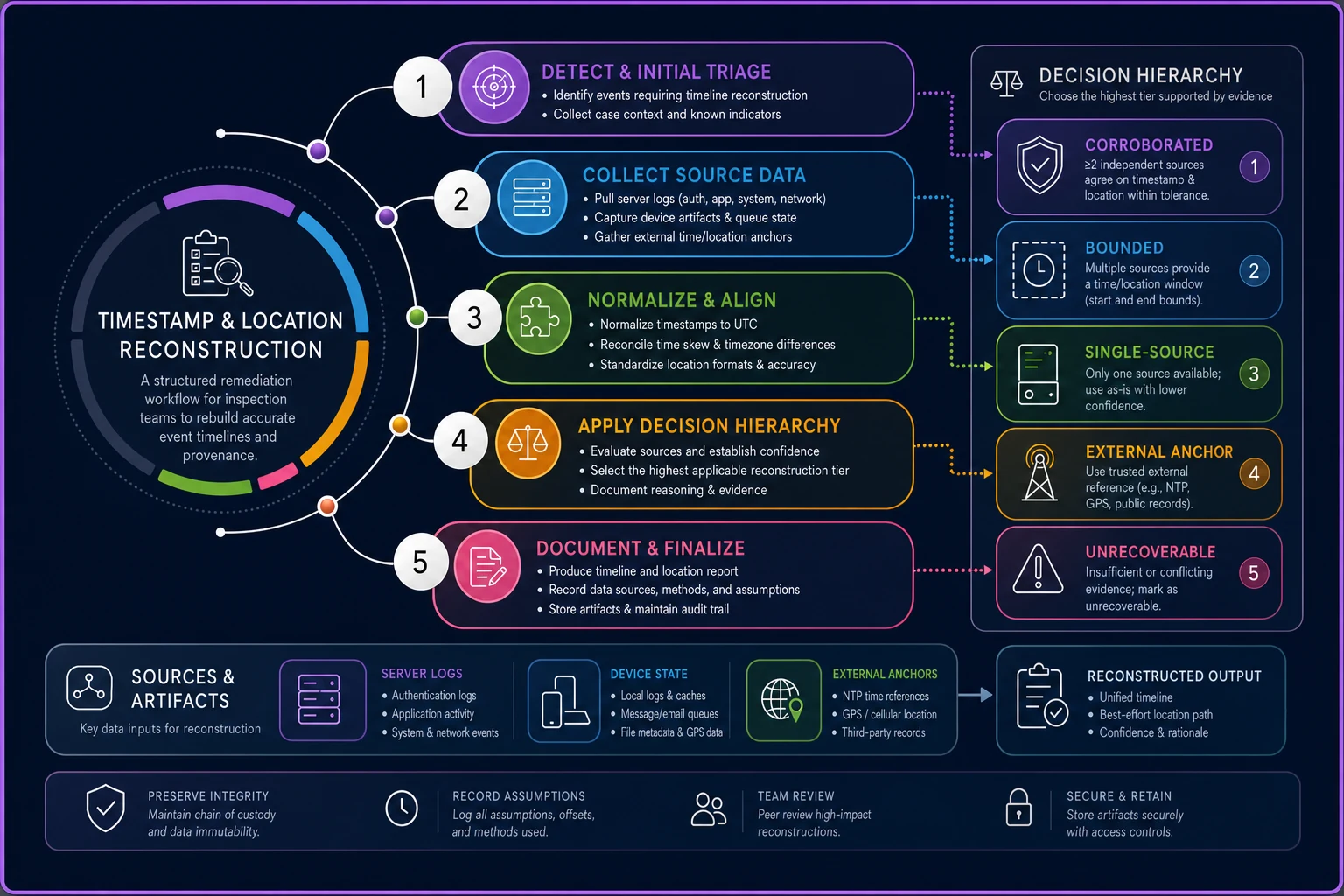
Use this flow as a checklist during remediation.
Audit-ready statements you can lift directly
Auditors want language that's honest about certainty. Here are templates that hold up, phrased the way an assessor actually wants to read them:
-
Verified (corroborated) "Capture time and location independently corroborated by [source 1] and [source 2] within stated tolerance. No unresolved discrepancy."
-
Bounded "Precise capture time unavailable due to missing device metadata. Capture window bounded to [start]–[end] using [server receipt / queue log / anchor]. Location confirmed via [source]."
-
Single-source flagged "Time verified via [network]. Location metadata absent; capture location inferred from assigned scope and [anchor]. Not independently confirmed."
-
Unrecoverable "Timestamp and geotag unrecoverable. Inspection content, inspector identity, and assigned scope confirmed. Record classified as time/location-unverifiable; retained with disclosure."
The unrecoverable statement isn't an admission of failure. A record that honestly says "we can't verify this, here's what we can" is stronger in an audit than a record with a confident-looking timestamp that falls apart on cross-examination.
Where lightweight automation actually earns its place
Most of this hierarchy is judgment, and judgment doesn't automate well. But two narrow spots benefit from tooling, and they're worth calling out because they're where teams lose the most time.
The first is drift detection at ingest. When a record lands, the system can automatically compare device time against network and server time and flag any gap over your tolerance before the record is ever filed. Catching a 58-minute time-zone drift the moment it arrives is trivial; catching it eight months later during an audit is a forensic project. AI-assisted checks are good at this kind of quiet, high-volume cross-referencing — comparing three timestamp sources on every incoming record and only surfacing the ones that disagree.
The second is anchor matching. When metadata is missing, something has to correlate the orphaned record against work orders, badge logs, and adjacent inspections to propose a capture window. That correlation is tedious by hand and fast for software. The point isn't to have a system decide the answer — it's to have it assemble the candidate anchors so your inspector can apply the hierarchy in a few minutes instead of most of the afternoon.
Everything else — the prove/check judgment, the tier assignment, the disclosure language — stays human. Automation flags and assembles; people decide and sign.
A real scenario
A mid-sized facilities inspection team — roughly 30 inspectors across a dozen industrial sites — got hit during an accreditation cycle. The assessor sampled 40 records and flagged 11 for unverifiable timestamps. Nothing was fraudulent; the sites had poor cell coverage, so records batch-synced in the evenings and the device clocks had drifted. The precise-looking timestamps didn't match the sync logs, and that mismatch alone was enough to open findings.
They didn't buy new hardware. They made three changes: an ingest-time drift check that flagged any record where device and server time disagreed by more than 15 minutes, a standing rule to bound rather than blank out uncertain records, and the prove/check statement format for every flagged file. Reworking the 11 records took about a day and a half using anchors — work orders and gate logs mostly.
The following cycle, the assessor sampled a similar batch. Unverifiable findings dropped to one, and that one was already documented as bounded, so it didn't convert to a finding. Reconstruction time per flagged record fell from something close to half a day of digging to well under an hour. The physical inspection quality never changed — only the way the evidence was defended.
When to bound, when to declare unrecoverable
A quick decision aid, because this is where people freeze:
-
Bound it when you have at least one independent anchor and a defensible window, even a wide one. A four-hour window at a confirmed site beats a fake-precise minute.
-
Declare unrecoverable when every source is gone and no external anchor exists. Don't manufacture a window you can't support — an invented anchor is worse than an honest gap.
-
Don't waste time reconstructing low-stakes records that aren't in a sampling frame and don't tie to any incident. Fix the workflow hole instead and move on.
The teams that handle this well aren't the ones with perfect metadata. They're the ones whose remediation is consistent — same hierarchy, same statement format, same honesty about what's proven versus checked, every single time. Auditors sample for consistency, and consistency is the thing you can actually build. The timestamp problem is rarely about the timestamp. It's about whether your process for handling a missing one is boring, repeatable, and written down.
The teams that handle this well aren't the ones with perfect metadata. They're the ones whose remediation is consistent — same hierarchy, same statement format, same honesty about what's proven versus checked, every single time. Auditors sample for consistency, and consistency is the thing you can actually build. The timestamp problem is rarely about the timestamp. It's about whether your process for handling a missing one is boring, repeatable, and written down.
Ready to modernize your inspection process?
Join 500+ inspection teams using Chekzly to reduce paperwork, improve compliance, and accelerate reporting.