


An inspection fails. Not the "reschedule and re-run it" kind of fail — the kind where a finding surfaces a defect, a safety issue, or a vendor problem with real legal and financial exposure. Now the actual question starts: who decides what happens next?
If your honest answer is "it depends who's in the room," you don't have a governance problem you can patch later. You have one that's already costing you, quietly, every time an outcome gets stuck between departments.
Most inspection programs are built to answer did it pass? Very few are built to answer who owns the consequence when it doesn't? That second question is where cross-functional coordination breaks — legal wants documentation, procurement wants to protect the vendor relationship, operations wants the site open by Monday. Three teams, three incentives, one finding, no clear owner.
This is a systems piece, not a tips list. The goal is to show how decision authority, evidence, and escalation actually connect — and where the whole thing tends to snap as you grow.
Why inspection outcomes fall into the gap between teams
Inspection outcomes are strange organizationally. The inspector generates the finding, but rarely owns the decision that follows. That decision usually belongs to someone who wasn't on site and didn't see the evidence firsthand.
So the outcome travels. It leaves the field, lands in ops, sometimes bounces to procurement if a vendor's involved, and occasionally ends up with legal if there's liability or a contract clause at stake. Every one of those handoffs is a chance for the outcome to lose context, lose urgency, or lose its owner entirely.
The pattern worth naming: inspection programs are designed around detection, and governance is designed around consequences, and the two are almost never designed together. You end up with a great checklist producing findings that fall into an ownership vacuum.
-
No default owner per finding type. A cracked weld, an expired vendor cert, and a missing safety guard are wildly different problems, but they all route the same way — "up."
-
Decision authority is implied, not written. People assume who signs off, until someone challenges it during an audit or a dispute.
-
Evidence requests aren't tied to decisions. Legal asks for documentation after they need to act, and the photos or timestamps aren't there.
-
Escalation has no clock. Findings sit. Nobody's technically late because nobody defined "late."
A few reasons this shows up across so many operations:
The three-team tension, and why it's structural
It's tempting to frame the legal/procurement/ops conflict as a personality thing — the cautious lawyer, the relationship-protective buyer, the deadline-driven operator. It isn't. The tension is structural.
Eliminate inspection delays and errors.
Chekzly helps you plan, execute, and document inspections efficiently and accurately.
- Real-time inspection tracking
- Automated report generation
- Compliance and checklist management
No credit card required
Legal is optimizing for defensibility. Their worst-case scenario is a finding that becomes a lawsuit with no clean paper trail. So they want conservative decisions and complete evidence records.
Procurement is optimizing for supply continuity and cost. A hard-line response to a vendor finding can blow up a relationship they spent two years building, or kick off a re-sourcing scramble. So they want to negotiate, cure, and preserve.
Operations is optimizing for throughput and uptime. Every day a site or line sits idle over an unresolved finding is measurable money. So they want a decision — almost any decision — fast.
None of them is wrong. But when a finding lands and all three pull toward their own priorities with no pre-agreed framework, you get stalemate dressed up as collaboration. Findings can sit unresolved for three, four, five weeks not because anyone was negligent, but because no single function had the authority to break the tie.
The fix isn't picking a winner. It's deciding in advance who owns which decision, at which severity, with which evidence attached.
Start with a RACI that's tied to finding severity, not job titles
A generic org-chart RACI — "legal is consulted on everything legal-ish" — is useless in the field. Nobody reads it, and it doesn't tell an inspector what to do at 4pm on a Friday.
What actually works is a RACI mapped to finding severity tiers and finding categories, so the routing is mechanical. The inspector doesn't decide who owns it — the tier does.
| Finding tier | Example | Responsible (does the work) | Accountable (owns the call) | Consulted | Informed | Escalation SLA |
|---|---|---|---|---|---|---|
| Tier 1 – Minor | Cosmetic defect, minor doc gap | Site lead | Ops supervisor | — | Inspection manager | Resolve in 5 business days |
| Tier 2 – Moderate | Repeatable process defect, vendor cert lapse | Ops supervisor | Regional ops manager | Procurement | Legal (log only) | Decision in 48 hrs |
| Tier 3 – Serious | Safety-relevant defect, contract breach signal | Regional ops manager | Head of ops | Legal + Procurement | Exec sponsor | Decision in 24 hrs |
| Tier 4 – Critical | Imminent safety risk, regulatory reportable | Incident lead | Legal (with exec sign-off) | Ops + Procurement | Full leadership | Immediate, <4 hrs |
The important design choice: as severity climbs, accountability shifts function. Ops owns low-severity calls outright. Legal takes the wheel at the top. Procurement is consulted heavily in the middle band where vendor findings live, but almost never accountable for a safety decision — because that's not their mandate and shouldn't be.
One mistake worth flagging: teams love to put three names in the "Accountable" column because it feels collaborative. It's the single fastest way to guarantee nothing gets decided. Accountable is exactly one person, always. Everyone else is Consulted or Informed.
Escalation SLAs: the part everyone skips
A RACI without a clock is a suggestion. The SLA column above is what turns it into a system.
The principle is straightforward but rarely enforced: higher severity gets a shorter clock, and a missed clock auto-escalates. If a Tier 3 finding doesn't get a decision in 24 hours, it doesn't just sit there being late — it automatically jumps to the next tier's owner. Delay becomes escalation, not stagnation.
In practice, this usually breaks in one predictable way. Someone marks a finding as "under review" and that status becomes a black hole. No SLA is attached to "under review," so it can live there indefinitely. The fix is that every intermediate status carries its own clock. "Under review" gets 48 hours before it forces a decision or a documented reason for extension.
A real example: a mid-sized facilities inspection group had around 40–50 open findings at any given time. When they audited their own aging, roughly a third had been open more than three weeks — and almost all of those were stuck in vague statuses with no owner and no deadline. Nobody was ignoring them. There was just no mechanism forcing motion.
The scaling problem here is real. At 5 sites you can manage this in your head. At 25 sites with a few hundred inflight findings, "I'll follow up" stops working entirely. This is the same coordination wall that hits programs across the board — we've written about the broader version of it in when inspection programs fail to scale, and governance failures are usually a symptom of that same growth curve.
Tie every decision to a pre-defined evidence request
Most programs miss this connection entirely: decision authority and evidence requirements have to be designed as one thing.
If legal is Accountable at Tier 3, then the moment a finding is tagged Tier 3, the system should already know what evidence legal will need — timestamped photos, chain of custody, the specific contract clause reference, the inspector's certification status at time of inspection. That evidence request shouldn't be a scramble that happens after legal gets involved. It should fire the instant the tier is set.
-
What must be true to make this call? (evidence checklist)
-
Who provides each piece of evidence, and by when?
-
What's the documented decision output, and where does it live?
Define the evidence metadata (timestamps, GPS, inspector ID) as mandatory fields at capture to avoid post-escalation scramble.
When these playbooks are tight, the handoff between ops, procurement, and legal stops being a negotiation and becomes the transfer of a complete package. Legal isn't asking "can you get me the photos?" — the photos are already attached, because the playbook required them at capture time.
This is also where data integrity quietly matters more than anyone expects. A decision is only as defensible as the record underneath it, and records fall apart in predictable ways as you add sites and inspectors — something we broke down in detail in when inspection data governance breaks.
A workflow that actually holds under audit
Here's how this connects end to end, because the individual pieces don't matter if the flow between them leaks.
An inspector logs a finding. At the moment of logging, they select a category and answer a short set of severity questions — not a freeform "how bad is it," but structured questions that mechanically produce a tier. The inspector isn't deciding fault or consequence; they're describing what they saw, and the system assigns the tier.
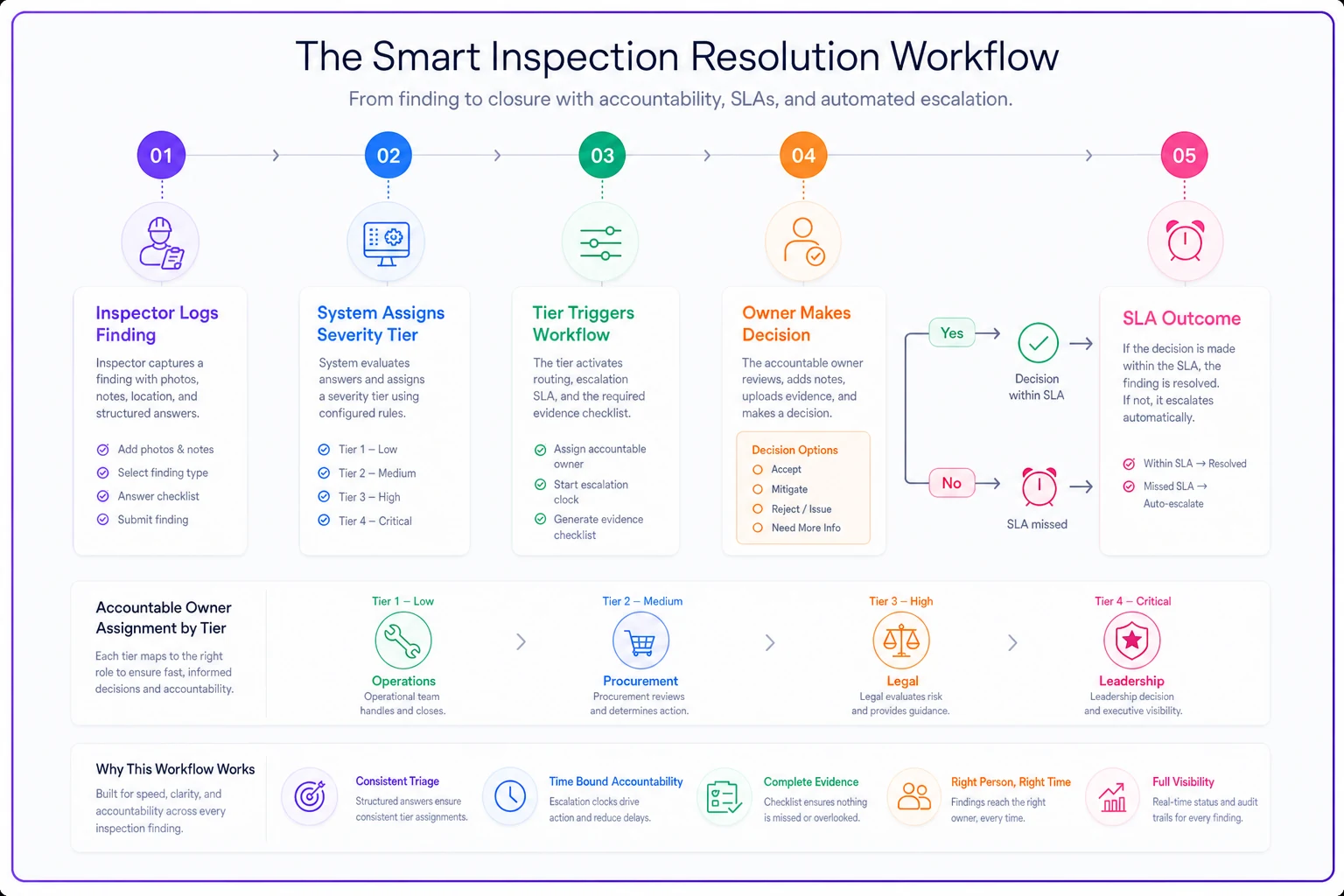
The tier assignment does three things simultaneously: it sets the Accountable owner, starts the escalation clock, and triggers the evidence request tied to that tier. If it's Tier 3, legal and procurement are auto-added as Consulted, the 24-hour clock starts, and the evidence checklist — photos with metadata, contract reference, cert status — is generated and assigned.
The Accountable owner now has a decision to make with a full package in front of them. They either decide within the SLA, or they document a specific reason for extension. If neither happens, the finding auto-escalates to the next tier's owner and everyone above gets notified. No quiet death in "under review."
When the decision is made, it's recorded as a decision output — what was decided, who decided it, what evidence it was based on, and the timestamp. That output becomes part of the permanent record. Six months later, when an auditor or opposing counsel asks "who decided to keep that vendor and on what basis," the answer is one retrieval, not a two-week email archaeology dig.
That last part — the audit-defensible handoff — is the whole point. Every transition between functions leaves a record of who held it, what they had, and what they did. No orphaned decisions.
When a formal governance blueprint makes sense (and when it doesn't)
This level of structure isn't free. It takes setup, buy-in from three departments, and discipline to maintain. So be honest about where you actually are.
When this makes sense:
-
You're running more than a handful of sites and findings routinely cross function lines.
-
Vendor findings or contract clauses are regularly in play.
-
You operate in a regulated or litigation-exposed environment where "who decided" is a question you'll eventually be asked under oath.
-
Findings are visibly aging because nobody clearly owns them.
When this is premature:
-
You're a single-site operation with two inspectors and a manager who sees every finding same-day. A four-tier RACI is overhead you don't need yet.
-
Your finding volume is low enough that everything gets handled inside one function anyway.
Who should NOT do this: teams that haven't first agreed on their severity definitions. If legal and ops don't share the same definition of "serious," a RACI mapped to severity just relocates the argument. Nail down the tiers before you build the routing. That agreement is the hard part — the table is the easy part.
Real scenario: a regional inspection group untangling ownership
A regional inspection outfit — around 18 sites, third-party and internal inspectors mixed, heavy vendor component — had a recurring pain that looked like a communication problem but wasn't.
The symptom: serious vendor-related findings routinely stalled. Procurement wanted to give vendors a cure period, ops wanted the affected line back, and legal only got looped in when things had already gone sideways. Average time-to-decision on serious findings was somewhere north of three weeks. During one audit cycle, two findings were flagged specifically because the decision rationale wasn't documented — the outcome existed, but nobody could show who chose it or why.
They didn't buy new inspection tech. They rebuilt the governance layer. Four severity tiers, one Accountable owner per tier, escalation clocks with auto-bump on breach, and evidence checklists that fired at tier assignment. Procurement stayed heavily Consulted on vendor findings but stopped being the bottleneck on safety calls, which moved to ops and legal by tier.
Within a couple of quarters, time-to-decision on serious findings dropped to roughly 4–6 days. The bigger win was quieter: the next audit cycle produced zero findings about missing decision rationale, because every decision now carried its owner, its evidence, and its timestamp. The vendor relationships didn't collapse either — procurement still got its cure periods, just inside a clock instead of an open-ended stall.
What didn't change: same inspectors, same checklists, same findings. They just stopped losing outcomes in the gap between departments.
Pulling it together
Inspection outcomes don't get lost because people are careless. They get lost because detection and consequence are designed by different teams for different goals, and nobody stitches the seam between them. The finding is somebody's job. The decision is somebody else's. The evidence to defend that decision is a third person's problem — and by the time anyone realizes it's missing, it's too late to capture.
A governance blueprint fixes the seam, not the people. Map authority to severity, not titles. Put a clock on every status so delay becomes escalation instead of silence. Tie evidence requests to the decisions they support, so the package is complete before anyone needs it. Record every handoff so the answer to "who owned this outcome" is never a guess.
Get that right and the legal-procurement-ops tension stops being a fight and becomes a routing rule. The lawyer still gets defensibility. The buyer still protects the relationship. The operator still gets a decision on the clock. They just stop colliding over the same finding — because you decided, in advance, who owns what.
Inspection outcomes don't get lost because people are careless. They get lost because detection and consequence are designed by different teams for different goals, and nobody stitches the seam between them. The finding is somebody's job. The decision is somebody else's. The evidence to defend that decision is a third person's problem — and by the time anyone realizes it's missing, it's too late to capture.
A governance blueprint fixes the seam, not the people. Map authority to severity, not titles. Put a clock on every status so delay becomes escalation instead of silence. Tie evidence requests to the decisions they support, so the package is complete before anyone needs it. Record every handoff so the answer to "who owned this outcome" is never a guess.
Get that right and the legal-procurement-ops tension stops being a fight and becomes a routing rule. The lawyer still gets defensibility. The buyer still protects the relationship. The operator still gets a decision on the clock. They just stop colliding over the same finding — because you decided, in advance, who owns what.
Ready to modernize your inspection process?
Join 500+ inspection teams using Chekzly to reduce paperwork, improve compliance, and accelerate reporting.