

Most multi-site inspection programs don't fail because someone made a bad decision. They fail because the program grew faster than its underlying systems could handle, and nobody noticed until a regulator or a bad incident forced the issue. One site runs beautifully, the model gets copied to twelve more, and suddenly the same checklist means three different things depending on who's holding the tablet.
A maturity model matters here not for grading yourself on a slide deck — it's about knowing what to fix next, and just as important, what to leave alone. A lot of programs waste money hardening things that aren't the bottleneck while ignoring the one gap that will actually blow up an audit. So this is less a scorecard and more a diagnostic: where does your program actually sit across the five things that determine whether it holds together at scale?
The five dimensions, and why they move at different speeds
People, process, data, tech, and compliance. Every inspection program has all five, but they almost never mature evenly. That mismatch is where most of the pain lives.
The classic pattern: a company invests heavily in technology — new mobile app, sensor integrations, a nice dashboard — while its process definitions and data model are still stuck at Level 1. Now you've got a fast, shiny way to produce inconsistent data. Tech outran process. What you get is more records, more quickly, all slightly wrong in ways nobody can reconcile later.
The opposite happens too. A program has genuinely mature process documentation — thick SOPs, defined roles, escalation paths — but the data underneath is a mess of free-text fields and inconsistent site names. On paper it looks disciplined. In practice you can't answer a simple question like "how many out-of-tolerance findings did the Midwest region log last quarter" without a week of manual cleanup.
So the first honest thing to do is stop treating maturity as one number. Score each dimension separately. A program that's at Level 3 on people but Level 1 on data is a very different animal from one that's the reverse, and they need opposite fixes.
The maturity rubric
Four levels, five dimensions. Level 1 is "it works because specific people make it work." Level 4 is "it works even when those people leave, sites get added, or a regulator shows up unannounced."
Eliminate inspection delays and errors.
Chekzly helps you plan, execute, and document inspections efficiently and accurately.
- Real-time inspection tracking
- Automated report generation
- Compliance and checklist management
No credit card required
| Dimension | Level 1 — Ad hoc | Level 2 — Defined | Level 3 — Managed | Level 4 — Optimized |
|---|---|---|---|---|
| People | Tribal knowledge, no competency baseline | Roles defined, onboarding exists | Competency tracked, re-cert scheduled | Cross-site calibration, performance feeds back into training |
| Process | Site-specific habits, undocumented | Standard SOPs written, not enforced | SOP version control, deviations logged | Continuous improvement loop tied to findings data |
| Data | Free text, inconsistent fields | Shared schema, some validation | Structured event model, mandatory fields | Cross-site analytics, lineage and audit trails |
| Tech | Paper or scattered spreadsheets | Single app, no integration | Integrated capture, evidence and calibration linked | Automated checks, exception flagging, retrieval SOPs |
| Compliance | Reactive, scramble before audits | Calendar-based readiness | Continuous evidence chain, defined retention | Audit-ready on demand, controls verified regularly |
The trap most managers fall into is aiming straight for Level 4 across the board. That's a multi-year, budget-heavy fantasy that gets abandoned halfway. The useful move is getting every dimension to at least Level 2 first — a stable floor — before pushing any single dimension higher. A program with no Level 1 gaps is far more resilient than one with two dimensions at Level 4 and one still stuck at Level 1.
Gating criteria: you can't skip levels
You cannot advance a dimension to the next level until it clears the gate below it. Maturity isn't a menu you order off. Each level assumes the previous one is actually true.
A concrete example: teams love to buy analytics dashboards — that's a Level 3 or 4 data capability. But dashboards built on a Level 1 data foundation (free-text fields, inconsistent site codes, optional entries) produce charts that look authoritative and are quietly wrong. You've spent real money to industrialize your bad data. The gate you skipped was a structured event model with mandatory fields. Until that exists, the dashboard is a liability, not an asset.
-
Data → Level 3 requires a shared event schema that every site actually uses, not one that exists in a document while sites do their own thing. If you've watched inspection data governance break across multi-site teams, you already know a schema nobody enforces is worse than no schema — it creates false confidence.
-
Process → Level 3 requires version control on your checklists and SOPs, with deviations logged rather than silently absorbed.
-
Compliance → Level 3 requires that evidence — photos, timestamps, calibration certs — is captured in a retrievable, defensible chain, not reassembled from email and memory before an audit.
-
People → Level 3 requires that competency is tracked over time, not just checked once at onboarding.
The gates aren't bureaucracy. They're what stops you from building the second floor before the foundation is poured.
Quick wins vs. long-term controls
Not everything needs to be a program. Some of the highest-value moves take a week and cost nothing but attention. Others are structural and take quarters. Knowing the difference keeps you from treating a two-day fix like a capital project.
Quick wins (days to a few weeks):
-
Standardize site names and codes everywhere. Sounds trivial — it's usually the single biggest blocker to cross-site reporting, and it's fixable in an afternoon of cleanup plus a locked dropdown.
-
Make the three or four fields that matter for audits mandatory. Not all of them, just the ones that regularly show up as findings.
-
Create a single shared calendar for accreditation and regulator cycles so readiness stops being a surprise.
-
Write down the escalation path that currently lives in one manager's head.
Lock site codes early — it usually unlocks cross-site reporting faster than any dashboard.
Long-term controls (quarters):
-
A structured event model with validation and lineage.
-
Cross-site competency tracking with scheduled re-certification.
-
Automated exception flagging on inspection results.
-
Continuous evidence chains with defined retention and retrieval SOPs — the kind of records discipline that keeps you from scrambling to reconstruct history when audit findings hit.
The mistake is spending your first ninety days on the long-term controls and having nothing to show for it. Front-load the quick wins. They build credibility with field teams and buy you the political room to do the slow structural work.
Staged milestones for a multi-site rollout
Rolling maturity out across sites is itself a project with sequencing, and doing it in random order across sites is how programs stall.
-
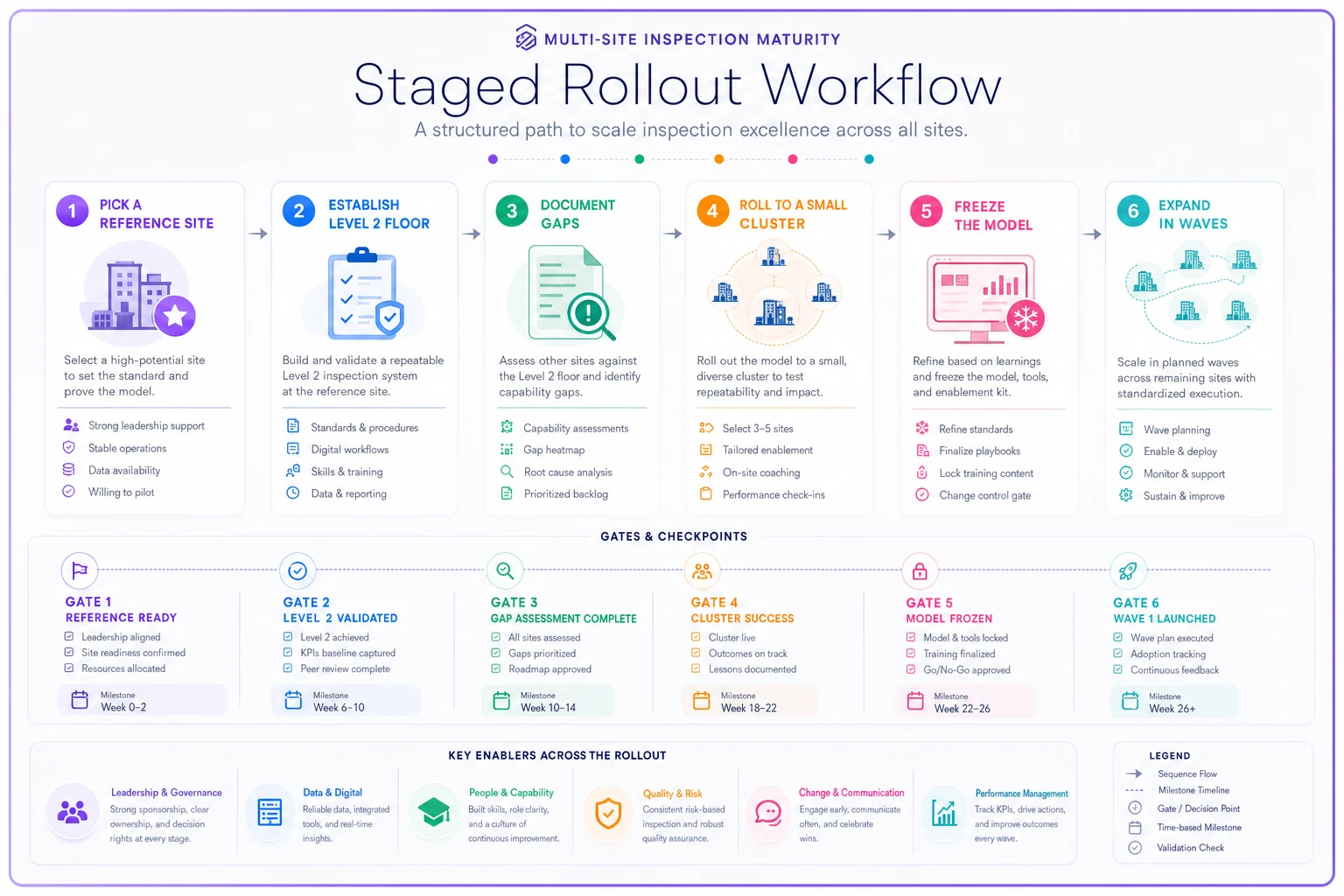
Pick a reference site, not your best one. Choose a site that's average — representative of the mess you'll actually face. Your best site hides problems because its people compensate. An average site surfaces them early, while the cost of fixing is still low.
-
Establish the Level 2 floor at the reference site. Standard SOPs, single capture tool, shared schema, calendar-based compliance. Prove the floor is achievable before you copy anything.
-
Document the gaps you hit. Every workaround the reference site needed becomes part of the rollout playbook. This is the step everyone skips, and it's why rollout #7 hits the same wall as rollout #1.
-
Roll to a cluster of three to five sites, not all at once. A small cluster surfaces coordination problems — conflicting site codes, regional habits, calibration differences — while they're still manageable. If you've dealt with inspection programs failing to scale across multi-site teams, you know the failure mode is almost always trying to convert everything simultaneously.
-
Freeze the model, then expand. Once the cluster runs stable for a full inspection cycle, lock the process and data definitions and expand in waves. Changing the model mid-rollout is how version parity falls apart.
-
Layer in Level 3 controls only after the floor holds everywhere. Analytics, automated flagging, cross-site competency — these come after coverage, not during.
Here's a simple workflow for rolling maturity out across sites.
When this staged approach is a bad idea
If you have three sites and a stable team, this is overkill. A structured cluster rollout makes sense somewhere north of five or six sites, or when sites are genuinely independent — different regions, different regulators, different calibration regimes. Below that, you can standardize directly and skip the ceremony.
And if you're under active regulatory pressure — an open finding, a pending audit — don't run a slow maturity program. Fix the specific compliance gap first, then come back to the model. Maturity work is for building durability, not firefighting.
A real scenario
A regional facilities inspection company — around 14 sites, roughly 90 field inspectors — had bought a solid mobile capture tool the year before. Tech looked like Level 3. But their data was Level 1: every site named things differently, half the fields were free text, and "pass/fail" meant different thresholds depending on the inspector.
The visible symptom was that regional rollups took someone two to three days of manual reconciliation every month, and they still couldn't trust the numbers. When an audit came up, evidence retrieval was a scramble across email and local folders.
They didn't buy anything new. They scored each dimension honestly, saw the data gap, and spent about six weeks on quick wins: locked site codes, four mandatory audit-critical fields, a shared pass/fail definition. Then they gated further work — no dashboards until the schema held. Over the next two quarters they layered in structured events and a retrievable evidence chain.
The reconciliation work dropped from a few days a month to a couple of hours. Audit prep stopped being a fire drill. Nothing dramatic happened — no revenue miracle — but the program stopped being fragile, and adding their 15th and 16th sites afterward took a fraction of the effort the earlier ones had.
The assessment checklist
Run this on each dimension. If you can't honestly check the box, that's your gate.
-
- [ ] People Can a new inspector reach baseline competency without shadowing one specific veteran?
-
- [ ] People Is re-certification scheduled, or does it happen when someone remembers?
-
- [ ] Process Are your checklists version-controlled, with deviations logged?
-
- [ ] Process Would two sites inspecting the same asset produce the same record?
-
- [ ] Data Do all sites use one enforced schema with mandatory audit-critical fields?
-
- [ ] Data Can you produce a clean cross-site report without manual cleanup?
-
- [ ] Tech Are evidence, calibration status, and results linked, or scattered?
-
- [ ] Compliance Could you assemble a defensible evidence chain today, unannounced?
-
- [ ] Compliance Is retention defined and actually applied?
Any unchecked box in the top two levels is more urgent than anything higher up. Fix floors before ceilings.
Where this leaves you
A maturity model is only useful if it changes what you do next week. The real value isn't the label — nobody cares whether you call yourself Level 2 or Level 3. It's the sequencing discipline: score each dimension separately, respect the gates, ship quick wins early to earn room for the slow structural work, and roll out to clusters instead of everything at once.
The programs that scale cleanly aren't the ones with the most technology. They're the ones where each dimension is honestly at Level 2 before anyone gets ambitious — where the floor is solid enough that adding the next five sites feels like a copy job instead of a rebuild. That's the whole point of measuring maturity: not to admire the score, but to know exactly which foundation to pour next.
Ready to modernize your inspection process?
Join 500+ inspection teams using Chekzly to reduce paperwork, improve compliance, and accelerate reporting.