


Most inspection COEs die quietly. Not because the idea was wrong, but because nobody decided who pays for it, who it serves, and what it's actually on the hook for. A slide deck gets approved, a "Director of Inspection Excellence" gets hired, and eighteen months later the group is a two-person team writing SOPs nobody reads while regional ops managers keep doing whatever they were doing before.
So instead of making the case for why a center of excellence matters — you already know — this is about the parts that determine whether it actually works: how it gets funded, what it commits to deliver, how it measures itself, and what the org looks like when it's running across dozens of sites.
What separates a real COE from a vanity team is boring: the operating model. Get the funding and intake wrong and no amount of inspection expertise saves you.
Start with the funding fight, because everything else depends on it
The single most consequential decision you'll make is how the COE gets paid. This isn't a finance footnote — it changes who the COE answers to, how field teams treat it, and whether it survives the next budget cut.
There are really two models, with a hybrid in the middle.
Central budget. The COE is funded as corporate overhead. Field sites don't pay for it directly. This makes the COE free to use, which drives adoption, but it also makes its value invisible on any site P&L — which is exactly where it gets cut when margins tighten.
Chargeback. Sites pay the COE for services: audits, calibration oversight, inspector certification, report QA. This forces the COE to prove value every quarter, but it creates a failure mode where sites skip the expensive-but-important services (audit prep, root-cause reviews) to protect their own numbers.
Central funding kills accountability. Chargeback kills coverage. Pure versions of either one break.
| Dimension | Central budget | Chargeback | Hybrid (recommended) |
|---|---|---|---|
| Adoption by field sites | High (it's free) | Low to medium (sites ration it) | High for core, metered for extras |
| COE accountability | Weak — no customer pressure | Strong — sites can walk away | Strong on billable work |
| Risk of being cut | High in downturns | Lower — tied to real spend | Moderate |
| Standardization | Easier to mandate | Harder — sites negotiate | Mandate core, sell the rest |
| Admin overhead | Low | High (tracking, invoicing) | Medium |
The hybrid that tends to hold up: core mandates are centrally funded, elective services are charged back. Calibration standards, audit-defensibility rules, the master checklist library, inspector certification — centrally funded and non-optional. Surge inspection support, custom analytics, special investigations, extra training cohorts — billed to the requesting site.
This matters because it maps funding to authority. The centrally funded work is where the COE has the right to say "no, you will do it this way." The billable work is where the COE has to earn the engagement. Confusing the two is how COEs end up mandating things nobody wants while begging for budget to do the things sites actually need.
When each model actually makes sense
-
Go central-only if you're early, under 15–20 sites, and the main goal is getting everyone on the same standard. Chargeback admin isn't worth it yet.
-
Go chargeback-heavy if your sites are genuine P&L owners with strong local managers who will ignore anything "free" because free things feel optional.
-
Go hybrid once you're past roughly 25 sites and the COE has both compliance mandates and value-add services it can sell.
One warning on chargeback: if your internal transfer-pricing is a bureaucratic mess — and in large enterprises it usually is — heavy chargeback can bury the COE in cost-allocation meetings. Price the services simply. Flat per-audit, per-inspector-cert, per-day-of-support. Otherwise you'll spend more time invoicing than inspecting.
The charter: what the COE is actually on the hook for
A charter that says "drive inspection excellence" is useless. The charter needs to name specific decision rights, because the real conflicts are about authority, not aspiration.
Eliminate inspection delays and errors.
Chekzly helps you plan, execute, and document inspections efficiently and accurately.
- Real-time inspection tracking
- Automated report generation
- Compliance and checklist management
No credit card required
It should spell out, in plain language:
-
Which standards are mandatory vs. advisory. Field teams need to know, with zero ambiguity, what they can't deviate from. Calibration tolerances, evidence capture rules, certification requirements — mandatory. Scheduling approaches, local staffing models — advisory.
-
Who owns the master checklist and SOP library. One owner. Version-controlled. Field sites submit change requests; the COE approves or rejects. Non-negotiable if you want audit defensibility.
-
Escalation authority. When a site's data looks wrong or an inspector fails a competency check, what can the COE actually do about it? Flag it? Pause the site? Pull certifications? Write it down.
-
Audit representation. When a regulator or accreditor shows up, does the COE speak for the program or does the site? In defensible programs, the COE owns the narrative and the evidence trail.
-
What the COE explicitly does NOT do. This is the most-skipped section and the most important. If the COE doesn't do local scheduling, doesn't manage site headcount, doesn't own site safety outcomes — say so. Scope creep is what turns a sharp COE into an understaffed help desk.
The programs that scale well have charters that read like contracts, not mission statements. Specific enough that two managers in different regions would resolve a dispute the same way.
The intake and service catalog
If sites can't figure out how to get help from the COE, they'll either flood you with Slack messages or route around you entirely. Both are bad. You need a service catalog and an intake process, and you need it early.
A service catalog is just a published list of what the COE offers, what each service costs (or that it's centrally funded), what the SLA is, and how to request it. Treat it like a menu.
-
Inspector certification & recertification — centrally funded, 2-week turnaround
-
Checklist / SOP change requests — centrally funded, 5-business-day review
-
Calibration cert review & out-of-tolerance adjudication — centrally funded, 48-hour turnaround for urgent
-
Audit readiness prep — billable, scheduled 6+ weeks out
-
Surge inspection support — billable, best-effort based on capacity
-
Custom analytics / investigation support — billable, scoped per request
-
New-site onboarding — centrally funded, 90-day program
The intake workflow itself doesn't need to be fancy, but it needs to be one front door. Here's the flow that tends to work:
-
Requester submits through a single intake form — not email, not a hallway conversation — that captures site, service type, urgency, and context.
-
Intake triage
someone on the COE (rotating duty works fine) reviews daily and routes to the right owner or kicks it back for missing info.
-
Billable requests get a quick scope-and-estimate step before work starts, so there are no surprise invoices.
-
Everything lands in a tracked queue with an owner and a due date.
-
Closure requires a documented outcome and, for audit-relevant work, a record that survives in the evidence system.
The single biggest intake mistake is letting urgent verbal requests jump the queue without a trace. Three months later you can't reconstruct who asked for what, and your audit trail has holes. If it's urgent, fine — but it still gets logged, even after the fact.
Here's a simple workflow diagram:
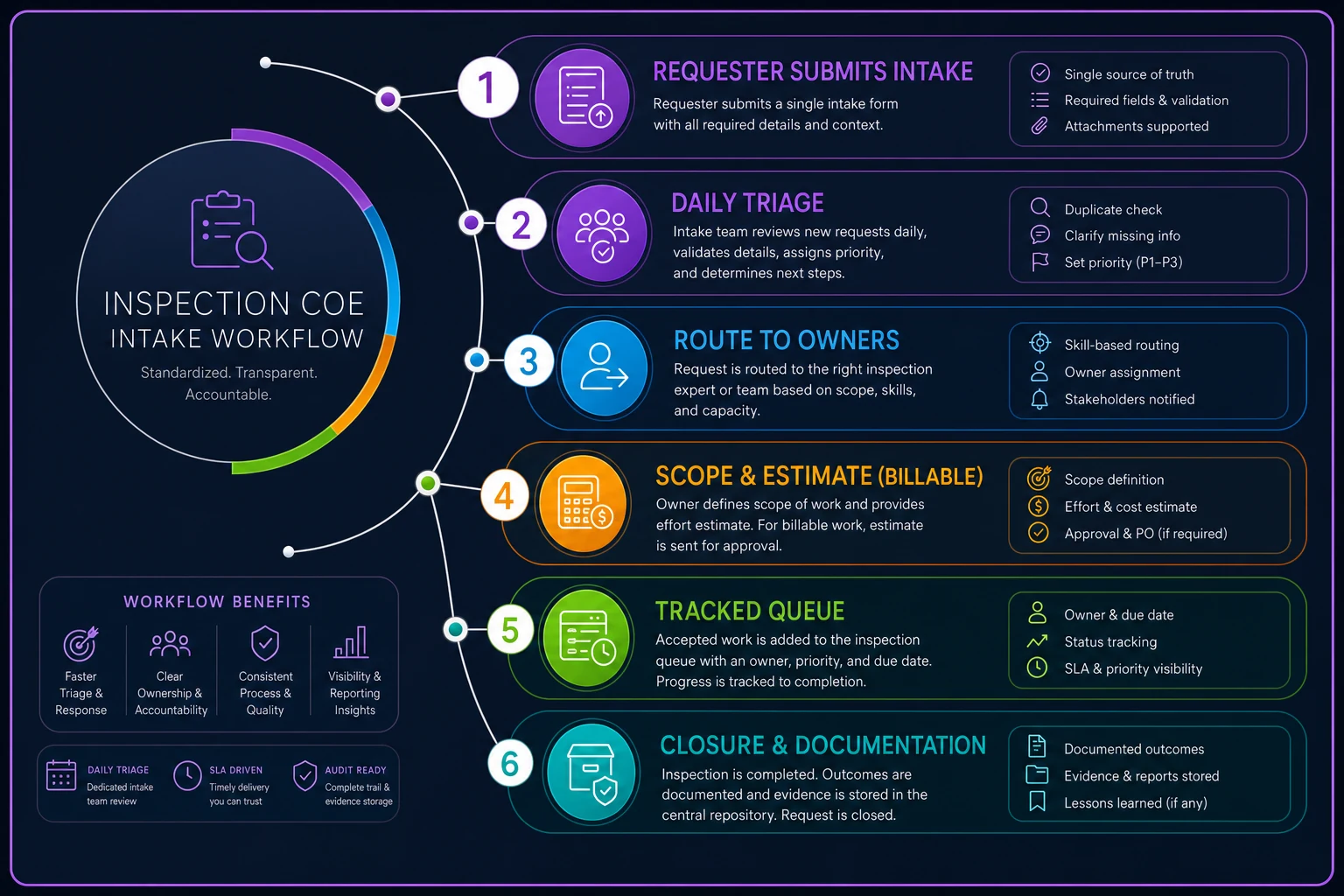
This is also where a shared operational platform earns its keep. When intake, the service catalog, SLA clocks, and evidence records all live in one system instead of scattered across inboxes and spreadsheets, the COE can actually see its own workload — and so can the sites it serves. A COE running on email will not survive 40 sites.
Scorecards: how the COE proves it's working
A COE without a scorecard is just a cost center waiting to be questioned. But most inspection scorecards measure activity — inspections completed, SOPs published — instead of outcomes like defect escape rate, audit findings, or cycle time. Activity metrics make the COE look busy. They don't make it look valuable.
Two scorecards are needed, and people constantly collapse them into one:
The COE's own scorecard — how well is the center doing its job?
-
Intake SLA adherence (are you hitting your turnaround commitments?)
-
Certification backlog and aging
-
Checklist change-request cycle time
-
Audit findings attributable to COE-owned standards (you want this trending down)
-
Site satisfaction — actually survey the field. If sites hate the COE, adoption quietly collapses.
The program scorecard — how healthy is inspection across the enterprise?
-
Defect / finding escape rate (issues caught in audit that field inspection missed)
-
Inspection cycle time site-to-site
-
Calibration compliance rate
-
Inspector certification currency across the population
-
Evidence completeness (how often do packages have gaps)
The distinction matters because they fail differently. The COE scorecard can look great while the program scorecard rots — you're hitting all your SLAs on a certification process that isn't improving field quality. If you only watch one, watch the gap between them.
For building out the full metric set, our breakdown of what a practical inspection analytics program looks like covers a KPI taxonomy that maps cleanly onto both scorecards.
KPI mandates vs. KPI guidance
Some KPIs you mandate — every site reports them, same definition, no exceptions. Others you offer as guidance — sites can track them locally if they want.
Mandate the ones tied to audit-defensibility and cross-site comparison: calibration compliance, certification currency, evidence completeness, finding escape rate. These have to be defined identically everywhere or the numbers are meaningless.
Leave local operational metrics — inspector utilization, local scheduling efficiency — as guidance. The moment you mandate a metric, sites start gaming it. Only mandate the ones where gaming is caught by the audit process anyway.
A worked org structure for a mid-size program
Say you're running inspections across roughly 35 sites, three regions, with around 180 field inspectors. Here's an org template that holds up without being bloated:
-
COE Lead — owns the charter, the funding relationship with corporate, and audit representation.
-
Standards & SOP Owner (1 person, maybe 2 at this scale) — owns the master checklist/SOP library, change requests, version control. This is the audit-defensibility backbone.
-
Certification & Competency Lead — owns inspector onboarding, certification, recertification tracking. At 180 inspectors with recert cycles, this is close to a full-time role on its own.
-
Calibration & Equipment Standards Lead — owns calibration certs, out-of-tolerance rules, tagging standards.
-
Analytics / Data Lead — owns both scorecards, data definitions, and dashboard delivery.
-
Regional COE Liaisons (one per region, often dotted-line from the field) — the critical glue. The COE's local face and the field's advocate upward.
That liaison role is the one everybody underfunds and then regrets. A central COE with no trusted presence in the regions becomes "those corporate people" who send rules nobody follows. The liaison is how mandates actually land. Even a dotted-line, 30%-of-their-time liaison beats a pure central team firing SOPs into the void.
Standing up this org also means a real onboarding and competency pipeline, not just hiring. The certification lead's entire job depends on it — our guide to turning new hires into audit-ready inspectors covers the competency-check and recert workflow this role needs to own from day one.
What breaks at scale — and it's always the same three things
Programs that run fine at 10 sites hit predictable walls as they grow. The failure modes are consistent enough to plan around.
First, the single-owner bottleneck. At small scale, one person informally owns the checklists and carries all the history in their head. At 40 sites, that person becomes a chokepoint — every change waits on them, and when they're on vacation the whole pipeline stalls. The fix is process and version control, not heroics. We went deep on this in when inspection programs fail to scale, and the COE context follows the same pattern: informal ownership that worked for 10 sites quietly strangles 40.
Second, standard drift. Each region starts adapting the standard for local conditions. Individually reasonable, collectively catastrophic. Three years later you have five dialects of the same checklist and an auditor asking why Site 12 and Site 29 capture evidence differently. The COE's whole reason to exist is preventing this, and it only works if change requests flow through one controlled pipeline.
Third, the invisible-value spiral. The COE does good work, prevents findings nobody sees because they were prevented, and then gets questioned at budget time: "what do you actually do?" This is the central-funding trap. The defense is the program scorecard — specifically the escape-rate and findings trends you can point to when the conversation comes up.
A real scenario
A regional facilities inspection group — about 40 sites, industrial, heavy regulator exposure — ran everything through site managers with no central standard. Every site had its own checklist version and its own interpretation of what "documented" meant.
Before the COE: a biennial accreditation cycle generated somewhere around 20–25 findings across the portfolio, most of them paperwork and evidence-gap issues — missing timestamps, inconsistent calibration records, checklist versions nobody could track. Audit prep consumed roughly six weeks of scramble across the regions each cycle.
They stood up a lean COE using roughly the org template above, minus one regional liaison they couldn't fund yet. Core standards centrally funded, audit prep and surge support charged back. One SOP owner took control of the checklist library with real version control. The certification lead got the inspector population onto a single recert cadence.
By the following accreditation cycle, findings dropped to single digits — most of what remained were genuine operational issues, not documentation gaps. Audit prep went from a six-week scramble to something closer to a two-week verification pass, because the evidence was already consistent and retrievable. The chargeback revenue on audit prep roughly covered the two billable roles, which made the whole COE a much easier conversation at budget time.
Nothing glamorous. But the finance side noticed. The thing that actually drove it wasn't any single tool — it was deciding, up front, what was mandatory, who owned it, and who paid for what.
Who should NOT build a COE yet
A quick reality check, because not every program is ready:
-
Under roughly 10 sites with low regulator exposure — you probably need a shared checklist and a calibration standard, not a chartered COE with scorecards and chargeback. The overhead will outweigh the benefit.
-
If leadership won't grant real decision rights — a COE that can recommend but never mandate is a suggestion box. Don't build it until the authority is backed in writing.
-
If you can't fund even one regional liaison — a pure central team with no field presence tends to get ignored. Better to wait until you can seat someone trusted in the regions.
These aren't edge cases. They're the three most common reasons COEs get stood up before the org is ready to support them.
Putting it together
An inspection center of excellence lives or dies on operating-model decisions that feel like finance and org-chart trivia: who funds it, what it's contractually on the hook for, how requests come in, and which numbers it's measured against. The inspection expertise is the easy part. The hard part is building a structure where that expertise has the authority to apply, the funding to survive, and the scorecards to prove it mattered.
Decide the funding model first. Write a charter that reads like a contract. Publish a service catalog with one front door. Run two scorecards, not one. Seat someone in every region. Do those five things and the COE has a real shot at outlasting the budget cycle that kills most of them.
Decide the funding model first. Write a charter that reads like a contract. Publish a service catalog with one front door. Run two scorecards, not one. Seat someone in every region. Do those five things and the COE has a real shot at outlasting the budget cycle that kills most of them.
Ready to modernize your inspection process?
Join 500+ inspection teams using Chekzly to reduce paperwork, improve compliance, and accelerate reporting.