


Most inspection programs don't collapse because of bad tools or weak checklists. They collapse because the people side was never built as a system. You can have perfect calibration logs, versioned forms, and a clean evidence trail — and still lose your best inspectors to a competitor, promote the wrong person into a lead role, or walk into an ISO audit with half your team's competencies undocumented.
The frustrating part is that the HR side of inspection work gets treated as paperwork instead of operations. Hiring, training, promotion, and retention all feed directly into the numbers you report every quarter: defect catch rates, report turnaround, audit findings, inspector utilization. When those connections aren't mapped, your workforce strategy becomes a series of reactions — backfilling a resignation here, scrambling to re-certify someone there — instead of a system that produces audit-ready inspectors on a predictable schedule.
This piece is about treating your inspection workforce strategy as an operational system, not an HR afterthought. Role definitions, competency tiers, promotion logic, mentorship, and retention levers all connect. When one is weak, the others start to leak.
The real problem: your org chart doesn't match how inspection work actually flows
Walk into most multi-site inspection teams and you'll find job titles that describe seniority but not capability. "Senior Inspector" means someone's been around five years. "Inspector II" means a manager liked them enough to bump the pay band. There's rarely a hard line between what an Inspector I can sign off on versus what requires a Level II or a lead.
-
Work gets assigned to whoever's available, not whoever's qualified, which quietly inflates your rework and dispute rates.
-
Audit evidence for "who was authorized to perform this inspection" becomes a guessing game.
-
Promotion decisions turn political, because there's no objective bar to point to.
This usually surfaces when a regulator asks a simple question: show me the qualification records for the person who performed this high-risk inspection. If your role definitions are tenure-based, you're now reverse-engineering competency from a resume. That's not a position you want to be in.
A role definition that actually works has three parts: the scope of inspections the role can perform independently, the decisions the role can make without escalation, and the evidence the role is responsible for producing. Everything else — pay band, title, reporting line — hangs off those three.
Competency tiers that map to risk, not years
Most career ladders go wrong in the same way: they build tiers around pay and headcount budgets, then try to backfill competencies to justify them. Flip it. Build tiers around the risk and complexity of the work, then attach pay to the tier.
Eliminate inspection delays and errors.
Chekzly helps you plan, execute, and document inspections efficiently and accurately.
- Real-time inspection tracking
- Automated report generation
- Compliance and checklist management
No credit card required
A practical tiering model for inspection teams usually lands around four levels. The exact names matter less than the boundaries between them.
| Tier | Can work independently on | Decision authority | Evidence responsibility | Typical ramp time |
|---|---|---|---|---|
| Tier 1 – Field Inspector | Routine, low-risk inspections with standard checklists | Pass/fail against defined criteria; escalates anything ambiguous | Captures evidence per SOP, no final sign-off | 3–6 months |
| Tier 2 – Qualified Inspector | Standard-risk inspections, some non-routine conditions | Interprets out-of-tolerance results, initiates minor deviations | Signs off own work, flags borderline cases | 12–18 months |
| Tier 3 – Senior / Lead Inspector | High-risk or complex inspections, reviews Tier 1–2 work | Approves deviations, resolves conflicting findings | Reviews and co-signs others' evidence packages | 2–4 years |
| Tier 4 – Technical Authority / Trainer | Edge cases, new inspection types, method development | Final technical arbiter, defines acceptance criteria | Owns competency sign-offs for lower tiers | 4+ years |
The boundary that matters most is between Tier 2 and Tier 3 — the line between "can do the work" and "can judge someone else's work." A lot of programs blur this and let any senior reviewer look over any junior's work. That's how inconsistent sign-offs creep in, because two reviewers end up applying two different standards.
One thing worth flagging: the ramp times in that table are approximate, and they're where budgets get blown. Managers assume a sharp hire hits Tier 2 in six months. In practice, the gap between "technically capable" and "audit-defensible" is usually another full inspection cycle. If your onboarding doesn't build toward documented competency from day one, you'll keep discovering that gap at the worst possible time. The mechanics of getting there are covered in depth in turning new hires into audit-ready inspectors, which pairs naturally with a tiered ladder.
Promotion checklists: making "ready" an objective call
If you ask most inspection managers how they decide someone's ready for the next tier, you'll get some version of "you just know." That's the gut-feel trap, and it fails in both directions. You promote people who aren't ready because they're well-liked, and you hold back people who are ready because they're quiet.
-
Volume threshold — The candidate has independently completed a minimum number of inspections at their current tier without a material error. Not a round marketing number — something like 80–120 inspections depending on complexity, tracked against defect catch and rework rates.
-
Quality gate — Their rework rate, dispute rate, and audit-finding rate sit at or below the team median for their current tier over the trailing 6–12 months.
-
Competency demonstration — A Tier 3 or 4 has observed and signed off on a defined set of scenarios the next tier requires, including at least one non-routine or out-of-tolerance case.
-
Evidence discipline — A sample audit of their recent inspection packages shows complete metadata, correct checklist versions, and clean chain-of-custody. No "mostly complete."
-
Judgment check — For Tier 3 and up, they've correctly handled a review of someone else's work, including catching a real error, under observation.
The quality gate is where promotions should actually get blocked, and it almost never does. Managers look at volume and tenure, nod, and sign off. But if someone's dispute rate is quietly running above the team median, promoting them means giving that person authority over other people's work. You've just scaled a problem.
Keep the whole checklist tied to numbers you already track in your inspection analytics. If your promotion criteria live in a separate spreadsheet nobody updates, they'll be ignored within two quarters.
Mentorship that produces capability, not just friendliness
Mentorship programs in inspection teams tend to drift into coffee chats and vague shadowing. Pleasant, mostly useless for closing actual competency gaps. The mentorship that moves someone from Tier 1 to Tier 2 is structured around specific evidence a mentor signs off on.
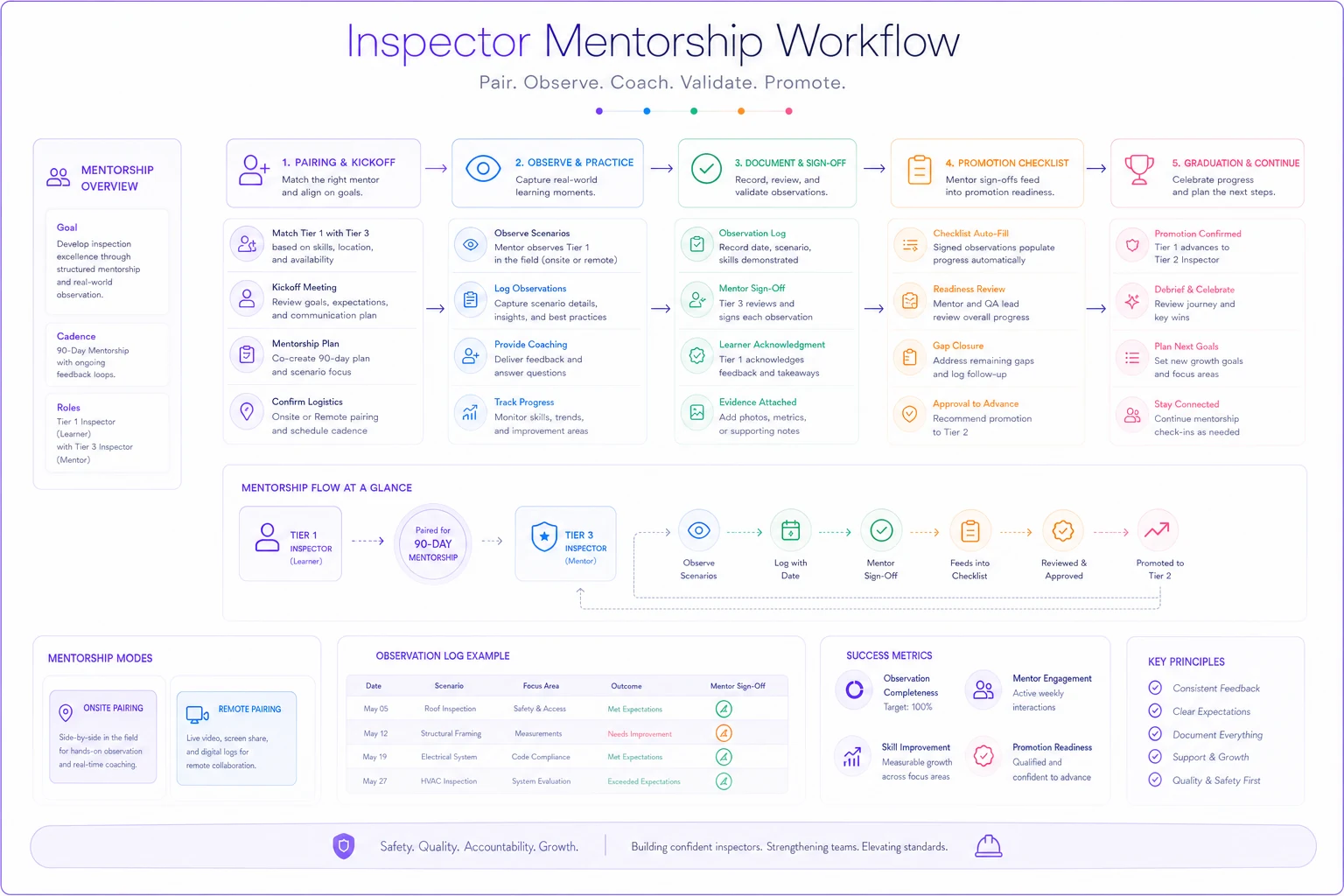
The workflow that works looks like this. A new Tier 1 inspector is paired with a Tier 3 for a defined block — say the first 90 days. During that block, the mentor isn't just available; they're accountable for a specific list of scenarios the mentee has to demonstrate. Routine inspection solo, non-routine inspection observed, one out-of-tolerance handling, one evidence package audit. Each gets logged with a date and a sign-off. At the end, the mentor's sign-off feeds into the promotion checklist — not as a replacement for it, but as a documented data point.
Pair new hires with meticulous, not fastest, inspectors for mentorship.
This diagram shows the mentor-mentee block, observable scenarios, and how sign-offs flow into promotion records.
Worth calling out: the best mentors are frequently not your highest-volume inspectors. Your fastest inspector often got fast by cutting corners that don't show up until an audit. The inspector who's slower but meticulous, who documents everything, who catches the ambiguous cases — that's your mentor. Pairing a new hire with your speed demon teaches them to be fast and sloppy. Mentorship ability is its own competency and should be treated and compensated as such.
There's also a coordination problem here that doesn't get enough attention. Across distributed teams, mentorship breaks down because the mentor and mentee are rarely on the same site. If your mentor is in one region and your new hire is in another, the shadowing never actually happens. This is one of the quieter reasons inspection programs fail to scale — the people-development layer assumes co-location that multi-site reality doesn't provide. You either budget for travel pairings, restructure territories so mentors and mentees overlap, or lean on guided remote demonstration for the observable scenarios.
Retention levers mapped to what actually drives turnover
Retention conversations usually jump straight to pay. Pay matters, but it's rarely the first thing that pushes a good inspector out the door. Across distributed field teams, inspectors tend to leave because of three things that compound: no visible path forward, a sense that the job is all travel and no growth, and the slow burn of being measured on metrics they can't influence.
-
Path visibility. A published competency ladder with clear promotion checklists is itself a retention tool. People stay when they can see the next rung and know exactly what reaching it requires. Ambiguity is what makes them start taking recruiter calls.
-
Workload and travel balance. Inspector burnout is often a routing problem dressed up as a morale problem. When your best people spend 60% of their week driving, they're not growing and they're not happy. Smarter batching directly affects retention, which is why workload design and reducing inspector travel time belongs in an HR conversation, not just an operations one.
-
Metric fairness. If you measure an inspector on defect catch rate but assign them the easy sites, and measure another on the same metric while handing them the hard sites, the second person will feel punished for doing harder work. Risk-weight your performance metrics by tier and site complexity, or your "fair" KPIs quietly drive your strongest people out.
A real scenario
A regional facility inspection firm running about 45 inspectors across three states was losing roughly a quarter of its Tier 2 and Tier 3 people every year — right where it hurt most, because those are the hardest and slowest roles to rebuild. Exit conversations kept surfacing the same two themes: no clear promotion path, and a feeling that the best inspectors got rewarded with more travel, not more growth.
They did two unglamorous things. First, they published a four-tier ladder with written promotion checklists tied to their existing quality metrics, so every inspector could see where they stood and what the next tier required. Second, they rebalanced routing so senior inspectors spent less time driving and more time on complex work and mentorship.
Within about a year, senior-tier turnover dropped to roughly half of what it had been. No big pay overhaul — people stayed because the path became visible and the job stopped feeling like a treadmill. The firm also stopped eating the hidden cost of constant re-hiring and re-certification, which was running somewhere in the range of $15k–$25k per lost senior inspector once you factored in recruiting, ramp time, and lost productivity.
Where this connects to audit readiness
Your competency tiers, promotion records, and mentorship sign-offs are audit evidence. When an auditor asks who was qualified to perform a given inspection and how you know, a tier system with documented promotion checklists answers the question in one move. A tenure-based org chart makes you improvise.
This is why the workforce system and the evidence system can't live in separate worlds. If your competency sign-offs sit in an HR folder while your inspection records sit in an operations platform, nobody can connect "this inspection" to "this person's documented qualification at that time." That linkage — person, tier, authorization date, inspection record — is exactly what gets probed in accreditation reviews.
Keeping competency records, promotion history, and inspection assignments in the same operational system rather than scattered across spreadsheets and email is what makes the whole thing defensible under audit. Not because software is magic, but because the alternative is reconstructing someone's qualification history from memory while an auditor waits.
When a formal ladder makes sense — and when it's overkill
A full tiered career ladder with promotion checklists is worth the overhead once you're past roughly 15–20 inspectors or operating across more than one site. Below that, your manager usually knows everyone's real capability, and heavy structure can slow you down more than it helps. Document role scope and keep competency records, but skip the elaborate four-tier machinery.
Where this becomes non-negotiable: multi-site teams, regulated inspection work, and any program heading toward accreditation. At that scale, informal judgment doesn't survive contact with turnover and audits. The manager who "just knew" everyone's capability leaves, and that knowledge walks out with them.
Who should hold off: teams in the middle of a major reorganization or a platform migration. Layering a new competency framework on top of operational chaos usually means the framework gets half-implemented and abandoned. Stabilize first, then build the ladder onto solid ground.
Building it so it survives you
The test of an inspection workforce strategy isn't whether it looks good in a slide deck. It's whether it still works after your best manager leaves, after you double your headcount, and after a regulator asks hard questions about who was qualified to do what.
That means role definitions tied to scope and evidence, competency tiers tied to risk, promotion checklists tied to the metrics you already track, mentorship that produces documented capability, and retention levers aimed at the real reasons people leave. When those pieces connect, hiring and promoting stop being reactive scrambles and start feeding a predictable pipeline that supports both your operational KPIs and your audit readiness at the same time.
Build it as a system, keep the records in one place, and tie every rung of the ladder to something you can measure and defend. That's the difference between a career ladder that looks nice on paper and one that actually holds up when it's tested.
Build it as a system, keep the records in one place, and tie every rung of the ladder to something you can measure and defend. That's the difference between a career ladder that looks nice on paper and one that actually holds up when it's tested.
Ready to modernize your inspection process?
Join 500+ inspection teams using Chekzly to reduce paperwork, improve compliance, and accelerate reporting.