

Most inspection programs don't fail their security review because someone did something wrong. They fail because the rules live in six different places, owned by four different people, and none of them agree on what happens to a photo of a cracked weld six months after it was captured.
That's the real problem with an inspection evidence security policy at scale. You've got a redaction SOP in a Google Doc, an encryption standard buried in an IT wiki, a retention schedule that legal wrote in 2021, and an MDM configuration the mobile team manages on their own. Each piece is probably fine in isolation. The failure happens in the seams — where one policy assumes something the other never enforced.
This article is about closing those seams. Not with another standalone document, but with a single governance layer that ties classification, access, encryption, retention, legal hold, and incident response together so they actually behave like one system.
The seam problem: where fragmented policies break
When an auditor or a defense attorney pulls on an evidence record, they don't attack your strongest control. They attack the handoff.
A typical example: your field team captures 40–50 photos per inspection. The redaction rules say faces and license plates get blurred before anything leaves the device. Good. But the retention policy says raw originals are kept for chain-of-custody purposes. Also reasonable — until someone asks: where are those raw originals, who can see them, and does the redaction rule apply to the copy sitting in cold storage? Suddenly nobody's sure. The redaction policy assumed the retention team would inherit the same access controls. The retention team assumed redaction already handled sensitivity.
That gap is where programs get burned. Not because a control was missing, but because two controls didn't share a definition.
In practice, this usually surfaces during three moments:
-
A subject-access or privacy request arrives, and you can't confirm every copy of a record was redacted consistently
-
A legal hold lands, and half your retention automation keeps deleting on schedule because it never knew to pause
-
A device gets lost, and nobody can say whether the evidence on it was encrypted and whether MDM could actually wipe it remotely
Each of those is a seam failure. And seams multiply as you grow.
Why this happens across almost every program
The root cause is organizational, not technical. Different controls get written by whoever owned the pain at the time.
Eliminate inspection delays and errors.
Chekzly helps you plan, execute, and document inspections efficiently and accurately.
- Real-time inspection tracking
- Automated report generation
- Compliance and checklist management
No credit card required
-
Redaction rules came from a privacy scare
-
Encryption standards came from IT security
-
Retention schedules came from legal or compliance
-
MDM came from whoever bought the phones
-
Incident response came from a post-mortem after something already went wrong
Nobody sat down and asked how these interact. So you end up with five policies that each optimize for their own worst-case scenario, and none of them optimized for the one that actually happens — an evidence record moving through its full lifecycle across devices, storage tiers, and people.
The other reason: policies get written for documents, but inspection evidence isn't a document. It's a bundle — photos, video, sensor readings, signatures, GPS, notes, timestamps — each with different sensitivity and a different useful lifespan. Applying one blanket rule to the whole bundle is what creates the contradictions.
What breaks specifically at scale
A single-site program can survive fragmented policies because one person holds the whole map in their head. That stops working somewhere around the second or third site.
Here's what tends to crack, roughly in order:
Access sprawl. At two sites, everyone knows who should see what. At eight sites with contractors, you've got dozens of accounts and no consistent rule for what "inspector," "reviewer," and "client-facing" actually mean in terms of permissions. Role definitions drift per site.
Retention drift. Different regions apply different retention windows — sometimes for good legal reasons, sometimes because someone copied the wrong template. Now you can't answer a simple question like "how long do we keep water-system inspection video?" with one number.
Legal hold that doesn't reach. This is the expensive one. A hold gets issued for one facility, but the evidence for that facility is scattered across shared cloud folders, inspector devices, and a backup archive. If your retention automation runs independently of your hold process, it keeps deleting during the hold. That's spoliation, and it's the kind of thing that turns a manageable dispute into a losing one.
Incident response paralysis. A device goes missing on a Friday. Who decides if it's a reportable breach? Does MDM wipe automatically or wait for approval? Does wiping destroy evidence under hold? Without a template that already answers these questions, teams freeze — and the clock on breach-notification deadlines is already running.
The connective tissue matters more than any single control. Your redaction work only holds up if it's paired with disciplined retention and retrieval — the same reasoning behind building an audit-ready inspection records system with metadata and retrieval SOPs. Isolated excellence in one control doesn't survive contact with scale.
The unified governance layer: one doc, five interlocking parts
The fix isn't more policies. It's collapsing them into a single governance document where each part explicitly references the others. One source of truth that a field lead, an IT admin, and a lawyer can all read and reach the same conclusion from.
Five parts have to live in that doc and talk to each other:
1. Evidence classification
Everything starts here, because classification is the key every other control looks up. Instead of treating all evidence the same, you tag each type with a sensitivity tier and a lifecycle profile.
A practical scheme uses three or four tiers:
| Tier | Example evidence | Access default | Encryption | Retention default |
|---|---|---|---|---|
| Sensitive | Photos with faces, personal ID, health/safety incident detail | Named reviewers only | At rest + in transit, device-encrypted | Shortest legal minimum |
| Standard | General condition photos, sensor readings, checklist data | Role-based (inspector, reviewer) | At rest + in transit | Program standard (e.g. 5–7 yrs) |
| Reference | Site maps, non-personal context shots | Broad internal | At rest | Long / indefinite |
| Signed package | Final report + signatures + hashes | Locked, read-only | At rest, integrity-protected | Statutory / contractual |
The point isn't the exact tiers — it's that classification becomes the input to access, encryption, and retention decisions instead of each of those being decided independently.
2. Role-based access mapped to classification
Once evidence is tiered, access stops being ad-hoc. You define a small number of roles and state, explicitly, what each role can do with each tier. The mistake to avoid: creating a unique permission set per person. Define roles, assign people to roles, and never let "special access for Dave" become permanent.
A good governance doc also states the deprovisioning rule in the same breath as the access rule. When a contractor's engagement ends, their access to Sensitive and Standard tiers revokes within a defined window — not whenever someone remembers.
3. Encryption and retention SLAs
This is where you turn vague promises into measurable commitments. "We encrypt data" is not a policy. An SLA looks like this:
-
Evidence encrypted at rest within X minutes of capture
-
All transfers over encrypted channels, no exceptions for "quick" sharing
-
Retention timers start at capture, not at upload
-
Deletion executes within a defined window after the retention date — and generates a deletion log
That deletion log matters more than people expect. Being able to prove you deleted something on schedule is as important as deleting it. It's the same discipline behind trustworthy signatures and timestamps — if you can't demonstrate a record's integrity through its lifecycle, the record itself weakens. That's exactly the problem digital-signature and timestamp standards are built to solve.
4. Legal-hold mapping
This is the part that saves you. Your governance doc needs an explicit map: given a hold trigger, which classifications, sites, date ranges, and storage locations are frozen, and how the freeze reaches every copy.
The critical design rule: legal hold overrides retention automation, always, and the override is technical — not a note asking someone to remember. When a hold is placed, the system stops the deletion timer for the matched records automatically. When the hold lifts, normal retention resumes, and the doc records who lifted it and when.
If your hold process is a manual email to the retention admin, you don't have a hold process. You have a hope.
5. Incident-response templates that combine redaction, MDM, and retention
This is the part almost nobody integrates, and it's exactly where redaction, device management, and retention have to act as one. Most incident plans treat a lost device as an IT problem. But a lost inspection device is simultaneously a privacy problem (unredacted originals), a device problem (MDM wipe), and an evidence problem (that device might hold records under hold).
Your template has to resolve all three at once. A workable response sequence:
-
Confirm scope. Identify the device, the user, and — using classification tags — what tiers of evidence it likely held.
-
Check for active holds. Before any wipe, confirm whether the device holds records under legal hold. If yes, the wipe decision escalates.
-
Assess encryption state. If MDM confirms the device was encrypted and the passcode policy was enforced, your breach exposure drops dramatically. Document this — it's often the difference between a reportable breach and a non-event.
-
Execute or hold the wipe. For non-hold devices, remote wipe per MDM policy. For hold devices, capture a forensic copy first if feasible, then wipe.
-
Verify redaction on surviving copies. Confirm cloud originals for that inspector are handled per the redaction SOP, so a lost device doesn't become a second leak through unblurred archives.
-
Log and notify. Record the timeline, and start any breach-notification clock based on confirmed exposure — not on panic.
The reason this belongs in the same document as everything else is steps 2 and 5. Those steps only work if incident response can read the classification tags, the hold map, and the redaction status. Wire redaction, MDM, and retention together and a lost device becomes a controlled 30-minute procedure instead of a two-week fire drill. Getting the redaction half right without breaking the evidentiary value of records is its own discipline — worth reading on separately in redacting inspection evidence without breaking audits.
A short real scenario
A mid-size facilities inspection outfit — around 30 field inspectors across 6 sites, roughly 900–1,000 inspections a month — had all five controls, but as separate documents. Their retention automation ran nightly. Their legal-hold process was an email to one compliance manager.
A dispute triggered a hold at one site. The email went out on a Thursday. The retention job ran that same night and deleted about three weeks of records that fell past the standard window — including material relevant to the hold. It took them the better part of two months and a painful conversation with outside counsel to reconstruct what they could from backups. Not everything came back.
After that, they merged the five policies into one governance doc and made two hard rules: holds pause retention technically, and classification tags drive access and retention automatically. The next hold, months later, took an afternoon — the matched records froze on their own, and the deletion log proved everything outside the hold was handled correctly. No reconstruction. No counsel scramble.
The difference wasn't better people. Their compliance manager was sharp both times. The difference was that the controls finally shared a brain.
When a unified layer makes sense — and when it doesn't
Worth being honest about this, because not every program needs the full framework.
It makes sense when:
-
You're running more than two sites, or using contractors with variable access needs
-
You've had even one near-miss with retention, legal hold, or a lost device
-
Different regions apply different retention or privacy rules
-
Your evidence includes personal data — faces, plates, health/safety detail
It's overkill when:
-
A single-site operation with one or two inspectors and low-sensitivity evidence
-
Programs where evidence genuinely is public or non-personal and holds are rare
For those situations, a lighter set of clearly written SOPs beats a heavy governance framework nobody follows. The cost of a unified layer is the discipline to maintain it — if you can't keep it current, it becomes shelf-ware, which is worse than a simple doc people actually read.
Who should not attempt this yet
If your evidence isn't classified at all — if a photo and a signed final report get treated identically today — start there before building the full layer. Classification is the foundation the other four parts read from. Trying to write access rules, retention SLAs, and hold maps on top of unclassified evidence just moves the seam problem into a bigger document.
Get classification working first. Even a rough two-tier split (sensitive vs. standard) gives the other controls something to look up. Once that's stable, the rest of the layer has something to attach to.
Getting to one source of truth
The tooling side is simpler than it sounds. What you're after is a system where classification tags actually drive behavior — where tagging a photo as Sensitive automatically sets its access, encryption, and retention, and where placing a hold automatically pauses deletion for the matched records.
Visualized below is a simple workflow showing how classification tags drive behavior across systems.
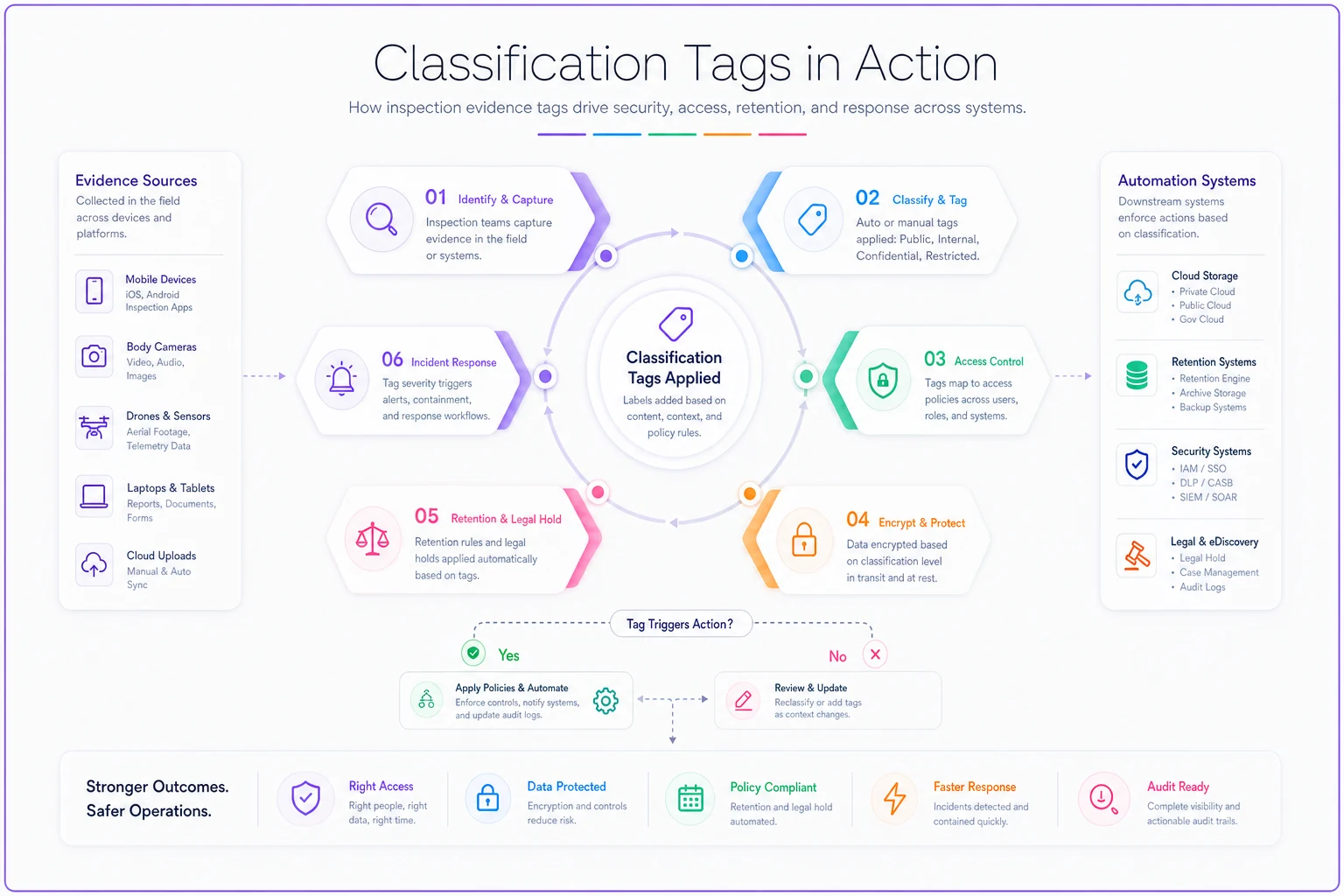
Modern inspection platforms with built-in policy automation can enforce these links so a field inspector never has to remember the retention window or the redaction rule. The classification does the remembering. That's the quiet payoff of consolidating governance: fewer decisions land on people in the field, and the ones that do are the ones humans are actually good at.
Automate classification at capture so policies apply consistently and reduce manual errors in the field.
The goal isn't a thicker binder. It's one document, and one enforced set of behaviors, where redaction, access, encryption, retention, legal hold, and incident response all read from the same definitions.
When they do, the seams disappear — and the seams were where you were losing.
Ready to modernize your inspection process?
Join 500+ inspection teams using Chekzly to reduce paperwork, improve compliance, and accelerate reporting.