

When a single inspection produces a photo, a thermal scan, a vibration reading, a voice note, and a form entry, you no longer have "an inspection record." You have five records that happen to share a job number. And the moment someone — a regulator, a plaintiff's lawyer, a recall coordinator — asks you to prove those five things describe the same event at the same moment, most programs find out their governance was built for one modality at a time.
That gap is the core of multimodal evidence governance inspections work. Not the capture. The stitching. Evidence that can't be fused reliably gets challenged, and evidence that gets challenged during a recall is evidence you effectively don't have.
This isn't something you notice early. It shows up at scale, when volume and legal stakes rise together.
Why multimodal evidence breaks differently than single-stream evidence
A photo program fails in predictable ways — bad metadata, wrong timestamps, no chain of custody. Teams have mostly learned to handle that, and if you haven't, the fundamentals are in the field SOP for admissible photos and video.
Multimodal evidence fails in the seams. The individual pieces can each be perfectly valid and the combined record still collapses.
A typical example: an inspector photographs a corroded weld, a handheld ultrasonic probe logs a wall-thickness reading, and the inspector dictates "looks worse than last quarter." Three valid artifacts. But the photo's EXIF clock is set to device-local time, the probe exports in UTC, and the voice note timestamps when the file was saved — about four minutes after the fact because the inspector was wearing gloves. Now try to reconstruct the sequence. You can't, not defensibly. In a recall timeline where you're trying to prove when a defect became detectable, four minutes of ambiguity across three devices is enough for opposing counsel to argue the readings describe different conditions entirely.
The pattern repeats across almost every multimodal program: each modality has its own clock, its own identity model, and its own idea of what constitutes an event. Governance that treats all evidence as one undifferentiated pile ignores this, and you don't find out until the worst possible moment.
Start with modality tiers, not a flat evidence policy
Stop treating all evidence as equal. Different modalities carry different evidentiary weight, different failure modes, and different handling costs. Lumping them together means you either over-govern cheap evidence or under-govern the stuff that actually decides cases.
Eliminate inspection delays and errors.
Chekzly helps you plan, execute, and document inspections efficiently and accurately.
- Real-time inspection tracking
- Automated report generation
- Compliance and checklist management
No credit card required
| Tier | Modalities | Evidentiary weight | Validation burden | Typical use |
|---|---|---|---|---|
| Tier 1 — Primary | Calibrated sensor readings, signed form entries, GPS-anchored photos/video | High, admissible on its own | Heavy (calibration cert, chain of custody, clock verification) | Investigations, recalls, regulator submissions |
| Tier 2 — Corroborating | Uncalibrated sensor data, thermal/acoustic scans, screenshots | Medium, strengthens Tier 1 | Moderate (source + timestamp verification) | Trend analytics, risk scoring, internal review |
| Tier 3 — Contextual | Voice notes, free-text comments, ambient photos | Low on its own | Light (just attribution + rough time) | Context, narrative, triage |
A Tier 3 voice note doesn't need a calibration cert chasing it.
The tiering tells your team where to spend validation effort. A Tier 3 voice note doesn't need a calibration cert chasing it. A Tier 1 ultrasonic reading absolutely does — and if that cert is missing, you want to know at capture, not at discovery.
One mistake worth naming: teams often promote evidence to a higher tier because it feels authoritative. A thermal image looks scientific, so people treat it as Tier 1. But if the camera's emissivity setting wasn't recorded and the device wasn't calibrated to a traceable standard, that image is Tier 2 at best. Looking technical and being admissible are not the same thing.
Minimal metadata per modality — enough to fuse, not a data-hoarding exercise
Once admissibility becomes a real concern, the instinct is to capture everything. That's a trap. Over-collection creates privacy exposure, storage cost, and — critically — more fields that can be wrong and get you impeached. The goal is the minimum metadata that makes a modality fusible and defensible.
-
Photos/video capture timestamp (with timezone), GPS with accuracy radius, device ID, inspector ID, job/asset ID, and capture settings that affect interpretation (for thermal: emissivity, range). The deeper treatment is in the admissible photos and video SOP.
-
Sensor readings reading value + units, sensor ID, calibration cert reference and expiry, capture timestamp in a declared timezone, asset ID, and sampling method.
-
Voice/text notes author ID, capture timestamp (when spoken/typed, not saved), associated job/asset ID, and a link to the artifact it's commenting on.
-
Form entries form version, submitter ID, submission timestamp, and signature reference.
Notice what's not on these lists: device battery level, app build number, location history beyond the capture point. Metadata you can't justify in a deposition is metadata that becomes a liability. Collect what proves who, what, when, where, and under what conditions — then stop.
The shared field across all of them is what makes fusion possible: asset ID and job ID. If every modality reliably carries both, you can reconstruct a complete evidence set even when the modalities live in different systems. If they don't, you're doing manual correlation indefinitely.
Ingestion and validation checks: catch the break at the door
The cheapest place to fix bad evidence is the moment it enters the system. The most expensive place is during an investigation, months later, when the inspector has left the company and the device has been re-imaged.
-
Schema check — does the artifact carry the minimum metadata for its modality and tier? Missing calibration reference on a Tier 1 sensor reading = reject or quarantine.
-
Clock sanity check — is the timestamp within a plausible window of the job? A reading dated three days before the work order opened gets flagged. A timezone that doesn't match the declared site location gets flagged.
-
Identity resolution — does the inspector ID, device ID, and asset ID resolve to real, active records? Orphan IDs are a classic sync artifact.
-
Calibration validity — for calibrated sensors, is the cert current as of the capture time, not the upload time? Out-of-tolerance handling should route here.
-
Duplicate and conflict detection — same asset, same timestamp, two contradictory readings means someone needs to reconcile before this enters the record of truth.
The ordering matters. Schema first, because there's no point validating a clock on an artifact that's missing half its fields. Identity before calibration, because a calibration check on a phantom device tells you nothing.
What usually goes wrong: teams run these checks as a nightly batch instead of at ingestion. By the time the batch flags a missing calibration cert, the inspector is three sites away and can't remember which probe they used. Validation that isn't synchronous with capture generates work tickets nobody can close. The broader records architecture — metadata discipline, retrieval, quarantine — is the same backbone described in the audit-ready inspection records system.
Fusion rules: how the pieces become one defensible record
Fusion is where governance earns its keep, and it's the part most programs skip entirely. They store the artifacts and assume anyone can see they belong together. In an adversarial review, assumptions get attacked.
Fusion rules answer three questions explicitly:
1. What binds artifacts into one evidence set? The join key. Asset ID + job ID + a time window. Everything inside that window, tied to that asset and job, is candidate evidence for one event. Define the window per use case — a few minutes for a point inspection, hours for a continuous monitoring run.
2. How do you handle temporal alignment across clocks? Normalize everything to a single reference timezone (UTC is the sane default) at ingestion, but preserve the original declared time in metadata. Show the regulator both the normalized sequence and the raw source values. Hiding the normalization looks like tampering; showing your work builds trust.
3. What happens when modalities disagree? This is the rule people forget. A sensor says the pressure was fine; the inspector's note says it looked wrong. Your fusion policy needs a precedence order tied to the tiers above — and a requirement that conflicts are surfaced, not silently resolved. A fused record that quietly drops the dissenting voice note is worse than one that shows the disagreement. In an investigation, the disagreement is often the most informative artifact you have.
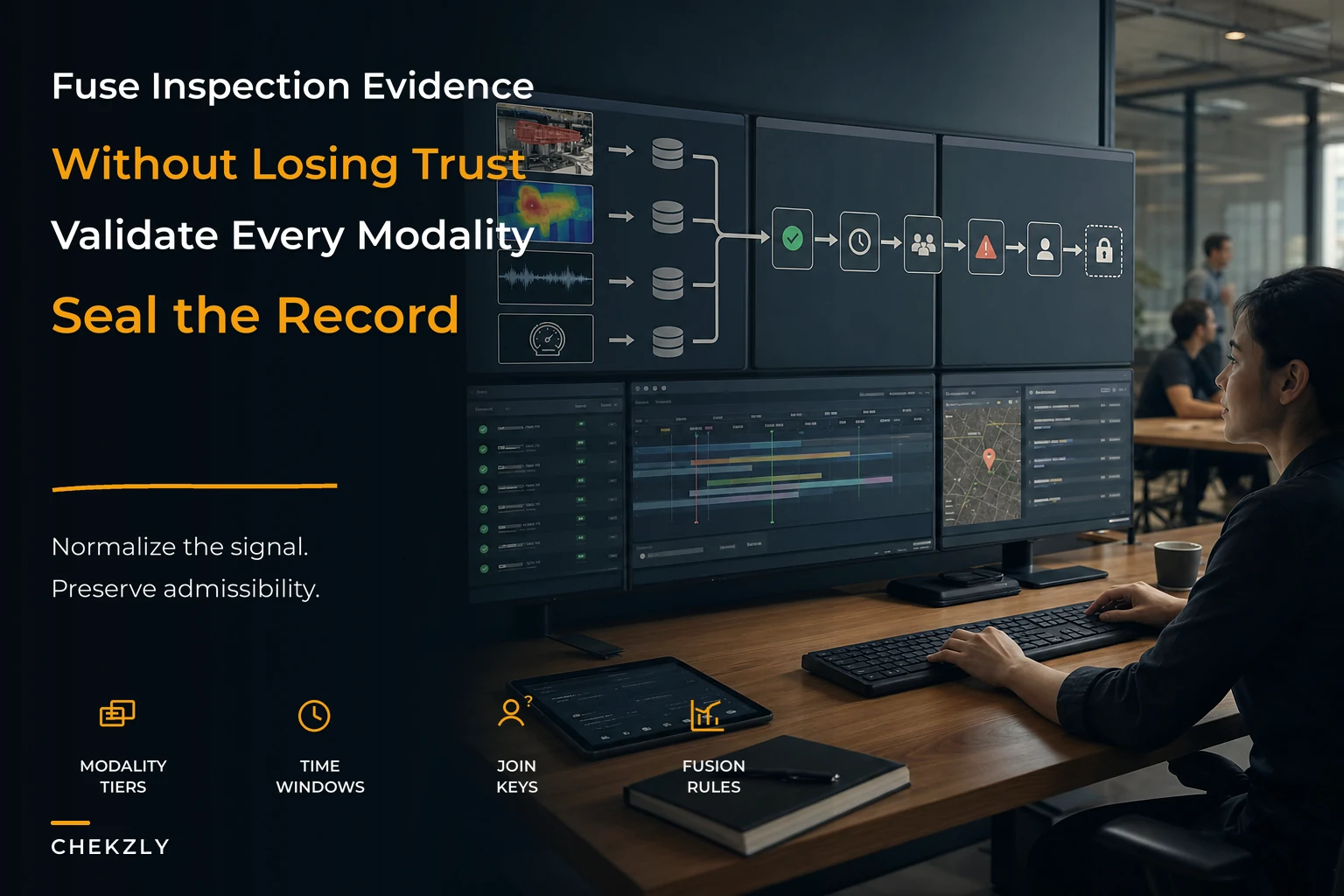
A clean way to think about the workflow: artifacts arrive → ingestion validates each one against its modality schema → valid artifacts are timestamp-normalized → the fusion engine groups them by join key and window → conflicts and gaps get flagged for human review → the reviewed set becomes the sealed evidence package. Nothing becomes "official" until it passes through grouping and conflict review. The sealing step — signatures, immutability, retention clock — is where admissibility locks in.
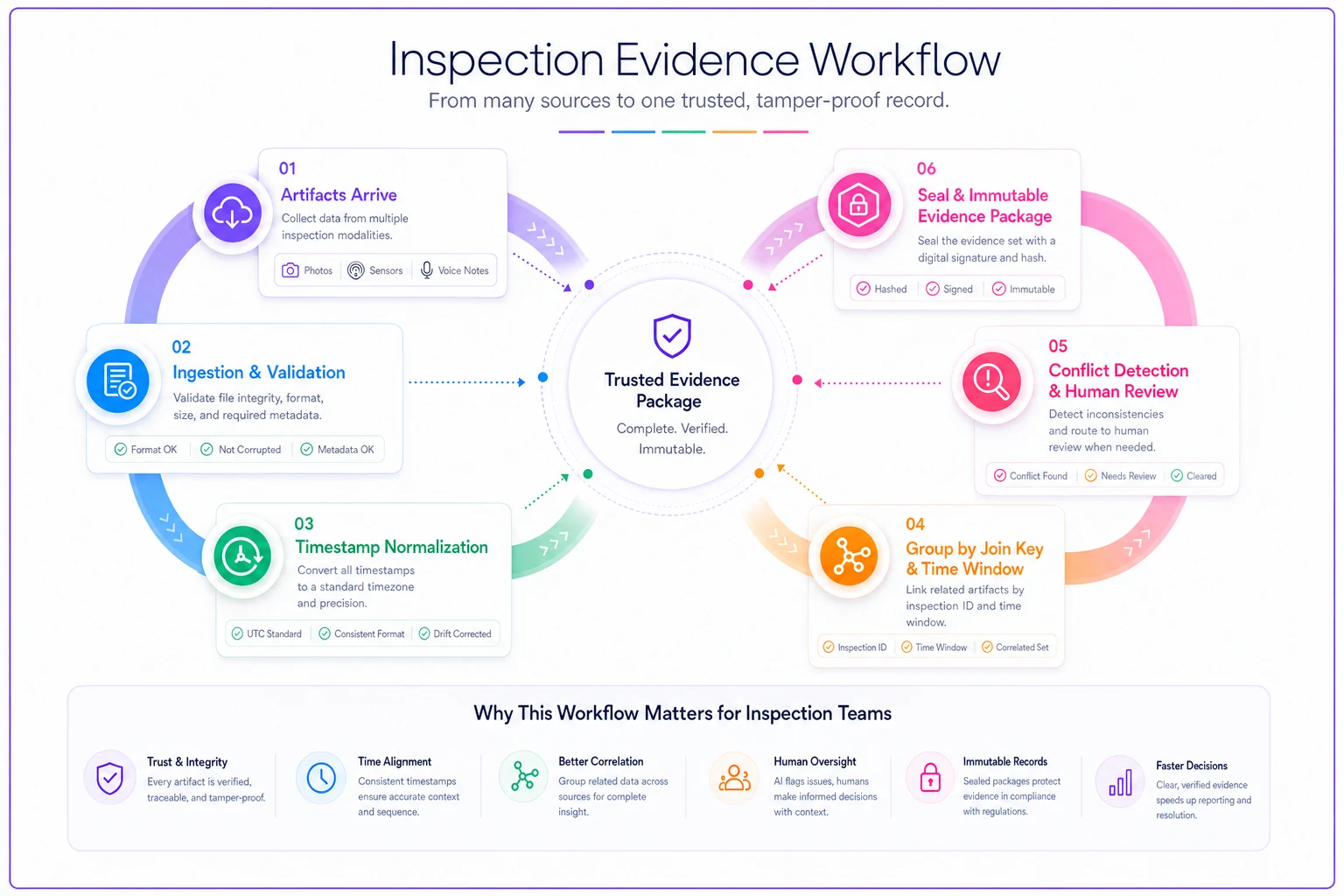
The sealing step — signatures, immutability, retention clock — is where admissibility locks in.
A real scenario: a recall that turned on sensor fusion
A mid-sized industrial equipment manufacturer — around 40 field inspectors across a dozen sites — hit a potential safety recall on a valve component. They needed to prove, across roughly 1,400 inspection events over 18 months, when a failure signature first became detectable and whether their inspectors should have caught it.
Their evidence existed. Photos in one system, vibration readings in a sensor platform, inspector notes in the mobile forms app. But the three systems used different timestamp conventions and only loosely shared asset IDs — some inspectors typed asset numbers by hand, so around 12% had typos or variant formats. Reconstructing a single defensible timeline per unit was taking their quality team close to two hours per unit, and the matches were shaky enough that legal didn't trust them.
Once they imposed a consistent join key (cleaned asset ID + job ID), normalized all timestamps to UTC with original values preserved, and ran a conflict pass, reconstruction dropped to roughly 15–20 minutes per unit. More importantly, the output was something counsel would actually stand behind, because the fusion logic was documented and disagreements were visible rather than buried. The recall scope narrowed too — reliable timelines showed the failure signature wasn't detectable as early as initially feared. Fewer units, defensible dates, far less argument.
The lesson wasn't "buy better sensors." The sensors were fine. The failure was that nothing governed how the streams came together.
When this level of governance makes sense — and when it's overkill
When it makes sense:
-
Your evidence routinely ends up in investigations, recalls, or regulatory submissions
-
You're combining two or more modalities per inspection (photos + sensor data is the common trigger)
-
You operate across multiple sites or timezones where clock drift is a real issue
-
Litigation or recall exposure is a live risk in your industry
When it's overkill:
-
Single-modality programs — if it's just checklists and photos, tier them and move on
-
Low-stakes internal inspections where no one will ever contest the record
-
Very low volume, where manual correlation genuinely costs less than building the rules
Who should not rush into this:
-
Programs that haven't nailed single-modality basics yet. If your photo metadata is inconsistent and calibration tracking is loose, fixing those first gives you more admissibility per dollar than any fusion layer. Fusion governance multiplies the quality of your inputs — including the problems, if the inputs are bad. Getting sensor data in cleanly before you ever fuse it is worth doing right; there's a practical walkthrough in the sensor-assisted inspections guide.
Fusion governance multiplies the quality of your inputs — including the problems, if the inputs are bad.
A short readiness checklist
Before you trust your evidence to survive an investigation, run through this:
-
[ ] Every modality has a defined tier and a documented minimum metadata set
-
[ ] Asset ID and job ID are carried by every artifact, with capture validated against real records
-
[ ] Timestamps are normalized to one reference zone, with original values preserved
-
[ ] Ingestion validation runs at capture time, not as an overnight batch
-
[ ] Calibration validity is checked against capture time, not upload time
-
[ ] Fusion join keys and time windows are defined per use case
-
[ ] Conflict handling surfaces disagreements instead of silently resolving them
-
[ ] Sealed evidence packages are immutable and carry their own provenance
Check most of these and your multimodal evidence will survive scrutiny. Miss several and you likely have evidence that looks complete and falls apart the moment someone pushes on it.
The part that scales with you
This is a systems problem rather than a capture problem because it gets worse as you grow. More inspectors means more clocks and more asset-ID typos. More sensor types means more timestamp conventions. More sites means more timezones. More volume means more legal exposure. Each compounds the others.
A program correlating evidence by hand at 200 inspections a month will drown at 2,000 — not because each inspection got harder, but because the seams multiplied faster than the volume. The teams that handle this well decide early what a fused evidence set means, enforce the join keys and metadata at the door, and make conflicts visible instead of convenient. Inspection platforms with AI-assisted automation can handle the normalization and grouping once those rules exist — but the rules have to come from you. Software enforces a fusion policy; it doesn't invent one.
Get the tiers, the minimal metadata, and the fusion rules right while your volume is still small enough to fix by hand. That window closes faster than most managers expect, and it doesn't reopen until after the investigation that exposed the gap.
Get the tiers, the minimal metadata, and the fusion rules right while your volume is still small enough to fix by hand. That window closes faster than most managers expect, and it doesn't reopen until after the investigation that exposed the gap.
Ready to modernize your inspection process?
Join 500+ inspection teams using Chekzly to reduce paperwork, improve compliance, and accelerate reporting.