

Most inspection programs don't fail during the inspection. They fail in the 48 hours after something goes wrong — when nobody's quite sure who owns the response, what evidence needs to be frozen, or whether the thing that just got flagged is a "log it and move on" or a "stop the line and call counsel" situation.
The gap between those two outcomes is where escalation architecture lives. And it's usually the least-designed part of the whole operation. Teams pour effort into checklists, calibration, and photo standards, then treat escalation as a phone tree that lives in someone's head. That works fine until you have three sites, two regulators, and a procurement contract with a 24-hour notification clause all touching the same event.
This is a systems piece, not a list of tips. The goal is to show how incident tiers, decision matrices, evidence requirements, RACI, and SLAs fit together into something that actually holds when the pressure's on — and where it tends to break as you scale.
Why escalation breaks quietly (until it breaks loudly)
The failure mode is almost never dramatic at first. What tends to happen across multi-site programs is that escalation degrades gradually, in ways that look fine on paper.
A single-site inspection team runs on relationships. The inspector knows to text the site manager, who knows to call the QA lead, who knows when to loop in legal. Nobody wrote it down because nobody needed to. The whole escalation path fit inside three people who ate lunch together. Then the program grows. New sites, contract inspectors, a procurement team managing third-party vendors, and a legal function that only hears about incidents after they've already gone sideways. Suddenly the informal path has 15 nodes instead of three, and the "everyone knows who to call" model quietly stops being true. Nobody notices until an incident routes to the wrong person, sits for two days, and turns a containable problem into a regulatory notification you missed the window on.
The core insight here: escalation isn't a communication problem, it's a classification problem. If people can't quickly and consistently agree on how serious this is, everything downstream — who gets called, what gets preserved, how fast — falls apart. Most broken escalation systems are actually broken tiering systems wearing a trench coat.
Incident tiers: the foundation everything else hangs on
Before you can build a decision matrix or assign SLAs, you need tiers that a tired inspector at 6pm can apply without calling a meeting. The mistake most programs make is building tiers around what happened (equipment failure, documentation gap, safety near-miss) instead of what response the event demands. The second framing is the one that scales.
Eliminate inspection delays and errors.
Chekzly helps you plan, execute, and document inspections efficiently and accurately.
- Real-time inspection tracking
- Automated report generation
- Compliance and checklist management
No credit card required
| Tier | Trigger character | Who must know | Evidence posture | Response clock |
|---|---|---|---|---|
| T1 – Routine deviation | Out-of-spec finding, no immediate risk, correctable in normal workflow | Site lead | Standard inspection record | Next business day |
| T2 – Elevated | Repeat finding, single-site safety concern, minor contract implication | Site lead + QA manager | Record + preserved raw evidence (photos, sensor logs) | 8 business hours |
| T3 – Serious | Safety event, potential regulatory reportable, vendor breach, cross-site pattern | QA + Ops director + Legal notified | Full evidence package, chain-of-custody locked | 4 hours to first action |
| T4 – Critical | Injury, environmental release, regulator on-site, litigation-triggering | Executive + Legal lead + Procurement + Comms | Full package, legal hold, no edits/deletes | Immediate, parallel response |
The number of tiers matters less than the discipline behind them. Four is usually the sweet spot — three feels too coarse once you have varied incident types, and five or more creates argument at the boundaries. What breaks programs is having tiers that sound different but trigger the same response. If T2 and T3 both mean "email the QA manager and wait," you don't have tiers, you have labels.
One pattern worth stealing: build a hard rule that anything genuinely ambiguous escalates up, not down. If an inspector can't decide between T2 and T3, it's a T3 until someone with authority downgrades it. This costs you some false alarms. It also means you never miss the window on the one that mattered because a field tech under-called it.
The decision matrix: making tiering repeatable
A tier definition is useless if two inspectors classify the same event differently. That's where the decision matrix earns its keep — it turns judgment into a lookup.
-
Identify the trigger. What did the inspection surface? Pull it straight from the finding, not from interpretation.
-
Check the hard-stop list. Injuries, environmental events, regulator presence, and named contract-breach conditions auto-classify as T3 or T4 regardless of anything else. No judgment call needed.
-
Score severity. Use a fixed three-level scale tied to concrete outcomes, not vibes — "correctable in normal work" vs. "requires stopping an activity" vs. "harm or exposure already occurred."
-
Score exposure. Is this reportable? Does a vendor SLA trigger a notification clock? Has the same finding appeared at another site in the last quarter?
-
Read the tier off the grid. Highest applicable dimension wins. Severity and exposure don't average — you take the worse one.
-
Log the classification with a one-line rationale. This is the part everyone skips and everyone regrets during an audit.
That last step is the sleeper. The rationale line — "classified T3 because same corrosion finding appeared at Site 4 in March" — is what lets an investigator six months later reconstruct why the response happened the way it did. Without it, you're defending decisions from memory, which never goes well.
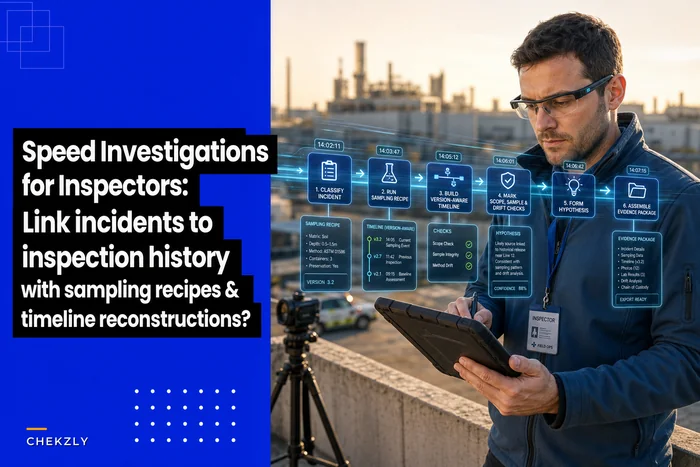
If you're already thinking about how incidents connect back to prior findings, the sampling and timeline approaches in tying incidents to inspection history pair directly with this classification step.
Evidence-package requirements per tier
Here's a distinction that saves programs a lot of pain: the evidence you collect during an inspection and the evidence you preserve during an incident are not the same thing, and they shouldn't follow the same rules.
Per-tier evidence requirements:
-
T1 Standard inspection record. Nothing special. Normal retention applies.
-
T2 Standard record plus raw source files preserved — original photos with intact metadata, sensor logs, the checklist version in use. Flagged so retention rules don't purge it early.
-
T3 Full evidence package assembled within the response window: all raw files, chain-of-custody log started, inspector statement captured while memory is fresh, related historical findings pulled and attached, checklist and calibration status snapshotted. Edit-locked.
-
T4 Everything in T3, plus a formal legal hold across all potentially relevant records, versioned copies of anything already changed, and a documented custody trail from the moment of discovery.
Freeze raw source files as soon as a T2 or higher is suspected to preserve metadata and clock the evidence capture.
The common failure is treating the evidence package as something you assemble after the dust settles. By then metadata's been stripped by a re-save, the sensor buffer has rolled over, and the inspector's recollection has gotten fuzzy. Evidence preservation is a response action, not a cleanup action. It has to happen inside the SLA clock, not after it.
A subtle point on chain-of-custody: it's not just for the courtroom scenario. Even for a T3 that never becomes litigation, being able to show an unbroken custody trail is what makes the eventual remediation defensible to a regulator or a customer. The near-miss-to-closure work in linking safety reports to verifiable remediation leans hard on exactly this — you can't prove closure if you can't prove what the evidence was at capture.
RACI: the part that dissolves under pressure
Every program has a RACI on paper. Almost none of them survive a real T3 at 9pm on a Friday.
The problem isn't the template. It's that most RACIs are built for the calm-day version of a role and never tested against the "everyone's already busy and the clock is running" version. When an incident hits, the questions that actually matter are narrow and urgent: Who decides the tier? Who's allowed to stop work? Who talks to the regulator? Who signs the legal hold? If those four answers aren't unambiguous, you get either paralysis or five people doing the same thing.
| Function | T1 | T2 | T3 | T4 |
|---|---|---|---|---|
| Tier classification | Inspector (A) | QA (A) | QA (A) | Ops Director (A) |
| Response execution | Site lead (R) | QA (R) | Ops (R) | Ops + Legal (R) |
| Legal decisions | — | Consulted | Legal (A) | Legal (A) |
| External notification | — | — | Legal + Ops (A) | Executive (A) |
| Procurement/vendor action | — | Informed | Procurement (R) | Procurement (R) |
| Evidence integrity | Inspector (R) | QA (R) | QA (A) | Legal (A) |
The Accountable role migrates upward as severity rises — that's deliberate. The single most common RACI failure is leaving accountability at the field level for events that need organizational authority. An inspector shouldn't be the accountable party for whether you notify a regulator. Equally common is the reverse: routing every T1 to a director, which trains everyone to ignore the escalation channel because it cries wolf.
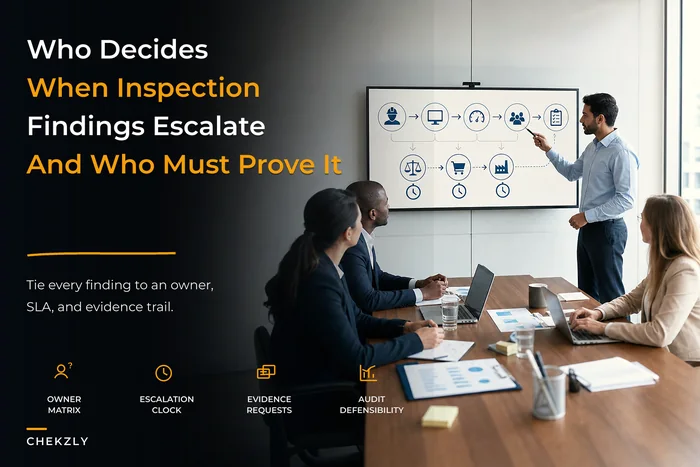
The ownership boundaries between ops, legal, and procurement deserve their own attention, because that's where handoffs stall. The governance blueprint for who owns inspection outcomes across legal, procurement, and operations covers those seams in depth — escalation architecture assumes those ownership lines already exist and just tells you when each owner gets pulled in.
SLAs that orchestrate, not just measure
An SLA on an incident isn't a performance metric — it's an orchestration tool. The clock is what forces parallel actions to actually happen in parallel instead of one person waiting on another.
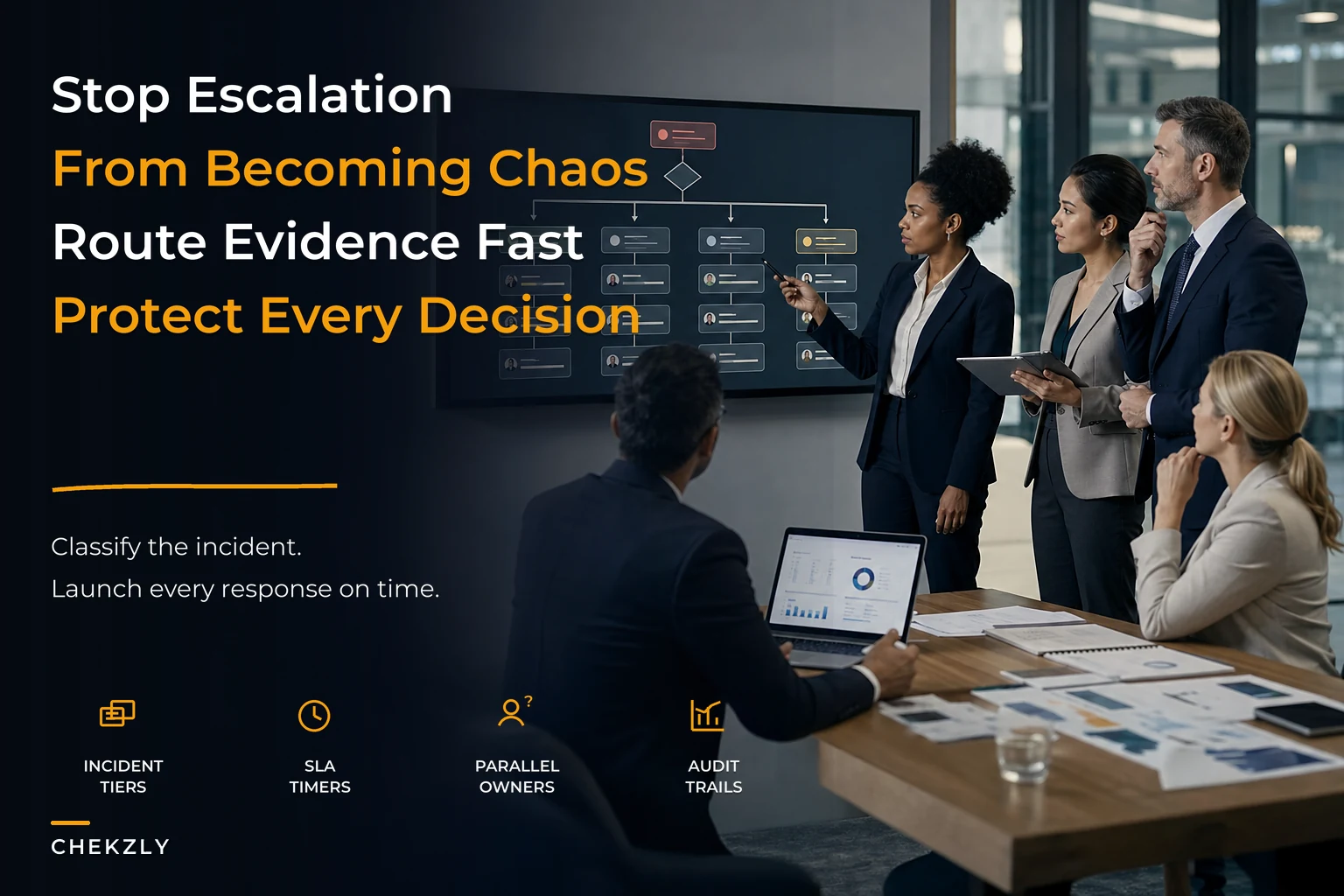
The distinction most programs miss: a T3 or T4 response is not a sequence, it's a fan-out. Legal starting its assessment, evidence getting frozen, and procurement checking vendor notification obligations should all start at roughly the same moment, not one after another. If your SLA is written as "step 1, then step 2, then step 3," you've serialized something that needs to be simultaneous, and your total response time balloons.
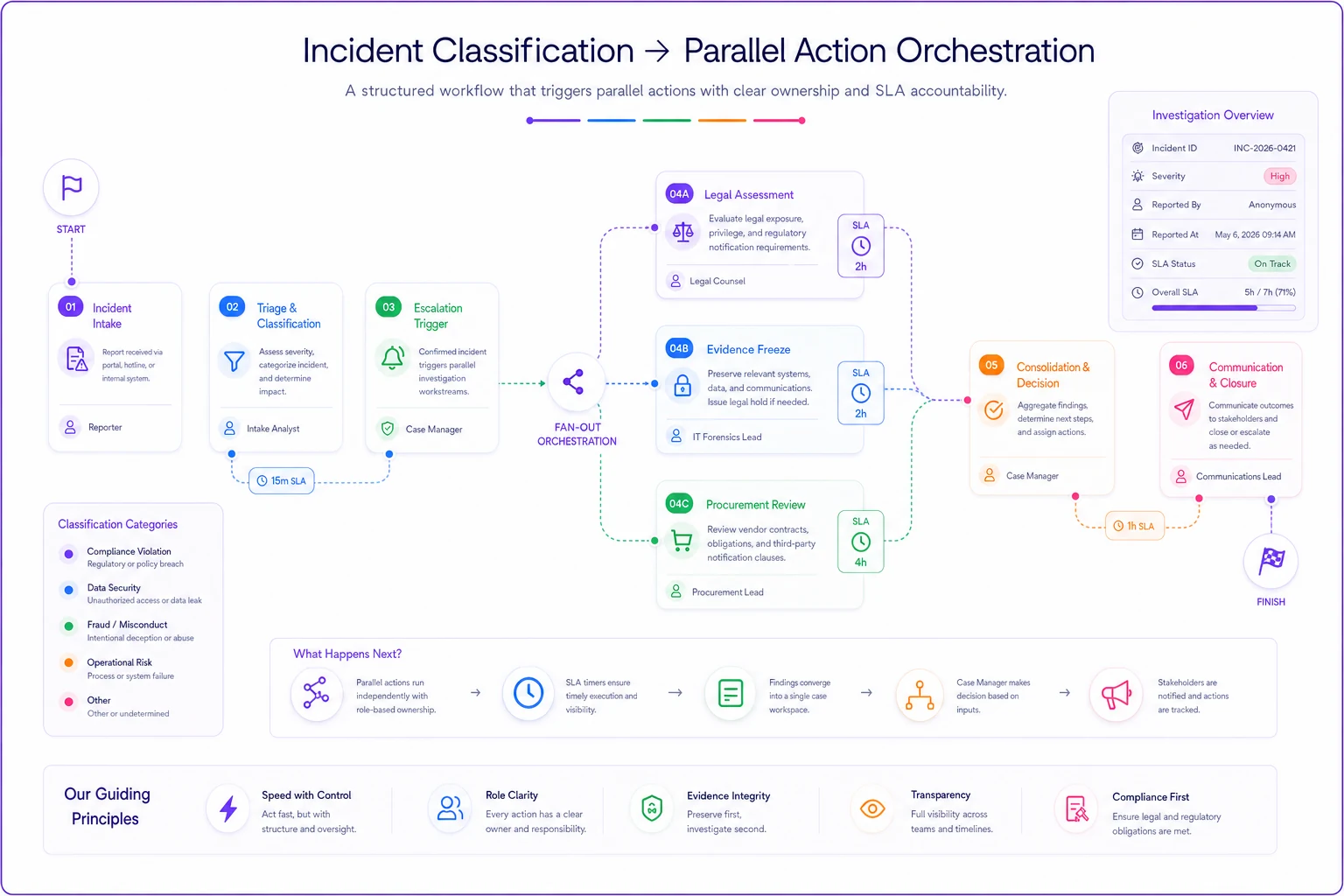
The diagram illustrates parallel actions starting from classification, with role labels and SLA clocks to show concurrency.
-
First acknowledgment the accountable party confirms they've got it. Short window — 30 minutes for T3, immediate for T4.
-
Evidence freeze independent of everything else, kicks off on classification.
-
First substantive action containment, work stoppage, or notification prep — inside the tier's response clock.
-
Notification decision for reportable events, a hard deadline that back-solves from the regulator's window. If the regulator gives you 24 hours, your internal decision SLA needs to be well inside that, not up against it.
The failure pattern here is subtle and expensive. Programs set an SLA against the external deadline — "we have 24 hours to notify" — and then use all 24. Which means if the classification was slow, or legal was hard to reach, or the evidence wasn't ready, you blow the window. The fix is to set internal SLAs that leave slack: the notification decision is due at hour 6, not hour 23. That buffer is what absorbs the real world.
A real scenario: the multi-site vendor breach
A mid-sized food manufacturer running inspections across four plants used a third-party inspection vendor for two of them. During a routine check, a contract inspector flagged a temperature-log discrepancy suggesting a cold-chain deviation had gone unrecorded — and possibly unaddressed — for around nine days.
Under the old model, this would've been a T1-ish "note it and ask the vendor about it" event. The site QA lead would've emailed the vendor, waited for a response, and the whole thing would've drifted for a week before anyone realized it might be a reportable food-safety issue with a contractual notification clause attached.
After tiered escalation was in place, the same finding hit the hard-stop list — a cold-chain deviation crossing a defined threshold auto-classified as T3. Three things kicked off at once: the raw temperature logs got frozen before the vendor's system rolled them over, legal got the 4-hour notice and started the reportability assessment, and procurement pulled the vendor contract to check the 24-hour breach-notification clause.
The reportability review came back clean — the deviation was within a tolerance that didn't require regulator notification — but the contract did require vendor notification, which went out inside the window instead of a week late. Before the redesign, an event like this typically took 6 to 9 days to fully resolve and often surfaced a missed contractual deadline in the process. After, resolution ran under 48 hours with the evidence package intact. The number that actually mattered to leadership wasn't the speed — it was that they stopped discovering missed notification windows during the next audit.
When this level of architecture makes sense — and when it doesn't
Not every program needs a four-tier matrix with concurrent SLAs. Building this out has real overhead, and imposing it on a small operation just creates process theater.
When it's worth it:
-
You run more than two sites, or use third-party inspectors under contract.
-
Your inspections touch reportable conditions — safety, environmental, food, regulated equipment.
-
Legal and procurement are separate functions that need to be pulled in, not the same person wearing three hats.
-
You've already had at least one incident where the response was slow or muddled and it cost you.
When it's overkill:
-
A single site with a tight team where everyone genuinely knows the escalation path and can execute it in minutes.
-
Very low regulatory exposure and no contractual notification obligations.
-
You'd spend more time maintaining the matrix than you'd ever spend responding to incidents.
Who should not do this yet: teams that haven't nailed down basic ownership between ops, legal, and procurement. Escalation architecture routes incidents to owners — if the owners themselves are undefined, you're building a highway that ends in a field. Fix ownership first, then build the escalation layer on top.
Keeping the whole thing honest with audit trails
The piece that ties everything together — and the piece most likely to be an afterthought — is the audit trail connecting each escalation decision back to the inspection evidence that triggered it.
For every incident above T1, you want a continuous, tamper-evident record: the original finding, the classification and its one-line rationale, who was notified and when, what evidence was frozen and its custody chain, what actions were taken against which SLA, and how the whole thing closed. Not as scattered emails and spreadsheet cells, but as a single linked record where each step points to the artifact behind it.
This is the piece that turns a chaotic response into a defensible one. When an auditor or regulator asks "how did you decide this wasn't reportable?" six months later, the answer isn't someone's memory — it's a timestamped decision with the evidence attached.
This is also where inspection management platforms that link findings, evidence, custody, and response actions into one connected record start earning their cost: not because they respond for you, but because they make the trail automatic instead of a thing someone has to remember to build during a crisis. The manual version works fine right up until you're responding to three incidents at once, and then it quietly doesn't.
The programs that handle incidents well aren't the ones with the fastest inspectors or the fanciest tools. They're the ones where classification is consistent, ownership is unambiguous, evidence gets frozen early, and the clock forces parallel action instead of a slow relay. Build those four things and most incidents stop being emergencies — they become procedures. That's the whole point of escalation architecture: turning the moments that used to cause panic into the moments your system is quietly best at.
Ready to modernize your inspection process?
Join 500+ inspection teams using Chekzly to reduce paperwork, improve compliance, and accelerate reporting.