



The hardest part of running inspections across regions isn't the inspections themselves. It's that every region quietly becomes its own company. The Texas team tags out-of-tolerance equipment one way. Ontario does it another. The group you acquired in Germany two years ago still runs a checklist format nobody at HQ has fully read. Each version works locally. None of them line up when an accreditation body or a corporate auditor asks you to prove consistency across the whole program.
What you end up with isn't a program — it's a federation of habits. And federations don't pass accreditation cleanly, not without a scramble, and definitely not at the renewal three years later when half the people who built the local workarounds have moved on.
This is about treating standardization as a system problem, not a documentation project. The usual approach — writing one giant master SOP and emailing it out — fails for predictable reasons. Regions nod, keep doing what they were doing, and the gap between "the standard" and "the work" widens until an audit exposes it.
Why regional drift is structural, not sloppy
People assume drift happens because field teams are careless. In real operations, it's almost the opposite. Drift happens because local teams are good at solving local problems.
A region adapts because it has to. Local regulators demand an extra signature. A client wants photos at a resolution the standard checklist doesn't require. One site runs older equipment that needs a different tolerance band. Each adaptation is rational. The problem is none of them get pushed back up into the canonical standard, so the "official" version and the "real" version separate over time.
Tenure makes it worse. A region that's been running for eight years has deep muscle memory. A region you stood up last quarter is still looking for guidance. Roll out a single standard and the mature region ignores it (because theirs works) while the new one over-interprets it (because they have nothing else). Drift in both directions from the same document.
The pattern worth remembering: standardization doesn't fail at the writing stage, it fails at the reconciliation stage. Nobody builds the mechanism to continuously compare local practice against the canonical control and decide, deliberately, which differences to kill and which to absorb. For a broader structural view of why these programs crack under growth, When inspection programs fail to scale covers the mechanics well.
The canonical standard matrix: your single source of truth
Before you can audit parity, you need something to measure parity against. A single master document isn't enough because it can't show where variation is allowed and where it isn't. What works better is a canonical standard matrix — a structured map of every control, the non-negotiable requirement, and what local variation is permitted within bounds.
Eliminate inspection delays and errors.
Chekzly helps you plan, execute, and document inspections efficiently and accurately.
- Real-time inspection tracking
- Automated report generation
- Compliance and checklist management
No credit card required
The point of the matrix is to make one decision explicit for every control: is this global‑fixed, global‑with‑local‑parameters, or local‑owned? Most programs have never actually made that decision. They just have documents that imply everything is fixed while reality proves everything is negotiable.
Here's a simplified version of what a few rows look like:
| Control area | Canonical requirement | Local variation allowed? | Variation bounds | Owner |
|---|---|---|---|---|
| Out‑of‑tolerance tagging | Red tag + system flag within 1 hour | No | None — global fixed | Central QA |
| Photo evidence | Timestamped, geotagged, min resolution | Parameters only | Resolution floor fixed; format per region | Regional lead |
| Calibration cert retention | Retained + retrievable | Yes | Retention period per local reg (min 3 yrs) | Regional compliance |
| Inspector sign‑off | Named, authenticated signature | No | None — global fixed | Central QA |
| Report language | Approved template structure | Yes | Translation + local fields, parity enforced | Localization lead |
-
They make too much global. Force every control to be globally fixed and regions will quietly violate the ones that don't fit their reality — now your whole matrix is untrustworthy. Be honest about what genuinely must be identical everywhere (evidence integrity, chain of custody, sign-off) versus what can flex (retention periods, language, specific equipment tolerances).
-
They don't name owners per row. A control with no named owner is a control nobody reconciles. When drift shows up, there's no one whose job it is to decide what to do about it.
-
They skip variation bounds. "Local variation allowed" with no bounds is just permission to drift. The bounds — a resolution floor, a minimum retention period — are what keep flexibility from becoming chaos.
Three things about building this matrix that people consistently get wrong:
Parity‑audit templates: proving the matrix is real
A matrix on paper means nothing until you can show, at any given point, how far each region sits from it. That's what a parity audit does. It's not the same as a compliance audit — compliance asks "did you follow your own rules," parity asks "are your rules the same rules as everyone else's, and are you actually running them."
A workable parity-audit template samples the same set of controls across every region on a fixed cadence and scores the gap. You're looking for three categories of finding:
-
Hard breaks — a region is violating a global‑fixed control. Unsigned reports, missing chain of custody. These are stop‑the‑line issues.
-
Out‑of‑bounds variation — a region is varying a flexible control beyond the allowed bounds. Retaining certs for 18 months when the floor is 3 years. These get a remediation deadline.
-
Undocumented adaptation — a region has a local practice that isn't in the matrix at all. This is the most important category, because it's your pipeline for deciding whether a good local idea should become canonical or get shut down.
Run these quarterly to start. The first two or three rounds will be ugly — expect double-digit findings per region — and that's not a failure, that's the matrix finally doing its job. The goal isn't zero findings. It's a declining trend and, more importantly, a shrinking number of undocumented adaptations, because that number shrinking means your reconciliation loop is actually working.
One thing worth noting: the regions that push back hardest on parity audits in the first few months are usually the ones sitting on the most undocumented adaptation. Not out of malice — they just never had anywhere to surface it. The audit gives them that place.
Migration playbook: moving local practices into canonical controls
This is where most standardization efforts die. You've got the matrix, you've run the parity audit, you know where everyone sits. Now you have to actually move a dozen regions from their own practices onto the canonical controls — without freezing the field or triggering a rebellion.
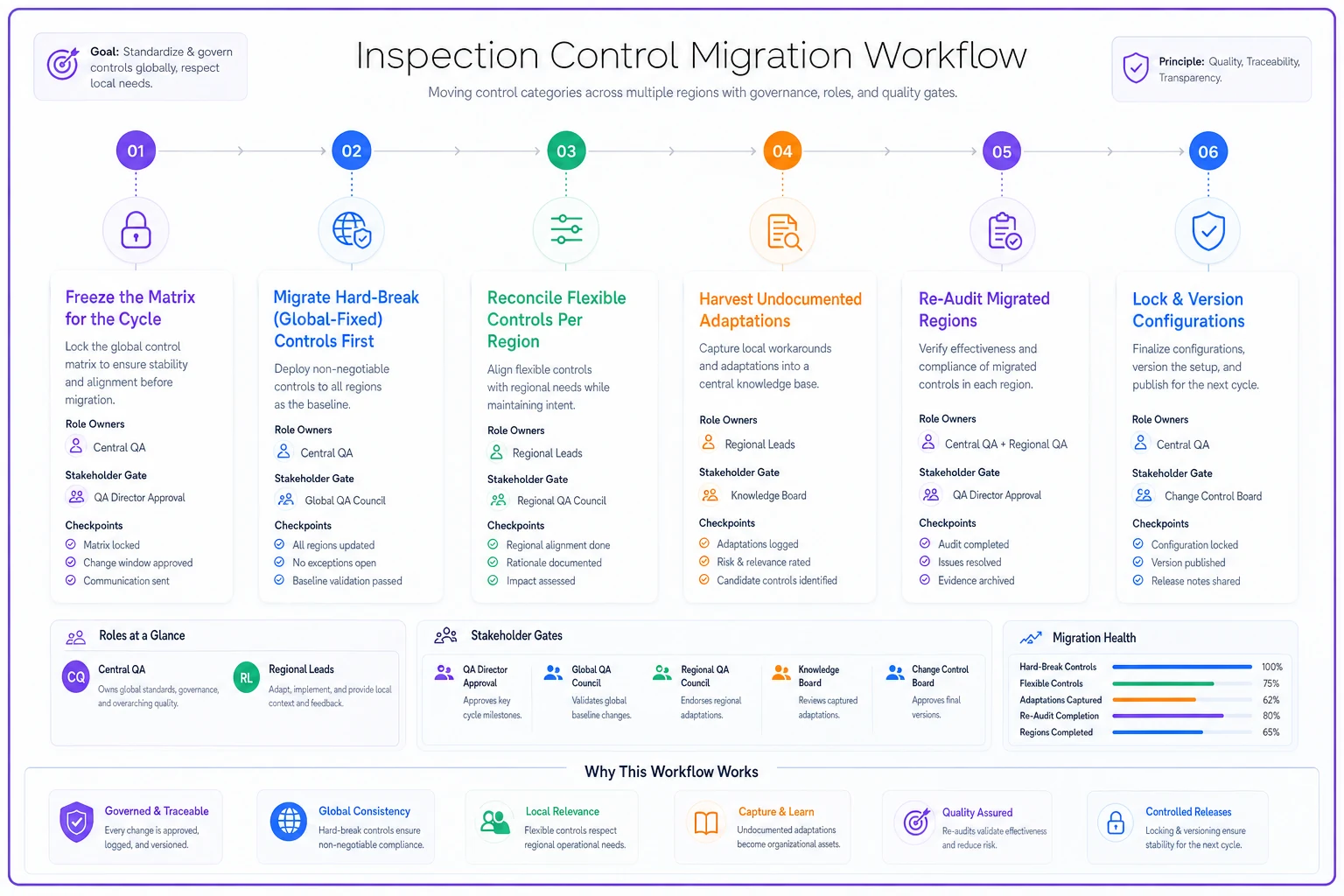
Doing it all at once with a hard cutover date is the mistake. A multi-region program is too big and too live for that. You need a staged migration that moves control categories, not whole regions, and treats absorption of good local ideas as part of the process rather than an afterthought.
-
Freeze the matrix for a cycle. No new canonical changes while you migrate — you can't hit a moving target. Queue proposed changes for the next cycle.
-
Migrate hard‑break controls first. These are the accreditation killers. Move every region onto the global‑fixed controls before touching anything flexible. Tightest timeline, non-negotiable.
-
Reconcile flexible controls region by region. For each flexible control, confirm the region is inside bounds or bring them in. Document the specific local parameter in the matrix so it's now sanctioned variation, not drift.
-
Harvest undocumented adaptations. Review every undocumented practice the parity audit surfaced. Decide: promote to canonical, allow as bounded local variation, or retire. This is the step that makes regions trust the system — they see their good ideas become the standard.
-
Re‑audit the migrated region. Don't declare a region migrated until a fresh parity pass confirms it. "We think they're done" is how programs fail renewals.
-
Lock and version. Once a region passes, lock its configuration and version it so you know exactly what state it was in on what date — which matters when an auditor asks about a specific inspection from eight months ago.
Here's a quick visual of the staged migration sequence.
A big part of the pain here is language and format parity across regions, which runs deeper than it looks. If you're migrating translated checklists, the rollout‑safe pattern for localized inspection checklists and version parity walks through how to keep a Spanish or German version in lockstep with the canonical English one — because a translation that drifts is just drift wearing a different language.
When a hard cutover actually makes sense
Staged migration is the default, but there's one case where a clean cutover is right: a small, new, or recently acquired region with little entrenched practice. If a region has three inspectors and a six-month history, dragging them through a six-step staged migration is overkill. Give them the canonical config, train them on it, audit at 30 days. The staged approach is for mature regions with deep muscle memory, not greenfield ones.
Who should not attempt this yet
Freeze the matrix for a migration cycle to avoid scope churn and conflicting changes mid-migration.
If you don't have a named central QA owner and at least one person per region who owns reconciliation, don't start the migration. You'll generate findings nobody closes and erode trust in the whole effort. Standardization without clear ownership isn't standardization — it's a longer list of things you're failing to do consistently. Build the ownership map first.
Accreditation roadmap: timelines and stakeholder gates
Accreditation across multiple regions isn't one event — it's a sequence of dependencies where a slip in one region can push the whole program's timeline. What separates programs that hit their accreditation date from the ones that scramble is stakeholder gates: defined points where specific people sign off before the next phase starts, so you catch problems while they're still cheap to fix.
A realistic multi-region roadmap runs somewhere between 9 and 14 months depending on how many regions you're dealing with and how much drift you're starting from. Rough shape:
-
Months 1–2
Matrix build and ownership.
Canonical standard matrix drafted, owners named, variation bounds set. Gate: central QA and regional leads jointly sign off on the matrix. If regions won't sign, you have a scope problem, not a schedule problem — fix it now. -
Months 2–4
Baseline parity audit.
First full parity pass across all regions. Gate: findings categorized and remediation timelines agreed. Legal and compliance review any hard breaks with regulatory exposure. -
Months 4–8
Migration.
Staged migration by control category. Gate: each region's re‑audit must pass before it's marked migrated. This is the gate programs are tempted to skip under deadline pressure — don't. -
Months 8–10
Internal dry‑run accreditation.
Run the actual accreditation checklist against the migrated program as if the assessor were on site. Gate: program owner signs off that evidence is retrievable and parity holds. -
Months 10–14
Formal accreditation and remediation.
External assessment, close any findings, achieve accreditation.
The stakeholder gates matter more than the timeline. A program that misses a date but hit its gates is in far better shape than one that hit the date with gates skipped — because skipped gates always resurface during the external assessment, when fixes are most expensive.
For the readiness mechanics in the final stretch — mapping your accreditation cycle to a calendar so you're not cramming before the assessor shows up — the calendar‑first accreditation readiness plan for ISO and regulator cycles pairs directly with this roadmap.
A real scenario: three regions, one accreditation
A mid-sized industrial inspection firm — around 40 inspectors across the US, Mexico, and Poland — went into an accreditation renewal confident and got hit with a parity finding. The assessor pulled the same control (out-of-tolerance equipment handling) across all three regions and found three genuinely different processes. The US flagged in their system within an hour. Mexico used a paper tag and logged it at end of shift. Poland did both but with a different tolerance band inherited from a legacy client spec.
None of the three were wrong on their own terms. But the firm couldn't demonstrate a consistent control, and that turned a routine renewal into a conditional finding with a 90-day remediation window.
Over the next two quarters they built a canonical standard matrix that made out-of-tolerance handling a global-fixed control with a one-hour system flag, ran a parity audit that surfaced roughly 30 undocumented adaptations they'd never catalogued, and migrated the three regions over about four months. The Poland tolerance band turned out to be a genuinely better spec for a certain equipment class — so instead of retiring it, they promoted it into the matrix as sanctioned bounded variation.
The outcome wasn't dramatic in a headline sense. Parity findings on the next internal audit dropped from double digits to low single digits. More practically: when the next client asked whether their process was consistent across all three countries, the answer was finally yes, and there was a matrix to prove it. The renewal after that was clean.
Where tooling earns its place
None of this requires software to be conceptually true. But past two or three regions it becomes nearly impossible to maintain by hand, because parity auditing is fundamentally a comparison problem — you're constantly checking what each region is actually doing against what the matrix says they should do, across hundreds of inspections.
This is where an AI-powered inspection platform with proper checklist versioning, configuration locking per region, and audit-ready logs stops being a convenience and becomes the thing that keeps parity from silently eroding between audits. When the matrix lives in the system — when a global-fixed control literally can't be edited at the regional level, and when every undocumented local field shows up as a flag for review — the reconciliation loop runs continuously instead of once a quarter in a spreadsheet. The automation isn't doing the thinking; it's doing the comparing, flagging, and version-tracking that humans quietly stop doing when they get busy. That's usually where drift sneaks back in.
The real shift
Standardizing inspections across regions isn't about forcing everyone to be identical. The programs that pass accreditation cleanly aren't the most rigid ones — they're the ones that know exactly where they're identical, exactly where they vary, and exactly who decides. The matrix makes those decisions explicit. The parity audit proves they're real. The migration moves practice onto them without breaking the field. And the accreditation roadmap, with its gates, keeps the whole thing moving toward a date you can actually hit.
Drift is going to happen no matter what, because your best regions will keep solving local problems. The question is whether you have a loop that catches those adaptations and decides what to do with them — or whether you find out about all of them at once, from an assessor, three weeks before your renewal.
Drift is going to happen no matter what, because your best regions will keep solving local problems. The question is whether you have a loop that catches those adaptations and decides what to do with them — or whether you find out about all of them at once, from an assessor, three weeks before your renewal.
Ready to modernize your inspection process?
Join 500+ inspection teams using Chekzly to reduce paperwork, improve compliance, and accelerate reporting.