


Most inspection programs treat legal as a phone number you dial after something goes wrong. The finding lands, the enforcement letter shows up, and only then does someone go digging for the photos, the calibration certs, and the inspector's notes — most of which are scattered across three systems and one person's phone. By that point counsel is doing archaeology, not strategy.
A real inspection regulatory strategy flips that order. Legal defines what "defensible" means before the inspection happens, and field teams execute against that definition every single day without thinking about it. The whole thing lives inside the workflow, not in a binder someone reads once a year.
This is where most programs get it wrong. They think regulatory strategy is a document. It's not. It's a set of triggers, checklists, and attestation habits wired into how work actually gets done. Get the wiring right and audits become boring. Get it wrong and every finding turns into a fire drill where counsel, ops, and the field all point at each other.
Why the counsel-field gap keeps reappearing
The gap almost always comes down to translation. Counsel thinks in terms of admissibility, chain of custody, privilege, and burden of proof. Field teams think in terms of getting to the next site before lunch. Nobody sits in the middle to convert legal requirements into field-executable steps, so requirements get lost on the way down and evidence gets lost on the way up.
A typical example: legal says "we need to be able to prove who took this measurement and when." Perfectly reasonable. But that requirement never gets converted into a specific field action — a signed attestation at capture, a locked timestamp, a device ID logged. So the inspector does what feels normal, snaps a photo, types a note later from memory, and moves on. Eighteen months later, an enforcement action asks who took the reading and the honest answer is "probably Dave, sometime that afternoon." That's not a defensible answer.
This tends to break in a predictable order. First the small stuff slips — a missing signature here, a fuzzy timestamp there. Then a pattern forms where certain site types or certain inspectors consistently produce weaker records. By the time anyone notices, you've got months of documentation that would fold under scrutiny, and no clean way to tell the strong records from the questionable ones.
The other reason it keeps recurring: requirements change and nobody tells the field. A regulator updates evidence format expectations, or a new standard requires additional metadata, and that change sits in an email thread between counsel and the compliance lead. The field keeps doing the old thing. Now you have version drift between what's legally required and what's actually being captured.
The four layers of a defensible inspection program
It helps to think of the program as four connected layers rather than a pile of policies. Each layer feeds the next, and a failure in one quietly weakens the others.
Eliminate inspection delays and errors.
Chekzly helps you plan, execute, and document inspections efficiently and accurately.
- Real-time inspection tracking
- Automated report generation
- Compliance and checklist management
No credit card required
| Layer | Who owns it | What it produces | Failure mode if ignored |
|---|---|---|---|
| Pre-clearance | Counsel + compliance | Rules for what "ready to inspect" means | Inspections proceed on shaky legal footing |
| Field capture | Inspectors + field leads | Attested, timestamped evidence | Records that can't survive challenge |
| Escalation | Field leads + counsel | Fast routing of edge cases | Problems buried until audit |
| Pre-audit engagement | Counsel + ops | Assembled, reviewed evidence packages | Scramble mode, gaps found too late |
The point isn't the categories themselves — it's that each layer hands something to the next. Pre-clearance decides what gets captured. Capture decides what can be escalated. Escalation decides what needs remediation before the package is built. If the handoffs are clean, counsel spends audit prep reviewing, not rebuilding.
Layer one: pre-clearance that actually clears something
Pre-clearance is the step everyone skips because it feels like overhead. The idea is simple: before an inspector shows up, the program confirms the inspection can be conducted in a way that produces defensible evidence. Not "can we do the inspection" — "can we do it in a way that holds up."
-
Is the applicable standard and version confirmed for this site type?
-
Are the required evidence formats known for this jurisdiction (photo specs, sample counts, signature requirements)?
-
Is the inspector currently credentialed for this scope, with no expired certs?
-
Are the instruments in calibration, with certs retrievable?
-
Are consent and access authorizations documented where required?
-
Is there a known escalation contact for edge cases at this site?
Pre-clearance is where legal risk is cheapest to fix. Catching an expired credential the night before costs a reassignment. Catching it during an enforcement review costs the credibility of every inspection that person ran in the interim. The economics of the program strongly favor front-loading these checks.
Where programs go wrong is treating pre-clearance as a one-time site setup rather than a per-engagement gate. A site that was cleared eight months ago may now fall under a revised standard, or the inspector's cert may have lapsed. Pre-clearance has to be a live check, not a stored yes.
Layer two: evidence attestation that means something later
Attestation is the difference between "here's a photo" and "here's a photo that a specific, credentialed person swears they took, at this time, with this device, of this thing." The second one survives cross-examination. The first one is just a JPEG.
The mistake most teams make is treating attestation as a signature at the end of a report. By then the inspector is attesting to a summary written from memory, sometimes hours after the fact. Real attestation happens at the point of capture, close to the moment the evidence is created. The tighter that window, the stronger the record.
-
Who captured it (identity, not just initials)
-
What it is and which checklist item it satisfies
-
When it was captured (locked, not editable after the fact)
-
Where it was captured (site plus location detail where relevant)
-
Which device or instrument was used, with cert reference if applicable
-
A short factual statement of what the evidence shows
-
The inspector's confirmation that the above is accurate
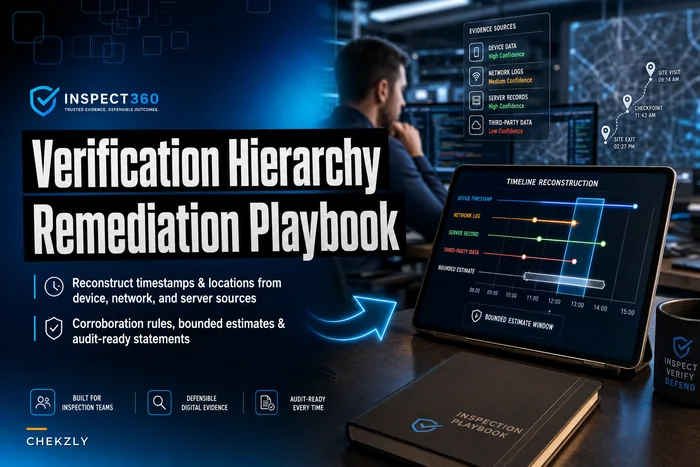
That last line matters more than people expect. An explicit confirmation converts a data field into a statement someone stands behind, which is exactly what counsel needs when the evidence gets questioned. This connects directly to how you handle timestamps and locations — if those can't be independently verified, the whole attestation weakens. There's a full breakdown of that problem in the verification hierarchy and remediation playbook worth reading alongside this.
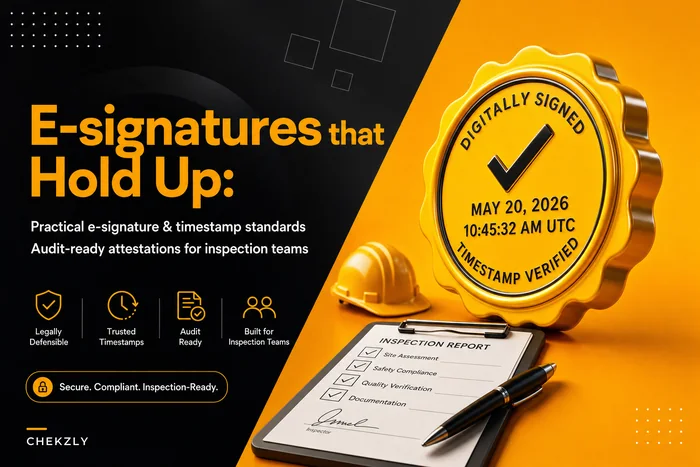
The same logic applies to how signatures are captured on the finished package. A scrawl on a PDF isn't the same as a signature bound to an identity and a timestamp that a court would accept. The practical standards for getting that right are covered in the piece on digital signatures and timestamps that hold up, and it's worth aligning your attestation template with those standards so the whole chain stays consistent.
Layer three: escalation triggers so problems surface early
Escalation is where most programs are silently broken. Not because they lack an escalation path, but because nobody knows when to use it. "Escalate if something seems off" is not a trigger. It's a hope.
The fix is defining specific, unambiguous conditions that force a field decision to move up the chain. When a trigger fires, the inspector doesn't get to judgment-call their way past it — they route it.
-
An out-of-tolerance instrument reading that can't be resolved on site
-
A refusal of access or a consent issue
-
Evidence that can't be captured in the required format (lighting, access, safety)
-
A finding that suggests potential legal exposure beyond the checklist scope
-
Any situation where the inspector is asked to sign off on something they can't personally verify
-
A standard or format ambiguity the inspector can't resolve
The operational subtlety here: escalation only works if it's fast and non-punishing. If routing something up costs the inspector an hour of forms and a lecture, they'll stop doing it and start absorbing edge cases quietly. That silent absorption is exactly what produces the weak records counsel finds later. The trigger has to be lightweight to pull, and pulling it has to be treated as good behavior, not failure.
Make pulling an escalation lightweight and clearly rewarded so inspectors choose to route rather than absorb edge cases.
A short escalation record should log what triggered it, the field context, the decision made, and who made it. That log becomes its own piece of evidence — it shows a regulator that the program has a functioning mechanism for handling edge cases rather than pretending they don't exist.
Layer four: pre-audit engagement workflow
Pre-audit engagement is the workflow that turns a pile of daily records into a reviewed, counsel-approved package before anyone from the outside asks for it. The programs that stay calm during audits are the ones that assembled and stress-tested their evidence months earlier, on their own schedule.
-
Scope the exposure. Identify which inspections, sites, or time periods are most likely to be examined and start there.
-
Pull the records. Retrieve the evidence for that scope, using consistent metadata so nothing hides in the gaps.
-
Check completeness. Match captured evidence against what each inspection was supposed to produce. Flag missing attestations, weak timestamps, and format mismatches.
-
Remediate what's fixable. Some gaps can be honestly closed — a re-inspection, a supplementary attestation, a documented explanation. Do it now, with a clear record of when and why.
-
Legal review. Counsel reviews the assembled package for virtue, admissibility, and consistency before it ever leaves the building.
-
Lock and store. Freeze the reviewed package so it can't drift, and record who reviewed it and when.
The reason this belongs to a workflow and not a checklist is that steps three and four are where the real value sits, and they depend entirely on retrieval quality. If you can't pull records by site, date, inspector, and standard in minutes, you can't do completeness checking at scale — you're spot-checking and praying. The mechanics of building that retrieval capability are laid out in the guide to an audit-ready inspection records system with metadata and retrieval SOPs, and pre-audit engagement basically fails without it.
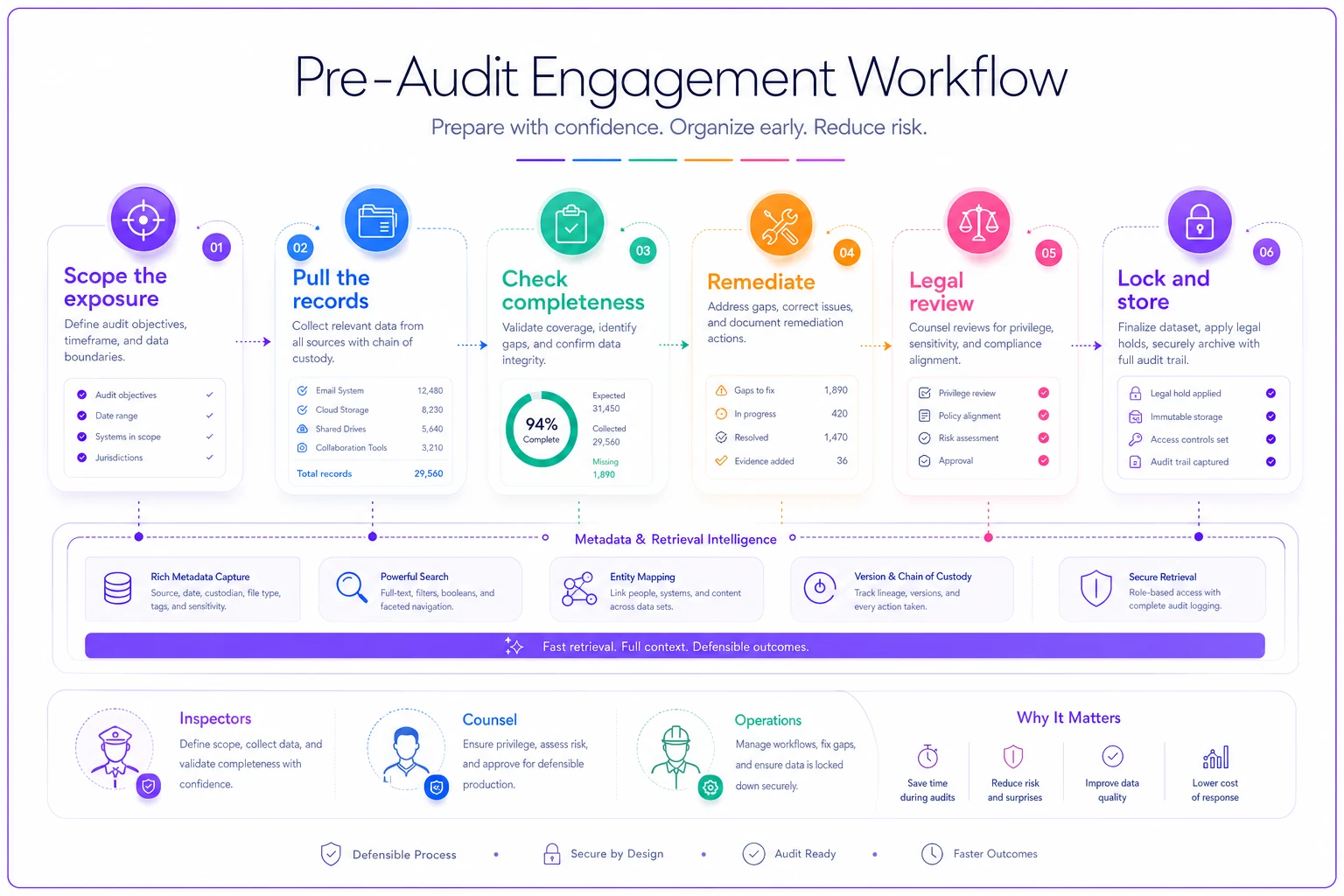
A simple visual like this helps teams align on who does each step and where retrieval and metadata fit into the loop.
A real scenario: multi-site environmental inspection team
Consider a regional environmental inspection outfit running around 40 inspectors across roughly 15 counties, handling somewhere between 900 and 1,100 inspections a month. On paper their program looked fine. In practice, when a state regulator opened a records request covering a six-month window, they discovered that close to a fifth of the relevant inspections had attestations added days after capture, and a handful had timestamps that couldn't be independently verified.
The scramble to reconstruct took two people most of a month and pulled counsel off other work entirely. They couldn't cleanly separate the strong records from the weak ones, so they had to treat a large batch as suspect. The regulatory outcome wasn't catastrophic, but it was a lot more painful than it needed to be, and it cost them credibility they'd rather have kept.
What changed afterward wasn't dramatic technology. They moved attestation to the point of capture, defined six hard escalation triggers, and added a quarterly pre-audit engagement pass on a rotating sample of sites. Within two quarters, the share of late attestations dropped to almost nothing, and their next records request took days to answer instead of a month. The difference wasn't effort — they were already working hard. The difference was sequencing the work so legal requirements shaped field behavior instead of chasing it.
When this level of structure makes sense — and when it doesn't
Not every program needs the full four-layer machine, and pretending otherwise wastes effort.
When it makes sense: You're in a regulated space with real enforcement teeth, you run across multiple sites or jurisdictions, your evidence has been challenged before, or the cost of a single bad audit outcome is high relative to the program. Multi-site coordination is the tipping point — once evidence is being produced by many people in many places, informal consistency stops working.
When it's overkill: A small single-site operation with low regulatory exposure and a stable, senior inspector can run a lighter version. Building formal escalation triggers for a two-person team that talks constantly is bureaucracy for its own sake.
Who should not do this: Anyone trying to bolt the full structure on all at once. Programs that try to implement pre-clearance, attestation, escalation, and pre-audit engagement simultaneously usually end up with four half-built layers and a frustrated field team. Sequence it. Attestation-at-capture first, because that's where the most evidence rots. Then escalation triggers. Then pre-audit engagement once your retrieval is solid enough to support it.
Where tooling quietly earns its place
None of this requires exotic software, but it does require the workflow to enforce itself. Pre-clearance checks that depend on someone remembering to run them will get skipped on a busy Monday. Attestation that relies on discipline will erode over time. Escalation triggers that live in a policy PDF might as well not exist.
The practical role of an operational platform here is narrow and useful: it puts the pre-clearance gate in front of the inspector so work can't start until the check passes, locks attestation and timestamps at the moment of capture so they can't be backfilled, routes triggered escalations automatically to the right person, and keeps records retrievable by the exact fields counsel needs during pre-audit engagement. AI-assisted checks can flag the quiet failures early — the late attestation, the missing cert reference, the format mismatch — so they surface during a routine pass instead of during a records request.
That's the core value: catching drift while it's still cheap to fix. Counsel still defines defensible, field leads still handle edge cases, inspectors still stand behind what they capture. The platform just makes sure those decisions get recorded in a form that survives scrutiny, consistently, without depending on anyone's memory on a hard day.
Closing thought
The programs that handle regulators well aren't the ones with the thickest policy manuals. They're the ones where legal requirements got translated into field behavior early, wired into the daily workflow, and reviewed on their own schedule instead of a regulator's.
Pre-clearance decides what you capture. Attestation makes it defensible. Escalation surfaces the hard cases before they become buried problems. Pre-audit engagement proves the whole thing works before anyone from outside asks. Treat those four layers as one connected system and the relationship between counsel and the field stops being a rescue operation. It becomes ordinary work — which, when a regulator finally calls, is exactly what you want it to be.
The programs that handle regulators well aren't the ones with the thickest policy manuals. They're the ones where legal requirements got translated into field behavior early, wired into the daily workflow, and reviewed on their own schedule instead of a regulator's.
Ready to modernize your inspection process?
Join 500+ inspection teams using Chekzly to reduce paperwork, improve compliance, and accelerate reporting.