

Most sensor programs don't fail because the hardware is bad. They fail because nobody decided, in writing, how much a given sensor is allowed to influence a decision. A vibration sensor on a pump and a cheap temperature probe zip-tied to a panel somehow end up feeding the same dashboard, with the same visual weight, and an inspector three sites away treats both as gospel. Then an audit asks a simple question — "why did you pass this asset?" — and the honest answer is "a sensor said it was fine," with no way to defend how much that sensor should have counted.
That gap is what sensor governance is really about. Not the networking, not the protocols, not the firmware. The governance layer answers a different set of questions: How much do we trust this class of device? What has to be true before its data can trigger — or suppress — an inspection? Who owns the call when the sensor and the inspector disagree?
If you've already worked through non-technical integration patterns and triage rules for sensor-assisted inspections, this is the policy scaffolding that sits on top of that plumbing. Integration gets the data in. Governance decides what it's allowed to do once it's there.
Why trust gets flattened as programs grow
In a single-site pilot, trust lives in people's heads. The reliability engineer knows the old ultrasonic sensor on Line 3 drifts in humidity, so he mentally discounts it. The inspector knows which gauges were calibrated last month. That works fine for one site, maybe two.
Then the program scales to fifteen sites, and the tribal knowledge doesn't travel. A new site inherits a dashboard full of green and red indicators with zero context about which readings deserve confidence. What tends to happen is that the moment sensor data crosses a site boundary, it loses its reliability history. Site B sees Site A's "clear" reading and treats it like a hands-on inspection, even though the sensor behind it is a consumer-grade unit with no calibration record.
-
Across device classes — a $40 probe and a $4,000 certified transmitter look identical on a screen.
-
Across sites — local knowledge about quirks and drift doesn't get encoded anywhere.
-
Across time — a sensor that was trustworthy at install silently degrades, and nobody re-rates it.
A policy framework exists to stop all three. Instead of trust living in one engineer's memory, it lives in a published mapping that every site, every inspector, and every auditor can read the same way.
The core idea: map sensor class to trust level, then tie trust to decision authority
The foundation is a mapping table. Every sensor in the program belongs to a class, every class carries a trust level, and every trust level has explicit rules about what it can and cannot do to an inspection outcome. This is the single most useful artifact you can build, because it forces a conversation most programs avoid: are we actually allowed to skip a physical inspection because a sensor told us to?
Eliminate inspection delays and errors.
Chekzly helps you plan, execute, and document inspections efficiently and accurately.
- Real-time inspection tracking
- Automated report generation
- Compliance and checklist management
No credit card required
| Sensor class | Example | Trust level | Decision authority | Required before trust applies |
|---|---|---|---|---|
| Certified, calibrated, redundant | Dual pressure transmitters, cert on file | Tier 1 | Can auto-clear a routine check; can trigger escalation on its own | Valid cal cert, redundancy agreement within tolerance |
| Certified, single, calibrated | Single calibrated flow meter | Tier 2 | Can extend an inspection interval; cannot fully replace a physical check | Current cal cert, drift check within 30 days |
| Uncalibrated but validated | COTS vibration sensor, field-validated against a reference | Tier 3 | Advisory only; can raise risk, never lower it | Baseline comparison against a Tier 1/2 reference |
| Unverified / consumer-grade | Hobby-grade temp probe, no cert | Tier 4 | Informational; flags for human review, no decision weight | None — permanently advisory |
The asymmetry in that table is the part people miss. A low-trust sensor should be allowed to add suspicion but never remove it. A Tier 4 probe reading 200°F should absolutely flag an asset for a physical look. That same probe reading "normal" should change nothing, because you can't trust its all-clear. This one rule — low-trust devices can escalate but not exonerate — prevents more bad audit outcomes than almost anything else in the framework.
Trust tiers also need to feed your risk model, not sit beside it. If you've set up risk scores that actually change inspection schedules, the sensor tier should be an input to that score's confidence weighting — a Tier 1 reading moves the schedule, a Tier 4 reading barely nudges it.
Onboarding: no sensor gets a trust level by accident
The fastest way to corrupt the whole framework is to let sensors onto the network without classification. In real operations, this usually happens when a contractor installs a device during a retrofit, wires it into the historian, and nobody files it under a class. Six months later it's feeding a dashboard at Tier 1 weight with Tier 4 provenance.
Onboarding has to be a gate, not a formality. Here's the sequence worth holding every new sensor to:
-
Register the device and assign a provisional class. No class, no data path into decision-making systems. It can log, but it can't influence.
-
Capture provenance. Make, model, calibration certificate (or explicit "none"), install date, installer, and the asset it monitors.
-
Run a baseline validation. Compare its readings against a known reference or a higher-trust sensor for a defined window — often a week or two of overlap.
-
Assign the real trust tier. Based on provenance plus validation results, not on the salesperson's spec sheet.
-
Record the re-rating schedule. When does this device get re-validated? A Tier 2 sensor might need quarterly checks; a Tier 1 might ride on its calibration cycle.
-
Publish it to the site team. Everyone touching that site's inspections should be able to see the device's tier and its last validation date.
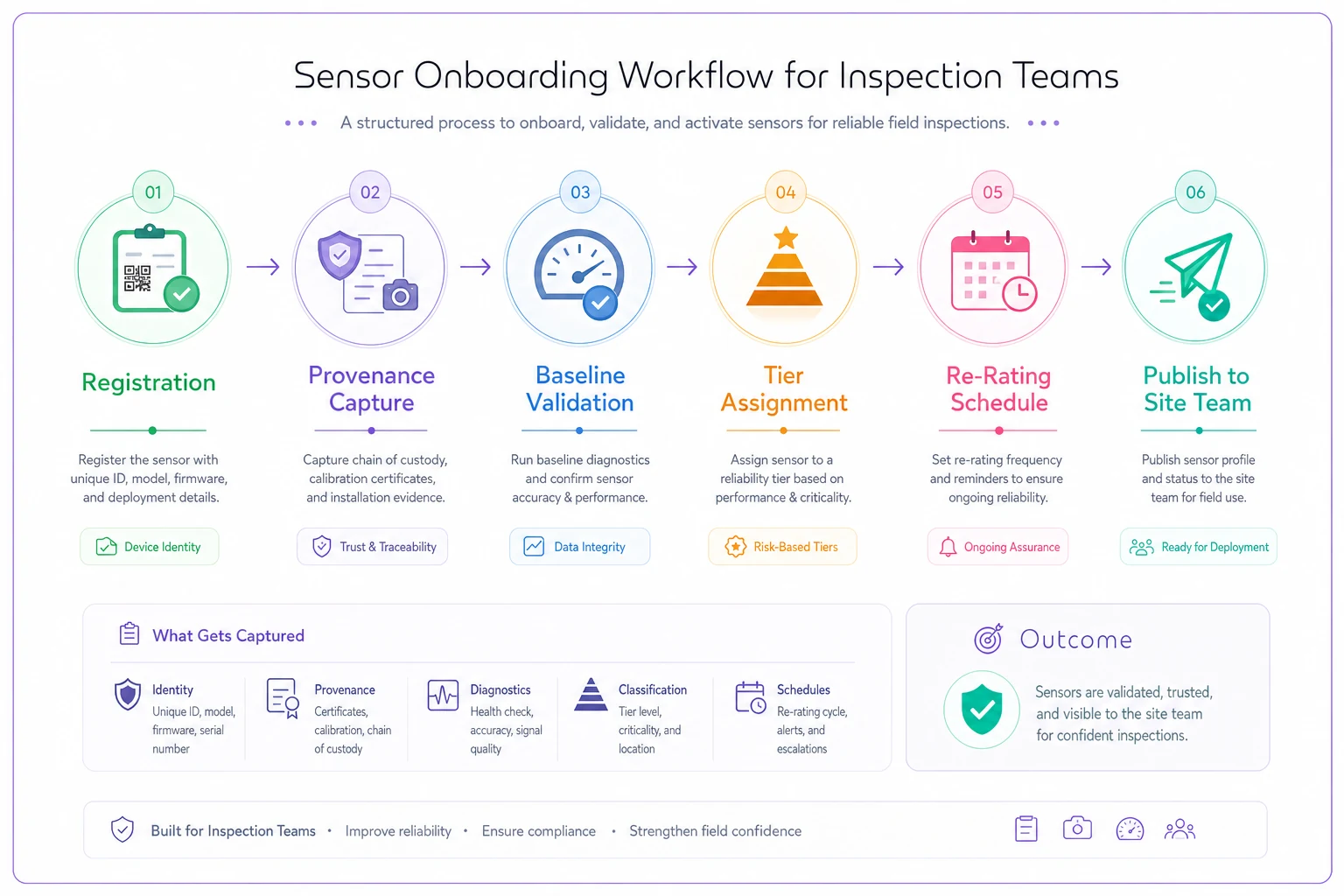
A simple diagram like this makes the gate steps obvious.
Enforce the onboarding gate so devices can't influence decisions until they complete validation.
The mistake worth calling out: teams treat onboarding as a one-time install task owned by facilities, when it's actually an ongoing data-quality responsibility owned by the inspection program. The installer's job ends when the wire is terminated. The governance job is just starting.
Telemetry SLAs: define "silence" before it costs you
A sensor that stops reporting is not automatically a good sign, and it is not automatically a bad one. Without a telemetry SLA, every gap in data turns into an improvised judgment call — and improvised judgment calls are exactly what audits punish.
-
Expected reporting frequency — every 60 seconds, every hour, on-change, whatever the device does.
-
Grace window — how long silence is tolerated before it means something.
-
Default assumption on silence — and this is the crucial one. When a Tier 1 safety sensor goes quiet, the safe default is usually to assume the worst and trigger a physical check, not to assume "probably fine, battery died."
-
Freshness requirement for decisions — how recent a reading must be before it's allowed to influence an inspection call. A 40-day-old reading clearing an asset is not a real clearance.
The pattern that burns people: stale data that still looks live. A dashboard shows a comfortable green reading, but that value is three weeks old because the gateway dropped offline and nobody noticed. The inspector trusts the color, not the timestamp. Your SLA has to make staleness loud — a reading past its freshness window should visibly degrade to "unknown," not sit there looking confident.
This connects directly to how you measure the program overall. The freshness and gap metrics belong in your inspection analytics KPI taxonomy alongside your inspection throughput and finding rates, so telemetry health gets reviewed on a cadence instead of discovered during an incident.
Correlation and validation: one sensor is an opinion, two are evidence
Single-sensor decisions are fragile. The governance framework should define when a reading needs corroboration before it's allowed to act — and correlation rules are how you encode that.
-
Cross-sensor agreement. If a temperature sensor spikes but the correlated pressure and flow sensors on the same loop stay flat, something is off with the sensor, not the asset. The framework should define which sensors should move together and what to do when they don't.
-
Physical plausibility bounds. A reading outside what the asset can physically produce is a sensor fault, full stop. These bounds are cheap to set and catch an enormous share of garbage data.
-
Rate-of-change limits. A value that jumps faster than physics allows is almost always a glitch, a reconnect artifact, or a wiring issue.
-
Reference comparison for low-trust tiers. Tier 3 and 4 devices should be periodically checked against a Tier 1/2 neighbor, and the drift logged.
A single anomalous reading should rarely drive an irreversible decision on its own. It should drive a question. Correlation rules are what convert a lone spike into either "escalate now, multiple signals agree" or "flag the sensor, it's disagreeing with everything around it." Both are useful outcomes. Acting on the lone spike as if it were truth is what gets you chasing phantom failures across a dozen sites.
Escalation rules tuned to decisions, not alarm counts
Plenty of sensor programs generate alerts. Far fewer generate decisions. The difference is whether your escalation rules are written in the language of inspection action rather than technical severity.
A technical alert says "threshold exceeded on channel 4." An inspection-oriented escalation rule says something closer to: "When a Tier 1 or Tier 2 sensor crosses its action threshold AND a correlated sensor agrees, dispatch a physical inspection within the SLA window and freeze any automated interval-extension on that asset."
-
The trust tier gate — low-trust sensors can raise a flag but don't trigger the full dispatch chain on their own.
-
The correlation requirement — one sensor raises a question, two trigger action.
-
The specific action — dispatch, freeze, notify — not just "alert someone."
-
The suppression of conflicting automation — if a sensor is screaming, the system shouldn't simultaneously be extending that asset's inspection interval because a different rule said it looked healthy.
That last point is a quiet failure mode in scaled programs. Two automated rules firing against each other — one extending an interval, one flagging a concern — leaves the asset in an undefined state. Escalation governance has to declare precedence: safety-relevant escalations always win and always override convenience automation.
Escalation rules also need a human-disagreement path. When the inspector on site looks at the asset and says "the sensor's wrong, this is fine" — or the reverse — that disagreement has to be captured, owned, and resolved by a named role, not absorbed silently. The sensor doesn't get the final word, and neither does the inspector in isolation. The framework names who adjudicates and records why.
A real scenario: a mid-size utility contractor
A regional utility maintenance contractor ran inspections across roughly 20 substations with a mix of around 400 sensors — some certified transmitters, a lot of cheaper add-on probes installed piecemeal over several years. Everything fed one shared dashboard. No trust tiers, no telemetry SLA, no correlation rules.
The breaking point was an audit finding. An inspector had extended an inspection interval on a transformer because the dashboard showed normal temperatures — except the reading was coming from an uncalibrated probe that had drifted low, and the certified sensor beside it had quietly dropped offline two weeks earlier. The "normal" reading was both wrong and stale, and nobody could explain on paper why that sensor had been trusted enough to delay a physical check.
They rebuilt the program around a trust-tier mapping and a freshness SLA. Every sensor got classified; roughly a quarter of them dropped to advisory-only status overnight once provenance was checked. They set the rule that low-trust sensors could never extend an interval, only flag for review. Stale readings past a freshness window flipped to "unknown" on the dashboard instead of showing the last value.
The visible change over the next couple of quarters was less dramatic than you'd expect and more useful than it sounds: nuisance dispatches driven by flaky single-sensor spikes dropped noticeably, because correlation rules now filtered them. At the same time, the number of defensible escalations went up — when a dispatch happened, there was a documented reason behind it. The next audit cycle produced no findings related to sensor-based decisions. Nothing about the hardware changed. What changed was the policy deciding what the hardware was allowed to do.
When this framework is worth the effort — and when it isn't
When it clearly makes sense:
-
You have more than a handful of sites and sensor knowledge no longer fits in one person's head.
-
Sensor data is influencing decisions — skipping, extending, or triggering inspections — not just getting logged.
-
You operate in a regulated or audited environment where "a sensor said so" has to survive scrutiny.
-
You have a mix of device quality and nobody can currently tell you which readings to trust.
When it's overkill:
-
A single site with a few certified sensors and one engineer who genuinely knows every device. Formalizing trust tiers there adds paperwork without adding safety.
-
A pure monitoring setup where sensors never touch inspection decisions — if the data only informs and never acts, lightweight is fine.
Who should not rush into this:
Teams that haven't yet nailed down basic provenance. If you can't currently answer "what model is this sensor and when was it last calibrated" for most of your devices, build that inventory first. A trust-tier framework layered on top of unknown provenance just assigns confident-looking tiers to devices you don't actually understand — which is arguably worse than having no tiers at all, because it manufactures false confidence.
Where the system tends to break
A few failure points worth watching as the program scales:
-
Orphaned sensors installed outside the onboarding gate, feeding decisions at a trust level nobody assigned.
-
Tier inflation — devices creeping up in trust over time because they've "been reliable," without re-validation to back it.
-
Silent staleness — the dashboard showing confident old values while the SLA that should flag them was never enforced.
-
Conflicting automation — interval-extension logic and escalation logic firing against each other with no declared precedence.
-
Unowned disagreements — inspector-vs-sensor conflicts resolved informally and never recorded, which is exactly the gap an audit finds.
Every one of these traces back to the same root: a decision about trust that was made implicitly instead of explicitly. The framework's whole job is to drag those implicit decisions into the open where a site team and an auditor can both read them the same way.
Pulling it together
Sensor governance for inspections isn't an IoT problem dressed up in policy language. It's an ownership problem. The hardware will keep producing numbers whether or not you've decided what those numbers mean, and in a growing program the cost of not deciding shows up as audit findings, nuisance dispatches, and inspectors who've quietly stopped trusting the dashboard entirely.
The fix is unglamorous and durable: classify every sensor, map each class to a trust level, write down what each level is allowed to do to a decision, enforce freshness and correlation before anything acts, and name who adjudicates when the sensor and the human disagree. Do that, and the question "why did you pass this asset?" has an answer you can hand to an auditor — one that doesn't start and end with "a sensor said it was fine."
Sensor governance for inspections isn't an IoT problem dressed up in policy language. It's an ownership problem. The hardware will keep producing numbers whether or not you've decided what those numbers mean, and in a growing program the cost of not deciding shows up as audit findings, nuisance dispatches, and inspectors who've quietly stopped trusting the dashboard entirely.
The fix is unglamorous and durable: classify every sensor, map each class to a trust level, write down what each level is allowed to do to a decision, enforce freshness and correlation before anything acts, and name who adjudicates when the sensor and the human disagree. Do that, and the question "why did you pass this asset?" has an answer you can hand to an auditor — one that doesn't start and end with "a sensor said it was fine."
Ready to modernize your inspection process?
Join 500+ inspection teams using Chekzly to reduce paperwork, improve compliance, and accelerate reporting.